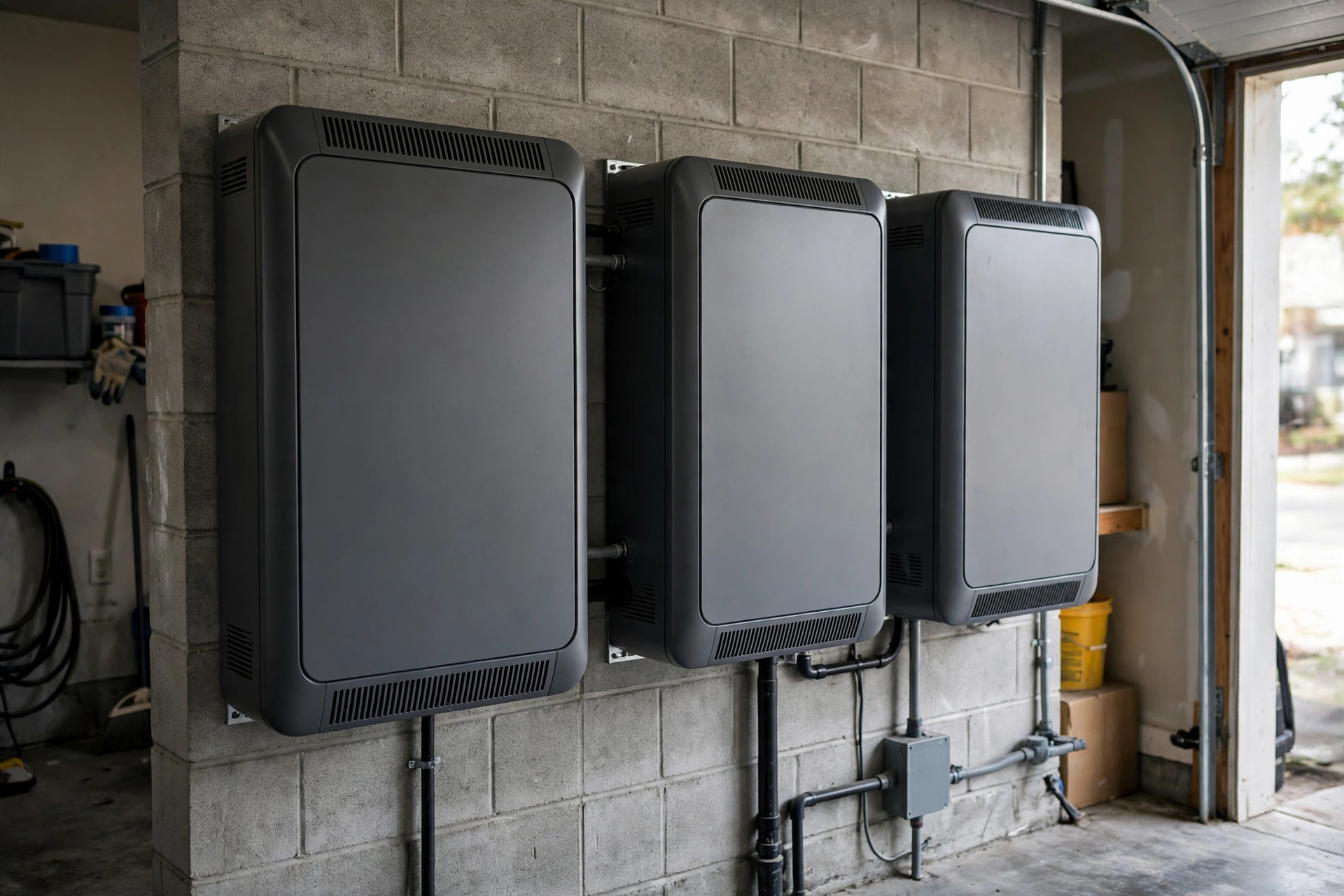
10kWh vs 13.5kWh vs 20kWh Home Battery: Which Size Is Right? (2026)
Key takeaways
- 13.5 kWh is the sweet spot for most homes: it covers a normal evening plus overnight essentials for a typical 3–4 bedroom house.
- Usable capacity runs 10–20% below headline capacity — a 10 kWh battery delivers roughly 9 kWh, a 13.5 kWh battery about 12 kWh, and a 20 kWh battery about 18 kWh.
- Air conditioning dominates runtime: a 3-ton central AC can cut backup hours by two-thirds, so whole-home AC backup realistically needs the 20 kWh tier.
- Size to your evening load (4 p.m. to midnight), not your daily total — most homes only need to cover 10–15 kWh of evening consumption.
- Modular systems let you start near 10 kWh and expand toward 20 kWh later, avoiding both an undersized battery and wasted capacity.
10kWh vs 13.5kWh vs 20kWh home battery: for most US homes, 13.5 kWh is the sweet spot, covering an evening of essential loads plus overnight basics, while 10 kWh suits smaller homes or backup-only setups and 20 kWh is the right call for large homes, EV charging, or whole-home backup. The real decision is not the headline number on the spec sheet — it is how many usable kilowatt-hours you get after depth-of-discharge and inverter losses, and how many watts your home actually draws when the grid goes down.
Home battery capacity has settled into three de facto tiers because the products on the market cluster there. A 10 kWh system is typically a single mid-size battery or a small modular stack. The 13.5 kWh tier exists largely because one of the best-selling home batteries in America is rated at exactly 13.5 kWh usable, and competitors have matched it. The 20 kWh tier is usually two batteries, or a modular stack with three or four modules. Understanding what each tier can and cannot do — in hours of runtime, not marketing claims — is how you avoid both an undersized battery that dies at 2 a.m. and an oversized one you never use.
10kWh vs 13.5kWh vs 20kWh Home Battery: The Short Answer
If your goal is keeping the lights, fridge, Wi-Fi, and a few outlets alive through a typical outage, 10 kWh is enough for a small to mid-size home. If you want to run your evening normally — cooking, laundry, TV, and overnight climate control — 13.5 kWh is the tier most installers recommend for a typical three- to four-bedroom home. If you have a large home, central air conditioning, a heat pump, or an EV you want to charge overnight, 20 kWh is where whole-home coverage starts to become realistic.
The single most common sizing mistake is comparing headline capacity instead of usable capacity. A lithium iron phosphate (LFP) battery with a 10 kWh nameplate and a 90 percent depth of discharge delivers about 9 kWh you can actually use. Round-trip efficiency through the inverter takes another 5 to 10 percent. So a "10 kWh" battery typically yields 8 to 9 kWh of real power at your outlets. Apply the same math across tiers and the gaps shrink: roughly 9, 12, and 18 kWh of usable energy respectively.
EF ECOFLOW 12kWh Power Station: DELTA Pro Ultra with Extra Battery, 120/240V 7200W AC Output, LiFePO4 Home Battery Backup Expandable to 90kWh

Modular 12.3kWh home battery (expandable to 90kWh) that spans all three compared tiers; top-rated EcoFlow home backup pick
*Affiliate Disclosure: As an Amazon Associate, Elevate Home earns from qualifying purchases. Pricing and availability subject to change.
What Each Tier Actually Buys You
10 kWh — the essentials tier. A 10 kWh battery covers the loads that matter most during an outage: refrigeration (100 to 200 watts running), LED lighting, internet and routers, phone charging, a gas furnace blower or a mini-split fan, and a few small electronics. It will not comfortably run central air conditioning, an electric range, or an electric water heater for long. It is the right tier for apartments, small homes under about 1,500 square feet, homes with gas heat and gas cooking, or anyone whose main goal is riding out the 4 to 8 hour outages that make up the large majority of US blackouts.
13.5 kWh — the whole-evening tier. This is the capacity that lets a typical family live more or less normally from sunset to bedtime and through the night on essentials. It covers the essentials tier plus a cooking session, a dishwasher or laundry cycle, and several hours of a modest air conditioner or heat pump. For solar owners, 13.5 kWh also matches the evening consumption of a home using 25 to 35 kWh per day — it stores the afternoon solar surplus and discharges it across the expensive evening peak. If you are unsure which tier to pick, this is the default recommendation, and it is no accident that it is the most common single-battery size sold in the US.
20 kWh — the whole-home and EV tier. Twenty kilowatt-hours is where you stop choosing which circuits to back up and start backing up nearly everything, at least for a night. It handles central AC for several hours, an EV trickle charge overnight, a well pump, and a heat pump water heater without forcing hard trade-offs. It is also the tier for homes with daily consumption above 40 kWh, for households that work from home with heavy daytime loads, and for anyone planning to add an EV or a heat pump in the next few years. For a deeper walkthrough of sizing math, see our all-electric home battery sizing guide.
Runtime Math: How Long Each Tier Lasts
Runtime is simple division: usable kilowatt-hours divided by your average load in kilowatts. The table below uses realistic usable capacities — 9 kWh, 12 kWh, and 18 kWh after depth-of-discharge and inverter losses — against four load profiles. Your actual runtime depends on which loads you run, but this is the math installers use, and it is the math you should check before signing a contract.
Two lessons fall out of that table. First, air conditioning dominates everything: a single 3-ton central AC unit draws 2,500 to 3,500 watts, so it can cut your runtime by two-thirds. If whole-home AC backup is a must-have, you need the 20 kWh tier and a soft starter for the compressor. Second, the jump from 10 to 13.5 kWh buys you roughly a third more runtime, but the jump to 20 kWh buys you genuine freedom from load management. For more on managing heavy loads during outages, read our guide to phantom loads and battery drain.
10 kWh vs 13.5 kWh vs 20 kWh: Side-by-Side Comparison
How Much Solar Each Tier Needs
A battery is only as useful as the solar that refills it. As a rule of thumb, you need roughly 1.5 to 2 kW of solar array per 10 kWh of battery to recharge it on a decent solar day after your home's daytime loads are served. That means a 10 kWh battery pairs well with a 4 to 6 kW array, a 13.5 kWh battery with a 6 to 8 kW array, and a 20 kWh battery with an 8 to 12 kW array. Undersized solar is the most common reason owners report that their battery "never fills up" in winter — and winter output can drop to a third of summer output in northern states.
This is also where net metering policy changes the answer. Under California's NEM 3.0, exported solar earns far less than imported evening power costs, which makes storing every surplus kilowatt-hour much more valuable — and pushes many solar owners from 10 kWh toward 13.5 or 20 kWh. Our California NEM 3 battery sizing guide walks through that math in detail. If you already have solar and are adding storage, read our guide to adding a battery to existing solar before choosing between AC-coupled and DC-coupled equipment, and see DC vs AC coupled batteries compared.
Cost per kWh: When Bigger Stops Paying
Battery pricing follows a familiar curve: the first battery carries the fixed costs — inverter, gateway, disconnects, labor, permits — and each additional kilowatt-hour is cheaper than the last. That is why 20 kWh systems often have the lowest cost per kilowatt-hour even though the total bill is highest. But cost per kWh is not the same as value. A kilowatt-hour you never cycle is wasted money, and batteries degrade with calendar age whether you use them or not.
The payback logic differs by use case. For backup-only buyers, value is measured in outages avoided, not dollars saved — and most US outages last under 8 hours, so a 10 or 13.5 kWh battery already covers the typical event. For solar self-consumption buyers, value is measured in avoided peak-rate imports, and the right size is roughly your evening consumption: size to your 4 p.m. to midnight usage, not your total daily usage. For time-of-use arbitrage buyers in states with wide peak/off-peak spreads, a larger battery can pay back faster, but only if your utility actually lets you cycle it daily. Check current battery tax credits and incentives before finalizing your budget, since the federal credit and several state programs materially change the effective cost per kWh.
Start Small or Buy Big? The Modular Answer
The strongest argument against agonizing over this choice is that many modern systems are modular: you can start with one battery and add modules later as your needs — or your budget — grow. A modular home battery system that starts near the 10 kWh tier and expands toward 20 kWh and beyond gives you the 10 kWh price today with the 20 kWh option tomorrow, without replacing the inverter or rewiring. When comparing modular systems, check three things: whether expansion requires an electrician visit, whether new and old modules can mix, and whether the warranty covers the full stack or resets per module.
There is one caveat to the modular strategy. Some product lines cap their stacks, some require matching firmware across modules, and some installers charge nearly as much for a later expansion visit as for the original install. If you are fairly confident you will need 20 kWh within two years — an EV is already on order, a heat pump conversion is planned — buying the larger system upfront is usually cheaper overall. If you are unsure, modular wins. Our guide to expanding home battery storage covers the compatibility traps to check before you commit.
Sizing Mistakes to Avoid
First, sizing to your monthly bill instead of your evening load. A home using 30 kWh a day might only use 10 kWh between sunset and bedtime — that home needs a 13.5 kWh battery, not a 30 kWh one. Second, forgetting surge power: a well pump or AC compressor can draw three to five times its running wattage at startup, and a battery's continuous output rating matters as much as its capacity. Check the inverter's continuous and peak watt ratings, not just the kWh number. Third, ignoring where the battery will live: garage fire codes, clearance rules, and temperature limits constrain placement, and cold garages reduce usable capacity in winter. See our home battery garage fire code guide for the placement rules that most often surprise buyers.
The Verdict: Which Tier Should You Buy?
Buy 10 kWh if your home is small, your heat and cooking are gas, and your goal is surviving typical outages with the essentials intact. Buy 13.5 kWh if you have a typical family home, rooftop solar, or want normal evenings without thinking about which circuits are on — this is the tier most buyers should default to. Buy 20 kWh if your home is large, all-electric, or charges an EV, or if whole-home backup including air conditioning is non-negotiable. And if you cannot decide between 13.5 and 20, choose a modular system that lets you start at the smaller tier and grow — the worst outcome is not buying slightly too little, it is buying a sealed system you cannot expand.
Whatever tier you choose, size it from your own numbers: pull twelve months of hourly usage from your utility, total your 4 p.m. to midnight consumption, and match the battery's usable — not headline — capacity to that figure. That one calculation matters more than any comparison table, including this one.
Frequently asked questions
Is a 10kWh battery enough to run a house?
A 10kWh battery is enough for essentials — fridge, lights, Wi-Fi, and small electronics — for roughly 18 hours at a 500-watt average draw, but it will not run central air conditioning or an electric range for long. It suits small homes, gas-heated homes, and backup-only use, not whole-home coverage.
Is 13.5 kWh enough for a house overnight?
For most average homes, yes. A 13.5 kWh battery delivers about 12 kWh of usable energy, which covers a normal evening of cooking, laundry, and lighting plus overnight essentials. It is the most common single-battery size in the US precisely because it matches typical evening consumption of 10–15 kWh.
How long will a 20kWh battery power a house?
A 20kWh battery delivers about 18 kWh usable, lasting roughly 36 hours on essentials-only loads, 18 hours at a typical 1,000-watt evening draw, or 7 hours with air conditioning running. With no load management at a 4,000-watt whole-home draw, expect around 4.5 hours.
Can I add more battery capacity later?
With modular systems, yes — you can start with one battery or a small stack and add modules later. Check before buying whether expansion needs an electrician, whether old and new modules can mix, and whether the warranty covers the full stack, since these rules vary by brand.
What size battery do I need for a 3-bedroom house?
Most 3-bedroom homes are well served by 13.5 kWh, which covers evening consumption plus overnight essentials. Go to 20 kWh if the home is all-electric, has central AC you want backed up, charges an EV, or uses more than 40 kWh per day.
Keep reading
Battery Sizing
Sizing Home Batteries for All-Electric Homes: Heat Pumps, EVs & Induction
Sizing home batteries for all-electric homes takes different math: heat pumps, EVs, and induction change kW an…
Expansion
Adding a Second Home Battery: 2026 Guide
Adding a second home battery in 2026: modular vs add-a-box expansion, inverter headroom, rewiring, permits, an…

California
California NEM 3.0 Battery Sizing Guide: 2026
California NEM 3.0 battery sizing guide for 2026: avoided-cost export math, why storage is now essential, sizi…
Incentives Guide
Home Battery Tax Credit: 2026 US & Canada Incentives Guide
Home battery tax credit guide for 2026: US federal credits, state rebates, utility VPP payments, and Canadian …
Interactive Tool
Home Battery Size Calculator: What Size Do You Need?
How many kWh of battery storage do you need? Our free home battery size calculator estimates your backup need,…
Interactive Tool
Power Outage Cost Calculator: What Blackouts Cost You
What do blackouts really cost you? Our power outage cost calculator totals food loss, hotels, lost work, and f…