Sizing Home Batteries for All-Electric Homes: Heat Pumps, EVs & Induction
Sizing home batteries for all-electric homes takes different math: heat pumps, EVs, and induction change kW and kWh needs. 2026 costs and worked examples.
12 MIN READ · UPDATED 2026-09-22
Key takeaways
- All-electric homes peak at 15-25 kW, roughly 3-5x a mixed-fuel home, so standard one-battery sizing fails on both power and energy.
- Size inverter capacity (kW) for worst-case simultaneous loads and storage (kWh) for target runtime; the two numbers are independent.
- Lock out heat pump backup strips and water-heater resistance elements during outages to avoid 10-20 kW spikes.
- Treat EV charging as a managed load: Level 1 or throttled Level 2 during outages, not a backed-up circuit at full speed.
- Expect $22,000-$48,000 installed for most all-electric homes in 2026, with smart panels often saving the cost of one battery.
An all-electric home is a different animal when the grid goes dark. A gas-heated house sips a few hundred watts through a winter outage; your heat pump, induction range, heat-pump water heater, and EV charger can pull 15 to 25 kilowatts all at once — three to five times the load of a conventional home. Size your battery the old way and you'll watch the inverter trip the moment the oven and heat pump overlap, leaving you cold, in the dark, and $20,000 poorer. This guide walks through the sizing math that actually works for all-electric homes: how to audit real loads, how to separate kW from kWh, and what each electrified appliance really costs you in battery capacity.
Why All-Electric Homes Break Standard Sizing Guides
Most battery sizing guides were written for the mixed-fuel home: gas furnace, gas water heater, gas range, and maybe one car in the garage. That home draws 3,000 to 6,000 watts in an evening peak, and a single 13.5-kWh battery with a 5-kW inverter covers it comfortably. Electrify everything and the picture changes completely. A cold-climate air-source heat pump pulls 3 to 7 kW in steady operation and can surge past 10 kW on startup or when backup heat strips engage. An induction range bursts to 7 to 11 kW when two burners and the oven run together. A Level 2 EV charger draws 7 to 11.5 kW continuously for hours. A heat-pump water heater adds 1 to 2 kW, and the electric dryer another 3 to 5 kW.
Stack even two or three of those simultaneously — entirely normal on a winter evening — and you're at 15 to 25 kW of peak demand with 60 to 100 kWh of daily consumption. That's not a sizing tweak; it's a different design problem. The standard one-battery recommendation undersizes you on both axes at once: not enough inverter capacity (kW) to start your loads, and not enough stored energy (kWh) to ride through a multi-hour outage.
The cost stakes follow the physics. A single-battery system runs $12,000 to $18,000 installed in 2026 US pricing; a properly sized two-to-three battery all-electric system runs $22,000 to $40,000. Undersize and you get an expensive system that trips offline under your real loads. Oversize blindly and you can spend $10,000 on storage you'll never discharge in a normal outage. The good news: the math is straightforward once you measure instead of guessing, and selective load management can shave the required size dramatically. Costs are 2026 US market ranges; get itemized local quotes.
Map Your Real Loads Before You Buy Anything
Sizing starts with measurement, not with a rule of thumb. The best source is your own utility interval data: most US smart meters log usage in 15-minute increments, and your utility's online portal or a green-button download gives you a full year of it. Look specifically at winter evening peaks and the coldest weeks of the year, because that's when your heat pump works hardest and your battery matters most. A year of 15-minute data tells you your true peak draw and your overnight consumption profile — the two inputs every sizing calculation needs.
For a more granular picture, install a circuit-level energy monitor (devices in the $150 to $350 range from brands like Emporia or Sense) on your main panel a month or two before you size the system. These show you exactly which circuits fire together: the heat pump defrost cycle overlapping with the dryer, the water heater reheat overlapping with dinner. That overlap is where inverters trip, and it's invisible in whole-home data. Run the monitor through at least one cold snap so you capture the heat pump at its hungriest.
Where you can't measure, use nameplate ratings with realistic duty cycles. Every major appliance has a data plate listing its electrical ratings; convert amps to watts (amps × volts), then estimate how long it actually runs. A heat pump nameplated at 30 amps on 240 volts can draw 7.2 kW — but it cycles, so its hourly average in mild weather might be 3 kW and 6 kW in a cold snap. Induction cooktops are nearly always intermittent: 10 minutes of searing at 8 kW is only about 1.3 kWh. EV charging is the opposite: a steady 7 to 11 kW for three to eight hours, which makes it the single largest energy sink in most all-electric homes. Document each load as both a peak (kW) and a typical energy per use (kWh), because your battery must satisfy both.
The Two Numbers That Matter: kW and kWh
Every battery decision comes down to two numbers, and confusing them is the most expensive mistake in home storage. Kilowatts (kW) are power — how much your system can deliver at any instant. This is set by the inverter and the batteries' discharge rating. Kilowatt-hours (kWh) are energy — how long it can keep delivering. A system with 15 kW of inverter capacity and 27 kWh of storage can run a 15-kW load for under two hours, or a 3-kW load for about eight hours. Your loads decide both numbers independently, and the bigger requirement on each axis sets your system size.
Size for power first, because it's the hard limit. Add up the loads that could realistically run at the same time during an outage: heat pump running plus one major appliance is the conservative design case. If that's 12 kW, you need at least 12 kW of continuous inverter capacity — most residential batteries deliver 5 to 11.5 kW each, so you're looking at two units in parallel or one large-capacity unit. Pay special attention to surge: heat pumps, well pumps, and compressors draw 3 to 5 times their running wattage for a fraction of a second at startup. Quality inverters handle 1.5 to 2 times their continuous rating for a few seconds, but a heat pump with backup strips engaging can exceed even that, which is why many installers add a soft-start device to the heat pump compressor.
Then size for energy: multiply your target runtime by your average outage load. If your essential evening load averages 4 kW and you want 8 hours of coverage, that's 32 kWh of usable storage. Apply two corrections: only 90 to 100 percent of a lithium battery's nameplate capacity is usable depending on the chemistry and settings, and round-trip efficiency (typically 90 to 95 percent) means you need to store slightly more than you plan to use. For solar-paired systems, add your expected daytime recharge — a 10-kW solar array making 40 kWh on a clear day can refill a mid-size battery daily, which lets you size storage for one night rather than three days. Without solar, size for your longest realistic outage plus a margin.
Heat Pumps: The Sizing Elephant in the Room
The heat pump dominates all-electric sizing because it's the only load that gets bigger exactly when the grid is most likely to fail: during extreme cold. A cold-climate heat pump rated at 4 tons might draw 3 to 4 kW at 40°F outdoor temperature and 5 to 7 kW at 0°F, as the coefficient of performance falls from 3.5 toward 1.5. Below the thermal balance point — often around 0 to 10°F — most systems call on electric resistance backup strips, which draw a brutal 10 to 20 kW. Those strips exist for comfort in normal operation; in an outage, they're the load that kills your battery plan.
You have three ways to handle this. The cheapest is lockout: program the thermostat or a smart panel to disable backup strips during outages, accepting a few degrees of drift. Most heat pumps still deliver useful heat at low temperatures without strips; you'll just heat more slowly. The middle path is a smaller strip stage: many air handlers allow the installer to wire only one of two strip banks (say 5 kW instead of 10 kW) as the emergency stage. The premium path is simply sizing for it — which usually means an extra battery and a larger inverter, adding $8,000 to $15,000 to the project. For affluent homeowners in cold climates, the pragmatic answer is usually lockout plus one modest strip stage, backed by a fireplace or a zoned mini-split covering the bedroom wing.
Don't forget the heat pump's defrost cycles, which briefly reverse the system and can spike draw for 5 to 10 minutes several times per night in humid cold. And if your home uses a heat-pump water heater, note its resistance backup element (typically 4.5 kW) — lock that out during outages too, since the heat-pump mode sips under 1 kW and a full tank holds a day of hot water. A licensed electrician or HVAC tech should make these control changes; misconfigured lockouts are a common source of cold-house complaints.
Fitting the EV Into Your Backup Plan
The EV is the largest single load in most all-electric homes and the one most often excluded from outage planning — deliberately. A typical EV consumes 0.28 to 0.35 kWh per mile, so adding 50 miles of range in a day needs 14 to 17.5 kWh: roughly a whole extra battery just for the car. Backing up the EV charger at full 11.5-kW Level 2 speed would also dominate your inverter capacity. Almost no residential design backs up EV charging at full tilt; instead, you manage it.
Start with the real question: how many miles must the car gain during an outage? For most households the answer is 20 to 40 miles per day — enough for school runs and groceries — which is 6 to 14 kWh. A Level 1 cord at 1.4 kW delivers that overnight in 5 to 10 hours and is trivial for any battery system to absorb. If you need faster recovery, a smart EVSE or smart panel can throttle the Level 2 charger to 3 to 6 kW during outages, or schedule charging for solar hours so the car drinks directly from the array instead of the battery. Some 2026 EVs also support bidirectional charging (vehicle-to-home), effectively turning a 60 to 100-kWh car battery into the biggest battery on the property — worth asking your installer about, though hardware and utility interconnection rules are still maturing.
The design that works for most affluent households: put the EV charger on a non-backed-up or throttled circuit, keep one Level 1 cord in the backed-up garage circuit for emergencies, and size the battery for the house first. Then, if your outage history or risk tolerance demands it, add storage for the car as a deliberate second phase rather than an accidental oversize. This keeps the first-phase budget honest and avoids the single most common all-electric sizing error: building the entire system around a load that only matters a few hours a week.
Three Worked Sizing Examples
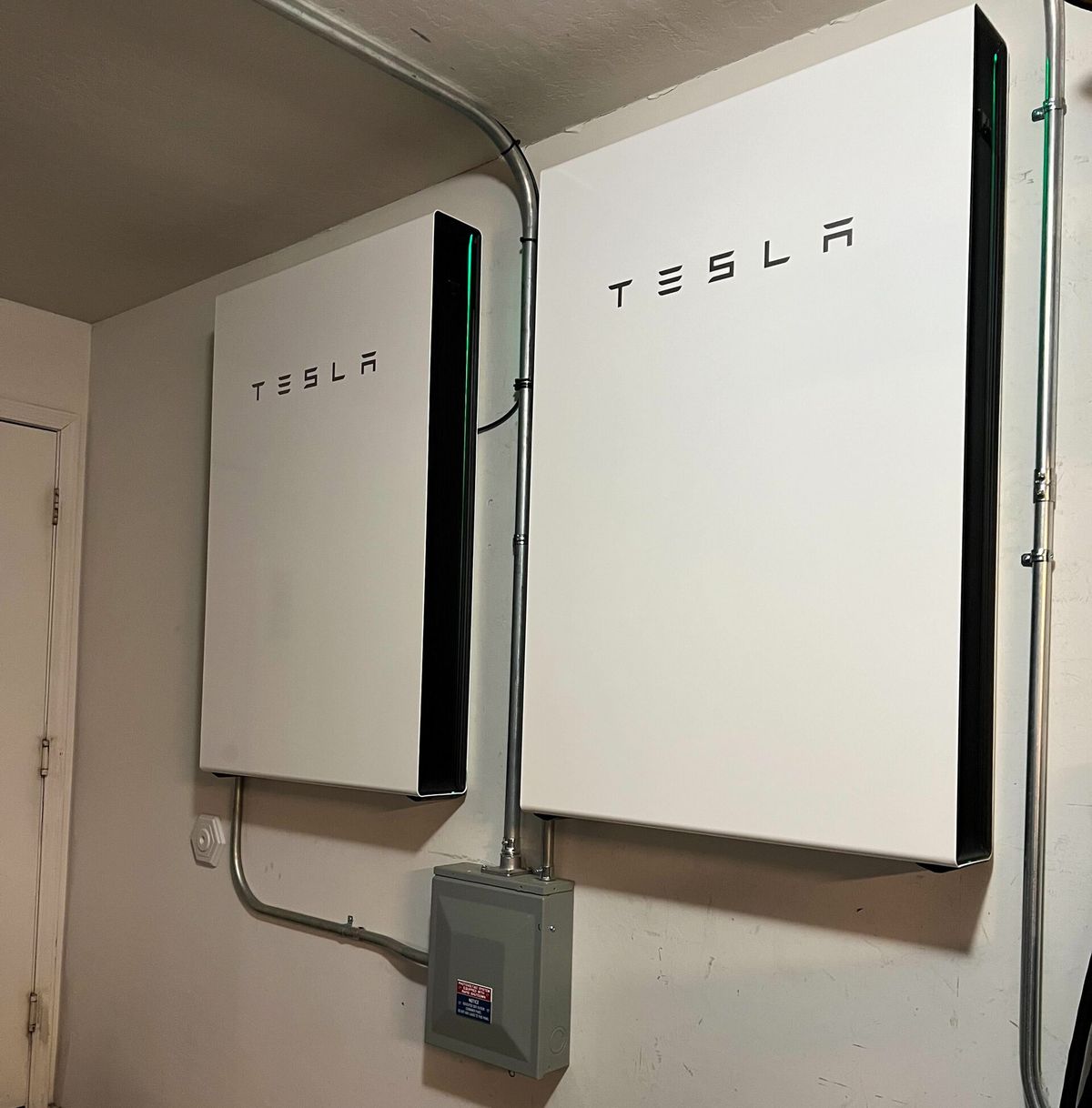
To make this concrete, here are three archetypes sized with the method above. A 1,800-square-foot all-electric townhome in a mild climate: 2-ton heat pump (2.5 kW running), induction range, heat-pump water heater, one EV at Level 1 during outages. Evening peak with management: about 6 kW. Eight-hour overnight target at 3.5 kW average: 28 kWh usable. The fit: two 13.5-kWh-class batteries with roughly 10 kW of combined inverter capacity, $22,000 to $30,000 installed. The EV charges overnight from the battery at Level 1 without drama.
A 3,200-square-foot suburban home in a cold climate: 4-ton heat pump with 10-kW strips locked out during outages, electric dryer, induction range, heat-pump water heater, one EV. Managed evening peak: 10 to 12 kW. Twelve-hour winter outage target at 5 kW average: 60 kWh usable. The fit: three to four battery units totaling 40 to 55 kWh with 15 to 20 kW of inverter capacity, $34,000 to $48,000 installed, plus a soft-start on the heat pump. This is the most common all-electric profile we see, and it's where a smart electrical panel earns its keep by shedding the dryer and range automatically.
A 5,000-square-foot luxury home with two EVs, pool equipment, and a 5-ton heat pump: managed peak 18 to 22 kW, full-day outage target 100+ kWh. The fit: four to six battery units or a commercial-scale residential system, 20 to 30 kW of inverter capacity, $55,000 to $85,000 installed — usually paired with 15 to 20 kW of solar that recharges daily. At this scale, many owners add a standby generator as the third leg: batteries handle the first 12 to 24 hours silently, and the generator covers multi-day events. These are 2026 US market ranges; get itemized local quotes, and have a licensed electrician verify your panel and service capacity before committing.
Sizing Mistakes That Cost Thousands
The most expensive mistake is sizing from a single number — usually the battery's kWh rating — while ignoring inverter capacity. A 40-kWh system behind a 7.6-kW inverter still trips when your 12-kW evening peak hits. Always confirm both numbers in writing from your installer: continuous inverter output in kW, surge rating and duration, and usable storage in kWh at your chosen depth of discharge. Get the surge behavior specified for your actual loads, not just the datasheet headline.
Second, forgetting simultaneity. Your loads never politely take turns. Model the realistic worst-case overlap — heat pump running, dryer tumbling, someone boiling pasta — and size the inverter for it, or install automated load shedding so the system enforces the limit for you. Smart panels that drop non-essential circuits when the battery takes over have become the standard solution in all-electric homes, and they typically cost $3,500 to $6,500 installed — far less than another battery.
Third, sizing for a fantasy outage. Designing for a five-day blackout with no solar and every appliance running is how $80,000 quotes happen. Size for your utility's actual outage history plus one bad day, pair with solar if your roof allows, and leave physical and electrical headroom — panel space, conduit, and inverter capacity — to add a battery later. Batteries are modular; buy what the next three years need and expand when the next EV or heat pump arrives. Finally, verify the 30 percent federal clean-energy tax credit treatment with your tax advisor: in 2026, standalone batteries of 3 kWh or more generally qualify, which can take a meaningful bite out of the numbers above.
Frequently asked questions
Most all-electric homes need 27 to 60 kWh of usable storage for a realistic overnight-to-full-day outage, versus 13 to 20 kWh for a mixed-fuel home. The exact number depends on your heat pump size, whether backup heat strips are locked out during outages, and how many miles of EV charging you require. Start from measured load data, not rules of thumb.
Usually not on its own. A single 13.5-kWh-class battery delivers around 5 to 11.5 kW of continuous power, which is below the 12 to 20 kW peak of a typical all-electric home. One battery can back up essential circuits with load management, but whole-home coverage in an all-electric house generally takes two to four units.
Most designers put the EV charger on a non-backed-up or throttled circuit rather than sizing the battery around it. Charging one EV at full Level 2 speed can consume an entire extra battery's worth of energy per day. Use Level 1 charging or scheduled solar-hours charging during outages instead.
Yes. Heat pump compressors draw 3 to 5 times their running wattage for a fraction of a second at startup, which can trip an undersized inverter. A soft-start device on the compressor, costing a few hundred dollars installed, smooths the surge and is standard practice in battery-backed all-electric homes.
Expect $22,000 to $30,000 installed for a smaller all-electric home, $34,000 to $48,000 for a typical 3,000+ square foot home, and $55,000 to $85,000 for large luxury homes with two EVs. Costs are 2026 US market ranges; get itemized local quotes, and confirm federal tax credit eligibility with your tax advisor.
Yes, often by the equivalent of one full battery. A smart panel automatically sheds non-essential loads like the dryer, range, or EV charger when running on battery, which lets you size the inverter for a managed peak instead of the worst-case overlap. Installed cost is typically $3,500 to $6,500.