Backyard Lazy Rivers: Cost & Design 2026
Backyard lazy river cost and design 2026: the luxury water feature's real price, pumps, current systems, space needs, and honest planning guide.
10 MIN READ · UPDATED 2026-09-22
Key takeaways
- A residential lazy river is a major waterscape project: expect $100,000–$300,000+ all-in for a properly engineered installation.
- The current is created by strategically placed pumps and jets — not by sloping the channel — and it must be engineered, not guessed.
- Plan for serious space: most residential lazy rivers need 1,500–3,000+ square feet of channel plus deck.
- Operating costs are significant — multiple pumps, heating a large water volume, and year-round maintenance add up.
- This is a design-build project for experienced waterscape contractors; standard pool builders often lack the hydraulics expertise.
Every resort pool you have ever loved had one, and now you are wondering whether that slow, winding ribbon of water can exist in your backyard: the lazy river, the single most transporting water feature in residential design. Float in a tube, drift past landscaping, under a bridge, through a grotto — it is the closest a backyard gets to a vacation. It is also one of the most complex, expensive, and misunderstood projects a homeowner can commission: a hydraulically engineered vessel, not a decorative stream, with real costs, real operating demands, and real engineering behind the gentle current. This guide gives you the honest 2026 picture — what it costs, how the current actually works, what space it needs, and how to tell whether your project and your contractor are up to it.
What a Residential Lazy River Actually Is
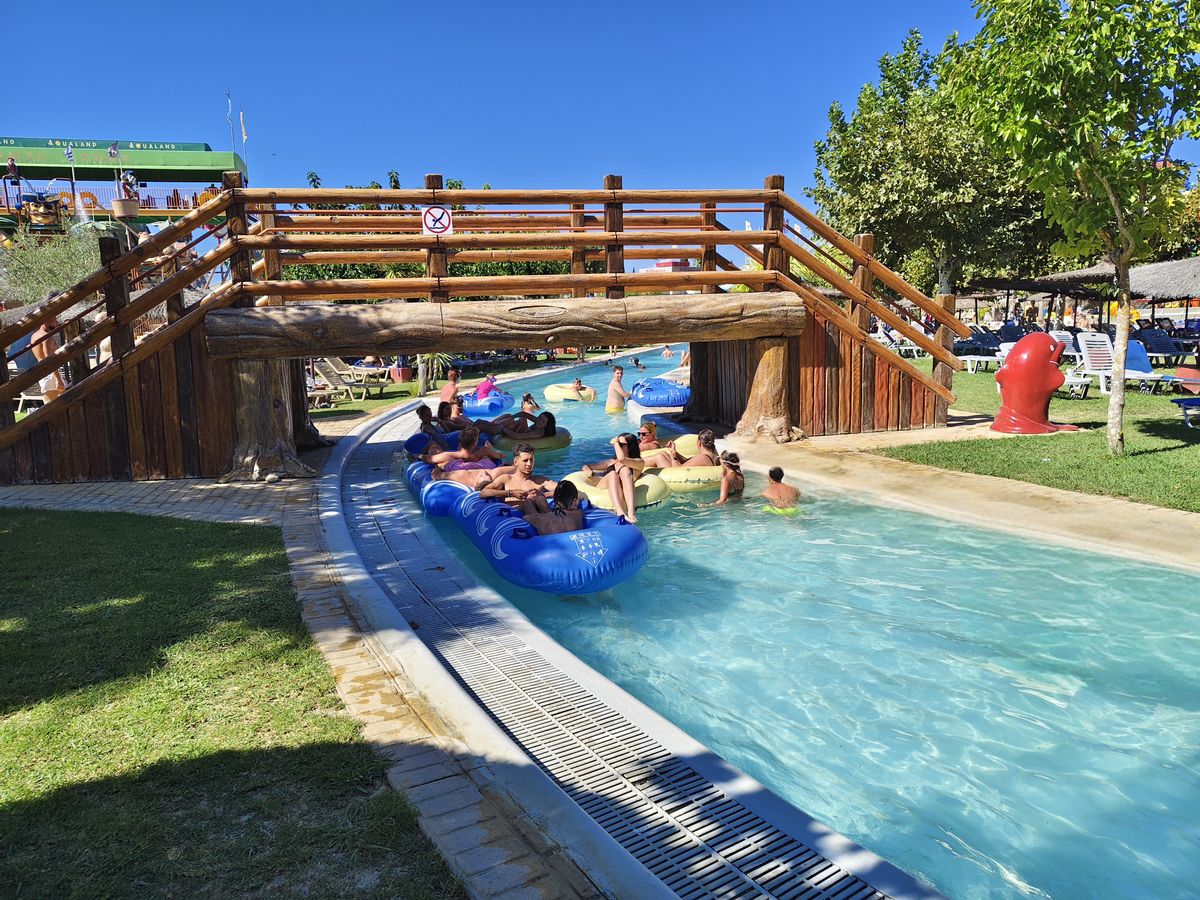
A lazy river is a continuous-loop channel — typically 8–14 feet wide and 3–4 feet deep — engineered so water circulates in a gentle, consistent current that carries floaters along the loop. Unlike a decorative stream, it is a swimming vessel built to pool standards: structural shotcrete or gunite shell, pool-grade interior finish, full filtration and sanitation, and barrier and safety compliance. Think of it as a pool that happens to be shaped like a river, not a landscaping water feature that happens to hold water.
The experience is the product: a slow drift (typically under 1–2 feet per second) past planting beds, rockwork, bridges, and entry beaches, with the channel wide enough for two tubes to pass comfortably. Well-designed rivers include varied zones — a sunny float stretch, a shaded grotto section, a wider 'lagoon' area for gathering — so the loop feels like a journey rather than a track. Poorly designed ones feel like an expensive moat: uniform, boring, and oddly tiring to float in.
Scale is the first reality check. A satisfying residential river needs enough loop length for the drift to feel unhurried — most successful projects run 150–400+ linear feet of channel, which translates to 1,500–3,000+ square feet of water surface plus deck. Below that scale, designers often pivot to a 'current channel' or swim-current feature: a shorter straight run with an adjustable current for exercise and play, delivering some of the sensation in a fraction of the space and cost. Know which one you are actually buying.
How the Current Works: Hydraulics, Not Hills
Filtration and turnover scale with the river's volume, and the volumes are large — a modest residential river can hold 30,000–60,000 gallons, two to three times a typical pool. Health-code turnover requirements apply just as they do to pools, which means filtration equipment sized for that volume: multiple large cartridge or sand filters, sanitation systems (chlorine, salt, or UV/ozone supplementation) rated for the gallonage, and the circulation pumps to move it all. Undersized filtration is one of the most common value-engineering mistakes in river projects — the water looks fine at commissioning and turns dull within a season because the system cannot keep up with the organic load across that much surface area. Size filtration for the river you built, not the pool you are used to, and budget filter maintenance (cleaning or media replacement) at the correspondingly larger scale.
The most common misconception about lazy rivers is that the water flows downhill. It does not — the channel is essentially level, because sloping the riverbed would create uneven depths, unpredictable currents, and safety problems. The current is manufactured: dedicated pumps draw water from the channel and return it through strategically placed jets and nozzles aimed along the direction of travel, each adding momentum to the flow. Balanced correctly, these inputs create a smooth, continuous drift around the entire loop.
'Balanced correctly' is doing heavy lifting in that sentence. The hydraulic engineering must account for friction losses along the channel walls, the momentum absorbed at curves (wide, sweeping curves preserve flow; tight turns kill it), the interference of features like bridges and grottos, and the return path that gets water back to the pump intakes without short-circuiting the loop. This is specialized work — closer to waterpark engineering than to standard pool plumbing — and it is why contractor selection matters so much.
Equipment-wise, expect multiple high-flow pumps dedicated to current generation, separate from the filtration pumps, plus a carefully designed return layout — often dozens of inlets. Variable-speed or variable-flow pumps are strongly preferred: they let the operator tune the current (gentle drift for floating, stronger flow for play) and cut energy use dramatically versus single-speed pumps running full-tilt. Ask any prospective contractor to explain their hydraulic model for your specific loop; a hand-wave here is a disqualifier.
2026 Costs: The Honest Breakdown
Residential lazy rivers live in a different cost universe from pools. A realistic all-in budget:
- Excavation and structural shell: $30,000–$80,000 — deeper, longer, and more complex forming than a pool, with extensive steel for the channel walls.
- Interior finish: $15,000–$40,000 — plaster, pebble, or tile across a very large surface area.
- Current-generation pumps, filtration, and sanitation: $20,000–$50,000 — multiple pumps, large filters, and chemical systems sized for thousands of gallons.
- Heating: $8,000–$20,000 — heating a river's water volume is a serious equipment commitment; many owners heat selectively or seasonally.
- Decking, bridges, rockwork, and landscaping: $25,000–$80,000+ — the features that make it feel like a river rather than a concrete ditch.
- Design, engineering, and permits: $10,000–$30,000 — hydraulic engineering and structural design are not optional.
Total: $100,000–$300,000+ for a properly executed residential river, with simpler compact designs starting near $75,000–$100,000 and elaborate resort-style projects exceeding $300,000. Operating costs run $300–$800+/month in season for energy, chemicals, and heating — the highest of any residential water feature. Budget the operating cost with the same seriousness as the construction cost; a river you cannot afford to run is a very expensive pond. Costs are 2026 US market ranges; get itemized local quotes.
Design Principles of a River That Feels Right
Lighting transforms the river from a daytime feature into an evening destination, and it should be designed with the hydraulics, not after them. Underwater LED fixtures along the channel walls create the glowing-water effect that makes night floating magical, but fixture placement must avoid the current-generation inlets and be serviceable without draining the channel — specify that in the design. Perimeter and landscape lighting matters equally: a dark river is a hazard, not an amenity, and the paths, bridges, and entries need the same careful illumination as the water. Low-voltage LED systems keep operating costs modest, and automation that ties river lighting to the pool and landscape scenes (sunset mode, party mode, late-night low mode) makes the whole waterscape feel intentional rather than assembled. Plan the conduit and transformer capacity during construction; retrofitting lighting into a finished river means cutting into the most expensive concrete on the property.
Great lazy rivers are designed around experience choreography. Vary the channel: alternate open sunny stretches with planted, shaded sections; include at least one wider lagoon area where floaters naturally gather and converse; add a grotto or bridge crossing for the moment of passage that makes the loop memorable. Keep curves generous — tight switchbacks look exciting on paper and feel like work in a tube. A good rule: if you cannot imagine floating it with a drink in hand without effort, the geometry is wrong.
Entries and exits deserve as much design attention as the channel: beach entries at one or two points, sturdy handrails where the current is perceptible, and non-slip surfaces throughout — wet, gently moving water over smooth stone is a slip hazard by design, so texture and railings are safety infrastructure, not decoration. Depth should stay consistent at 3–4 feet: deep enough to float comfortably, shallow enough to stand everywhere, which is both a comfort and a safety feature.
Integration with the property separates the showcase projects from the awkward ones. The river should connect logically to the house, the main pool (if any), and the outdoor living areas — a river marooned at the far corner of the lot gets used less than one woven into daily circulation. Plan sightlines too: the river is beautiful to look at, so orient primary windows and patio seating toward it. And plan the mechanicals early — pump vaults, equipment pads, and access for service need to be in the design, not discovered during construction.
Contractor Selection: The Make-or-Break Decision
A lazy river is not a project for a standard pool builder learning on your dime — it demands waterscape contractors with built river experience and demonstrated hydraulic competence. Vet candidates ruthlessly: visit at least two completed rivers they built (not pools — rivers), talk to those owners about current quality and operating costs, and ask the contractor to walk you through the hydraulic design of your loop specifically — pump sizing, inlet placement, expected current velocity, and how they validated the model.
Red flags: a bid dramatically lower than others (corners are being cut in hydraulics or structure, the two places you cannot afford it), reluctance to provide engineering calculations, no river references, or a proposal that treats the river as 'a pool with a funny shape.' Green flags: in-house or retained hydraulic engineering, detailed equipment schedules with pump curves matched to the loop, a commissioning plan that includes current-velocity testing and balancing after fill, and a service plan for the specialized equipment.
Contract structure matters at this price: fixed-price or guaranteed-maximum contracts with detailed scopes, milestone payments tied to completed inspections (not calendar dates), and retainage held until commissioning and balancing are complete and documented. At $150,000+, a construction attorney reviewing the contract is money well spent. The best river contractors will respect this process; the ones who bristle at it are telling you something.
Is a Lazy River Right for You? The Final Filter
Say yes if: you have the space (a third of an acre or more to do it well), the budget ($100k+ construction plus real operating costs, without straining the rest of the project), and the use case — a household that will actually float weekly, entertain often, or run a property where the river is a genuine amenity. Resort-style estates, multigenerational family compounds, and luxury short-term rentals are the natural fits.
Think twice if: the lot is tight (a cramped river disappoints more than no river), the budget would be stretched so thin that finishes or engineering get value-engineered (a cheap river is the worst of both worlds), or your household's real pool use is lap swimming and quick dips — in which case a superb pool plus a current-training lane delivers more daily value. Also weigh resale: a lazy river is a love-it-or-leave-it feature that narrows the buyer pool even as it wows the right buyer.
If you proceed, invest in the design phase proportionally — the engineering and design fees are the cheapest insurance in the project — and hire the specialist, not the generalist. A well-built lazy river is a generational amenity: the thing grandchildren remember, the reason summer gatherings happen at your house, the backyard feature that never gets old because drifting on water never gets old. Just go in with eyes open about the cost, the complexity, and the operating commitment — and then enjoy the finest float in residential life.
Frequently asked questions
A properly engineered residential lazy river typically costs $100,000–$300,000+ all-in, including excavation, shotcrete/gunite shell, interior finish, pumps and current systems, filtration, heating, decking, and landscaping. Smaller, simpler designs on favorable sites can come in near $75,000–$100,000, while elaborate resort-style rivers with grottos and bridges exceed $300,000. Costs are 2026 US market ranges; get itemized local quotes.
Most residential lazy rivers need 1,500–3,000+ square feet of water surface in a loop or kidney configuration, plus surrounding deck — realistically a third of an acre or more of total backyard to do it well. Narrower channels (8–10 feet wide) keep the footprint manageable while still floating comfortably. Tight lots can sometimes fit a compact current channel, but a true lazy-river experience needs room.
The current comes from strategically placed return jets and dedicated current-generation pumps that push water along the channel — not from sloping the riverbed, which would create uneven depths and safety issues. The channel is essentially level; carefully aimed and balanced flows create the gentle drift. Proper hydraulic engineering balances the flows so the current is consistent without dead spots or rapids.
Operating costs are the highest of any residential water feature: multiple high-flow pumps running long hours, heating a very large water volume, and chemical treatment for thousands of gallons. Expect $300–$800+/month in season for energy and chemicals on a typical residential river, varying widely with climate, heating, and pump efficiency. Variable-speed pumps and good hydraulic design meaningfully reduce the energy bill.
It is a major construction project either way — essentially building a second, hydraulically independent vessel connected to or alongside the pool. Some designs integrate the river as an extension of the pool's circulation, but most perform better as a separate system with dedicated pumps and filtration. Either approach requires excavation, structural work, and permits; there is no light-touch retrofit.
Yes — permits as a swimming pool structure at minimum, and the same barrier, alarm, and safety requirements as any pool, applied to a much larger water surface with more access points. Moving water adds considerations: intake and return grates must meet entrapment-safety standards, and the current, while gentle, means non-swimmers need the same supervision as in any pool. Your contractor and local building department will specify the requirements.