Best Walk In Tub With Shower Combo 2026: 7-Point Buyer's Guide
Key takeaways
- A walk-in tub with shower combo combines a low-threshold walk-in tub and a full standing shower in one footprint — best when one bathroom must serve both bathers and showerers.
- Most buyers get the combo wrong by bolting a cheap shower riser onto a tub: what matters is a reinforced surround wall, a proper diverter, and a drain that empties fast.
- Combo units typically add $400–$900 to the tub price plus $800–$2,500 in shower plumbing labor — installed totals usually land between $4,500 and $9,000 without jets.
- Check your water heater first: a walk-in tub holds 50–80 gallons, so a 40-gallon tank serving the whole house will leave you shivering mid-fill.
- If only one person showers and another soaks, the combo is the cheapest single-fixture fix; if everyone bathes, skip the combo and size up the tub instead.
The best walk in tub with shower combo 2026 setup is not a specific brand — it is a walk-in tub paired with a properly plumbed overhead or handheld shower on a diverter valve, reinforced surround walls, and a fast drain, so the fixture works as a full standing shower when you are in a hurry and as a therapeutic soak when you have time. For most homes, a quality combo configuration installed totals $4,500–$9,000 before hydrotherapy upgrades, and it fits the same 60-inch alcove your old tub occupied.
Multi-generational households run into the same conflict: a senior needs a low-threshold walk-in tub, but everyone else in the house still showers every morning. Replacing the tub with a walk-in tub alone solves the safety problem and creates a convenience problem — nobody wants to sit through a 10-minute fill just to rinse off before work. A combo fixes both with one fixture, one drain line, and one plumbing rough-in.
This guide covers exactly how combo units work, the seven features that separate a genuinely usable combo from a showerhead bolted onto a tub as an afterthought, real installed-cost ranges, and the plumbing gotchas (water heater capacity, drain speed, door clearance) that decide whether the combo actually fits your bathroom.
What a walk-in tub with shower combo actually is
A walk-in tub with shower combo is a single bathing fixture that does two jobs: the watertight door and contoured seat of a walk-in tub for seated soaking, plus shower functionality — either a handheld wand, an overhead rain or slide-bar shower, or both — fed through a diverter valve on the tub's filler. You close the door, stand or sit, divert water to the showerhead, and bathe exactly as you would in a standard tub-shower. No separate shower stall, no extra floor space, no second drain line to rough in.
There are two distinct ways this is sold, and the difference matters more than the brand name:
The integrated route costs less in labor and guarantees the surround walls are engineered to carry the shower fixtures. The field-added route preserves existing tile, which matters when the bathroom was remodeled recently. Either way, the result is the same user experience: shower or soak in one fixture.
ANZZI 30 x 53 In Walk-In Tub with Jets, Right Drain, 13 Whirlpool & 26 Air Jets

Walk-in tub + shower combo is a high-intent buyer query; the verified ANZZI unit is the card pick.
*Affiliate Disclosure: As an Amazon Associate, Elevate Home earns from qualifying purchases. Pricing and availability subject to change.
Who combo units suit — and who should choose differently
Combos make the most sense in one-bathroom homes and in multi-generational households where one bathroom must serve a senior who soaks and teenagers or working adults who shower. If your house has two full baths, putting a walk-in tub in one and keeping a standard shower in the other usually beats forcing both functions into a single fixture — redundancy is its own safety feature when a fixture is out of service.
Skip the combo and buy a larger or deeper walk-in tub instead if everyone in the household bathes. A combo's showerhead is a compromise piece of hardware: adequate for daily rinsing, but it will never match a dedicated shower with a fixed high-flow head and a thermostatic valve. If the fixture's primary job is soaking, spend the combo premium on a jetted model with an inline heater instead.
Also be honest about who will do the cleaning. Combo units roughly double the surface area you scrub versus a standard walk-in tub, and the shower surround above the tub collects the same soap film as any shower. If cleaning capacity is limited, a soaker-only tub with a handheld wand for rinsing (not showering) is the lower-maintenance choice. Our full walk-in tub buying guide walks through sizing and features in depth.
The 7 features that decide whether a combo actually works
1. Diverter valve quality. The diverter is the single most-used control on a combo unit, cycled twice daily. Cheap pull-up tub-spout diverters leak within a year or two, dribbling water from the spout while you shower. Specify a ceramic-disk three-way diverter — rated for hundreds of thousands of cycles — rather than a rubber-gasket pull diverter.
2. Surround walls that can carry a shower riser. Shower risers and slide bars apply leverage to the wall. On field-added combos, the installer must hit studs or solid blocking behind the tub surround, not just the acrylic flange. If your tub backs onto a tile wall, anchor the riser through the tile into blocking with waterproof gaskets, and seal every penetration with 100% silicone. This is the installation step most often skipped on cheap retrofits — and the one that causes leaks.
3. Drain speed. Every walk-in tub forces you to sit inside while it drains, but on a combo you will do it after a shower too, when you are wet and not yet warm. A standard 1.5-inch tub drain empties a 60-gallon tub in 8–12 minutes. Combo buyers should insist on the tub's fast-drain or powered-drain option — 2-inch drain assemblies or powered pump drains clear the tub in under 3 minutes. That single option does more for daily satisfaction than any jet package.
4. Handheld wand with a real slide bar, not a fixed hook. A handheld shower is not optional on a combo: it is how a seated bather rinses, and how a caregiver assists. The difference between a usable one and a frustrating one is the mount — a 24-inch minimum slide bar lets the wand park at seated head height or standing height, while a fixed cradle hook forces one user to hold it. Confirm the slide bar is included before you sign, because it is the line item most often cut.
5. Anti-scald protection. Seated bathers cannot jump back from a temperature spike the way a standing shower user can. Pressure-balancing valves are the legal minimum in most jurisdictions (ASSE 1016); a thermostatic mixing valve (ASSE 1070) set at 120°F at the tub filler is the safer choice for households with elderly or cognitively impaired users. Confirm which valve the combo kit includes — many tub-only models ship with basic non-pressure-balanced fillers that a shower addition cannot legally rely on.
6. Threshold and door swing versus your entry path. Combo units concentrate everything in the tub's footprint, so the door swing and step-over threshold become the whole accessibility story. A 3–5 inch threshold is standard; measure it against the user's actual step capability, not the brochure. Outward-swing doors need 24–30 inches of clear floor in front of the tub — verify that clearance exists before ordering, because the shower riser on the wall opposite can tempt installers to rotate the tub 180 degrees, which flips the drain side and the door swing with it.
7. Grab bar backing, not just grab bars. A combo used as a shower invites standing use, which means grab bars on at least two walls. The bars themselves are cheap; the blocking behind them is what matters. Specify 2×8 blocking at 33–36 inches height on the shower walls during rough-in, and confirm with a stud finder before the surround goes up. Properly placed bars are covered in our grab bar placement guide.
Size and retrofit: will a combo fit your bathroom?
Almost all walk-in tubs are designed as direct replacements for a standard 60 × 30-inch alcove tub — 52 to 60 inches long, 26 to 32 inches wide, with a tile flange that tucks behind the surround. That is the entire reason combos exist: you remove the old tub-shower, drop the walk-in combo into the same alcove, reconnect the same supply lines and the same drain, and the bathroom's footprint does not change at all.
Measure three things before you order. First, the rough opening: the alcove width at the narrowest point, including any tile that stays. A 60-inch alcove with tile returns often measures 59 inches clear — tubs are forgiving by about an inch with the flange, but not by three. Second, the drain location: walk-in tubs come in left-drain and right-drain configurations, and moving a drain in a slab-on-grade home can add $1,000+ to the job. Third, ceiling height over the shower end: overhead rain heads need roughly 80 inches of clear height above the tub rim; in basement bathrooms with 7-foot ceilings, a slide-bar handheld is the realistic choice.
Door swing deserves its own measurement. An outward-opening tub door sweeps a quarter-circle roughly 28 inches in radius. On a combo, that swing zone must stay clear of the vanity, the toilet, and the bathroom door — in 5 × 8-foot bathrooms, which are extremely common, the swing path often collides with something. Inswing doors exist but require the bather to step over the threshold and close the door behind them while standing in the tub — a maneuver most mobility-limited users cannot do safely. When in doubt, template the swing with painter's tape on the floor before the tub ships. Full rough-in details are in our walk-in tub installation requirements guide.
Combo unit vs walk-in tub + separate shower: the honest math
If your bathroom is large enough to hold both fixtures, run this comparison before committing to a combo:
The combo wins on cost and space; separate fixtures win on experience and redundancy. In the standard 5 × 8-foot hall bathroom, the decision is usually made for you — there is no room for two fixtures, and the combo is the answer.
2026 cost ranges: tub, combo kit, and installation
Walk-in tub pricing is the least transparent corner of bathroom remodeling: national brands quote installed prices only after an in-home consultation, and online tubs exclude labor. These ranges reflect 2026 market data from manufacturer list prices and contractor bid averages:
The line item buyers most often miss is the water heater. A walk-in tub holds 50–80 gallons; a 40-gallon tank also serving a dishwasher and laundry will run cold before the tub fills, which turns every soak into a tepid disappointment. Budget for the heater upgrade in the same project rather than discovering it in January. A full breakdown of every cost driver is in our walk-in tub cost guide.
Plumbing and electrical requirements, plainly stated
Combo plumbing is standard tub-shower rough-in: 1/2-inch supplies to a tub-shower valve, a shower riser to 72–78 inches, and a 1.5-inch (or upsized 2-inch) drain. The wrinkle is the diverter and the valve. Most online walk-in tubs ship with a Roman-style deck filler and a separate handheld wand; converting that to a true combo means either the manufacturer's shower kit with its own valve body or a plumber-supplied pressure-balancing tub-shower valve on the wall. Do not let an installer tee the showerhead off the wand hose — the resulting pressure drop makes the shower unusable whenever the tub filler is even slightly open.
Electrical requirements come from the jets, not the shower. A jetted combo typically needs a dedicated 20-amp GFCI circuit for the pump and blower, and models with an inline water heater need a second dedicated 20-amp circuit. NEC Article 680.71 requires hydromassage bathtub electrical equipment to be GFCI-protected and accessible without damaging the building structure — which is why reputable installers cut an access panel rather than burying the pump behind tile. If your panel has no spare breaker spaces, factor a subpanel or tandem breakers into the bid.
One more code point: most jurisdictions require the tub's door latch to be operable from both sides for rescue access, and some require an anti-scald device at the tub filler when the fixture serves elderly occupants. Your permit office will tell you in a five-minute call; ask before the rough-in inspection, not after.
The verdict: how to shop for a combo in 2026
Start from the household, not the hardware. If the bathroom must serve both a soaker and showerers, a combo in the existing alcove is the right answer — and it is dramatically cheaper than adding a second fixture. If only one person uses the bathroom and they bathe, buy the best jetted tub you can afford and skip the shower hardware entirely.
When you compare models, weight the boring features heaviest: a ceramic diverter, a powered fast drain, a real slide bar for the handheld, and documented grab-bar blocking. Jets, chromatherapy, and heated seats are pleasant, but they are the features you notice on day one; drain speed and diverter quality are the features you notice every day for fifteen years.
Finally, get the installed price in writing with the combo kit, the drain upgrade, the electrical circuits, and the water heater assessment each listed as separate line items. Walk-in tub quotes are famous for single-number pricing that hides exactly which of these are included. A contractor who itemizes is a contractor who has done this before — and that is the installer you want setting a watertight door you will trust for a decade.
Choosing between keeping the tub and switching to a shower-only layout? Our walk-in tub vs curbless shower comparison and the tub cut-out vs walk-in tub breakdown cover the alternatives honestly.
Frequently asked questions
Can you add a shower to any walk-in tub?
Almost any walk-in tub can accept a shower riser, diverter, and handheld wand, but a usable combo needs three things: a manufacturer shower kit or a plumber-installed pressure-balancing valve (not a tee off the wand hose), reinforced blocking behind the surround for the riser, and a fast drain. Tubs with flat, unreinforced apron walls are poor candidates — confirm blocking locations with the manufacturer before ordering.
How much does a walk-in tub with shower combo cost installed?
A quality combo installation typically runs $4,500–$9,000: $2,000–$5,500 for the tub (soaker vs jetted), $400–$900 for an integrated shower kit, and $1,500–$4,000 in labor. Add $1,500–$3,000 if your water heater needs upsizing to fill a 50–80 gallon tub, and $400–$1,200 for the dedicated GFCI circuits jetted models require.
Do walk-in tub shower combos require waiting in the tub while it drains?
Yes — the watertight door cannot open until the water level drops below the door seal. A standard drain takes 8–12 minutes for a full tub, which is why the fast-drain or powered-drain option is the single most important upgrade on a combo: it clears the tub in under 3 minutes so you are not sitting wet and cooling off after every shower.
What size water heater do I need for a walk-in tub combo?
Plan on a 50-gallon tank minimum, or a tankless unit rated for the tub's fill rate, if the tub serves a whole household. Walk-in tubs hold 50–80 gallons — a 40-gallon tank shared with laundry and dishwashing will run cold mid-fill. Have the installer assess recovery rate, not just tank size, before the tub ships.
Is a walk-in tub with shower combo better than a walk-in shower?
It depends on the user. A combo preserves the therapeutic soak — warm-water immersion helps arthritis, circulation, and muscle soreness — while adding daily shower function in one footprint. A curbless walk-in shower is cheaper, drains instantly, and has zero door maintenance, but offers no soaking. Households where the senior both showers daily and soaks weekly get the most from a combo.
Keep reading

Buying Guide
Walk-In Tub Buying Guide: Costs & Features (2026)
Walk-in tub buying guide for 2026: costs, must-have features, sizing and layout, plumbing and electrical needs…
Cost Guide
Walk-In Tub Cost: The Complete 2026 Price Guide
A walk-in tub costs between $5,500 and $12,000 fully installed in 2026. See the breakdown of equipment, plumbi…
Comparison
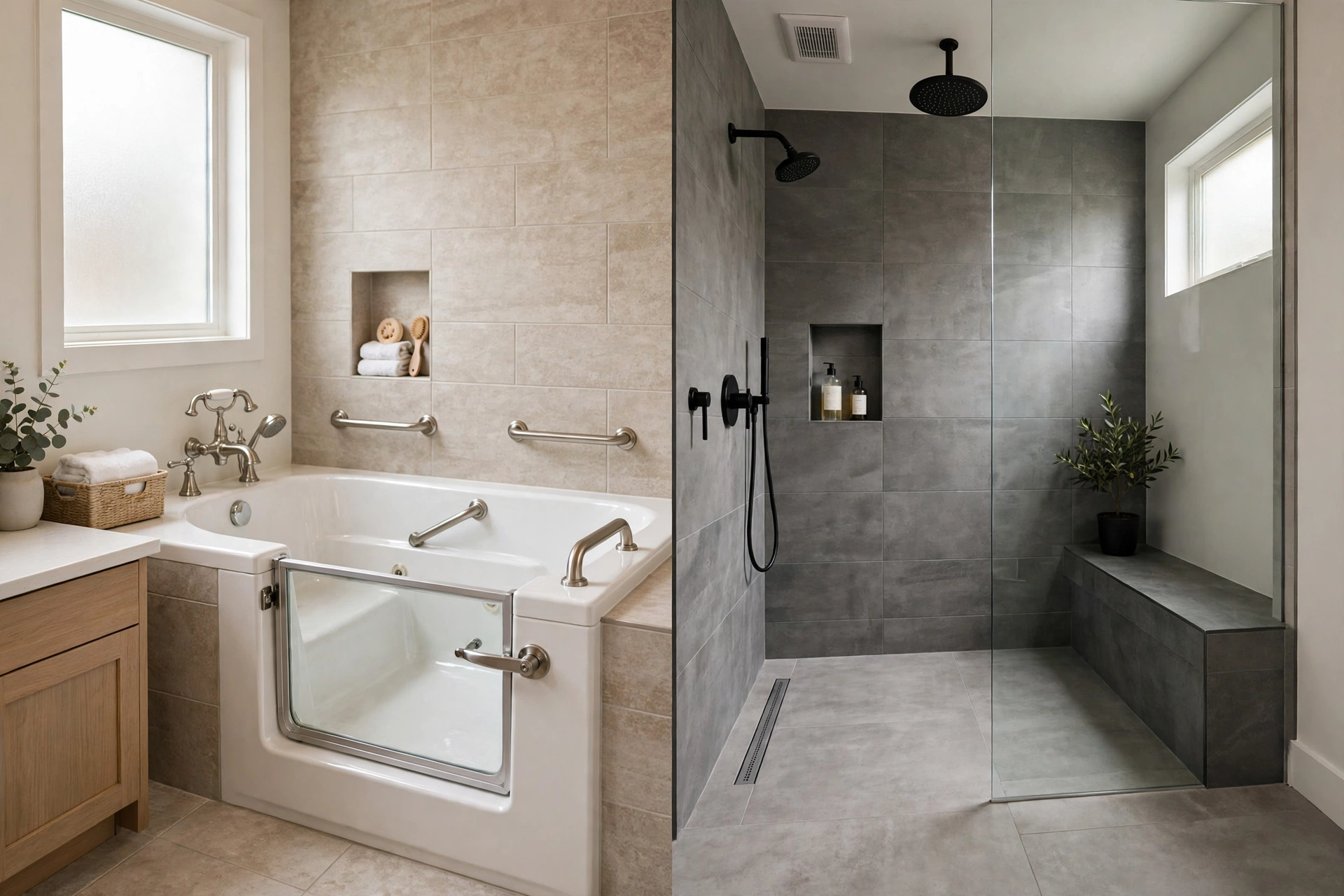
Walk In Tub vs Curbless Shower: Honest 2026 Comparison
Walk-in tub vs curbless shower: honest 2026 costs, accessibility, cleaning, and resale compared. Which bathing…
Bathroom
Walk-In Tub Installation Requirements: Guide
Walk in tub installation requirements: drain sizing, delivery clearances, floor structure, water heater sizing…
Interactive Tool
Aging in Place Renovation Cost Estimator 2026 Guide
Budget your aging-in-place renovation with our interactive estimator. Price accessible bathrooms, kitchens, el…
Transfer Equipment
100A vs 200A Automatic Transfer Switch
100 amp vs 200 amp transfer switch: service-entrance vs subpanel topology, when each is required, costs, and l…