Exterior Accessibility: Driveways, Walkways & Entry Lighting
Exterior accessibility starts at the curb: safer driveways, walkways, ramps, and entry lighting with 2026 cost ranges, contractor tips, and HOA guidance.
11 MIN READ · UPDATED 2026-09-22
Key takeaways
- Walk the full car-to-door route at night and in the rain; the hazards you find in bad conditions are the ones that cause falls.
- Walkways should be at least 36 inches wide (48 is better), firm, level, and free of heaves and lips over a half inch.
- A 1:12 slope is the widely referenced ramp standard; where a ramp will not fit, a porch lift ($4,000–$10,000) is the compact alternative.
- Layered entry lighting — overhead, step-level, and motion-sensor path lights — is the cheapest major safety upgrade outside the house.
- Check HOA architectural rules before changing anything visible from the street, and use licensed contractors for concrete, electrical, and drainage work.
Every trip out of the house begins the same way: car door to front door, across surfaces designed decades ago for people with perfect balance and 20/20 vision. Uneven pavers, a steep driveway, a dark porch, and steps with no handrail turn a thirty-second walk into the riskiest part of the day. Exterior accessibility is the discipline of making that journey boring — predictable footing, visible edges, sensible slopes, and light everywhere you need it. This guide walks the route from the curb to the threshold with 2026 cost ranges, contractor guidance, and the HOA and permit issues to clear before work starts.
Mapping the Car-to-Door Journey
Start with an audit, not a shopping list. Walk the full route — from where the car parks to the front door — three times: once in daylight, once after dark, and once in the rain if you can. Note every step, slope, dark patch, uneven joint, and narrow squeeze. The night walk is the revealing one: entries that feel fine at noon become obstacle courses when the only light is a dim porch bulb two houses down.
Count the transitions, because each one is a decision point for a foot. The curb or driveway apron, the driveway-to-walkway joint, every step or lip, the porch edge, the threshold itself — most homes have five to eight, and each needs to be visible, slip-resistant, and no taller than it has to be. Photograph each one; the photos become your punch list and your contractor briefing.
Pay attention to how the route is actually used, not how it was designed. The mail path, the trash route, the way guests arrive — accessibility improvements should follow real traffic, not the architect's ceremonial axis. If everyone enters through the garage, the garage path deserves the budget. If the front walk is the route, fix that one first and completely rather than spreading money thinly across three entrances.
Finally, audit in the worst season. Ice, wet leaves, and the low sun angles of winter change everything about an exterior route. A walkway that drains perfectly in July can sheet-ice in January where a downspout discharges across it. Design for February, and the rest of the year takes care of itself.
Driveways: Surface, Slope, and Drainage
The driveway is usually the longest part of the journey, and its condition sets the tone. Concrete is the best all-around surface for accessibility: firm, smooth, long-lived, and easy to keep level. Asphalt is cheaper but softens in heat and develops ruts and ridges that catch walker wheels. Pavers look beautiful but heave, settle, and grow weeds in the joints — each a small trip hazard multiplied across hundreds of joints. If pavers are non-negotiable aesthetically, budget for periodic re-leveling.
Slope matters more than surface. A driveway steeper than about 1:20 (5 percent) becomes genuinely difficult for manual wheelchair users and tiring for anyone with limited stamina, and steep aprons where the driveway meets the street are a classic trouble spot. Regrading a driveway is major work — often $8,000 to $20,000 — so where regrading is impractical, the strategy shifts to handrails along the walking lane, a level resting pad partway, and making sure the car parks as close to the entry as possible.
Drainage is the silent variable. Water crossing the walking path creates ice in winter, algae in summer, and eroded joints year-round. Resurfacing or replacing a two-car concrete driveway typically runs $6,000 to $14,000; while the concrete is open, it is the cheapest moment to add a trench drain across the walking lane or re-pitch a section that ponds. A licensed concrete contractor should evaluate drainage, not just quote square footage.
Heated driveways deserve an honest assessment. Hydronic or electric radiant systems under the concrete melt snow automatically — no shoveling, no freeze-thaw ice cycle on the main route — at roughly $15,000 to $30,000 for a typical two-car driveway, plus operating costs. For most households that is a luxury; for a household in snow country where an icy driveway is a recurring fall risk and shoveling is no longer safe, it is priced like the medical-grade intervention it effectively is.
Walkways: Width, Materials, and Trip Hazards
The walkway is where precision matters most, because it is the surface feet and wheels meet at every step. Aim for 48 inches wide — comfortable for a walker with margin, or two people side by side — with 36 inches as the absolute minimum for single-file passage. Then keep the full width clear: planters, hose reels, and decorative edging that pinch the path to 28 inches have quietly undone many well-built walkways.
Poured concrete with a broom finish is the workhorse: affordable at $8 to $18 per square foot installed, durable, and easy to keep level. Exposed aggregate looks richer and grips well. Brick and stone set in mortar perform well if the base is properly compacted; dry-laid units on sand shift over time and need re-leveling every few years. Whatever the material, joints and cracks wider than a half inch — or with vertical lips over a quarter inch — should be ground, filled, or replaced.
Eliminate the classic trip generators: tree roots heaving slabs (root barriers or rerouting, not just grinding, which thins the slab), downspouts discharging across the path (extend them past the walkway or into a drain), and the lip where the walkway meets the driveway or porch (bevel it or ramp it). Each fix is small; together they remove the majority of outdoor fall triggers.
Edge definition helps more than people expect, especially at dusk and for low vision. A walkway edge in a contrasting color or material — a darker border band, or low path lights marking both sides — keeps feet on the path and off the planting beds. It is a design detail that reads as landscaping and functions as a guardrail for attention.
Steps vs. Ramps at the Entry
The porch or stoop is the crux of the whole route: the place where the level change is biggest and the consequences of a fall are worst. If the entry has steps, they need handrails on both sides, risers of even height, treads at least 11 inches deep, and nosings with a contrasting strip so each edge reads clearly. Rebuilding a stoop with proper rails typically runs $3,000 to $8,000 depending on size and materials.
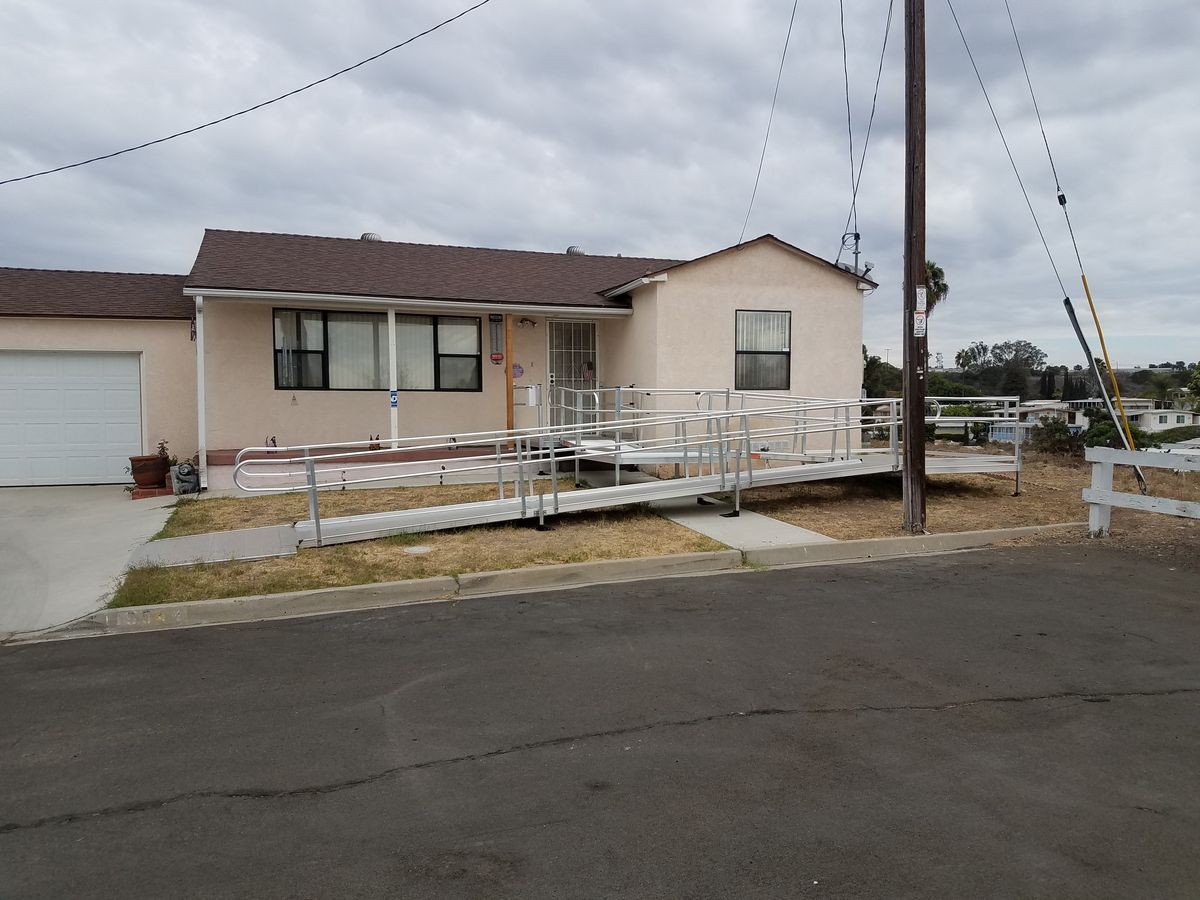
Where steps must go, a ramp built to the widely referenced 1:12 slope — one inch of rise per foot of run — is the standard answer. Do the math honestly: 24 inches of porch height needs 24 feet of ramp plus level landings top and bottom, which is why ramps need switchbacks or long side yards on many lots. A well-built wood, aluminum, or concrete ramp runs $1,500 to $6,000 for typical residential rises, with concrete at the high end and modular aluminum in the middle.
When a ramp will not fit, a porch lift — a small vertical platform lift — is the compact alternative at $4,000 to $10,000 installed. It needs a level concrete pad, a dedicated electrical circuit, and protection from weather, and it requires the user to operate gates and controls, so it suits some households better than others. A licensed installer and a permit are non-negotiable; this is regulated lifting equipment, not a DIY platform.
Whichever solution you choose, detail the top and bottom landings. The top landing must be level, large enough to maneuver a walker clear of the door swing, and protected from water running back toward the house. The bottom landing needs a firm, level pad where the ramp or lift meets the walkway — not grass, not gravel. Landings are where cheap installations reveal themselves; inspect them in the quote drawings, not after the concrete cures.
Entry Lighting and Visibility
Exterior lighting is the cheapest major safety upgrade on this entire list. Layer it: a bright overhead fixture at the entry door, step lights or strip lights marking each level change, and motion-sensor path lights along the walkway so the route lights itself as you move. A complete entry and path lighting package typically runs $500 to $2,000 installed by a licensed electrician, depending on fixture count and whether new circuits are needed.
Choose fixtures for function. Motion sensors should cover the approach, not just the door — the light needs to be on before the first step, not after. Aim for 3000K to 4000K color temperature and shielded fixtures that put light on the ground instead of in the eyes; glare from an unshielded floodlight is actively worse than moderate, even lighting for aging eyes. Solar path lights are fine as supplements but not as primary safety lighting — their output fades on cloudy weeks exactly when you need it most.
Visibility extends beyond the path. Illuminated, high-contrast house numbers help emergency responders find you fast — a genuine safety feature, not a nicety. A video doorbell or entry camera lets someone see who is at the door without rushing to it, which prevents the hurried, half-lit dash that causes falls. And a keypad smart lock means no fumbling for keys at a dark door.
Put exterior lights on sensible controls: motion sensors for paths, dusk-to-dawn or smart scheduling for the entry, and manual overrides that are easy to find. Test the whole system after dark before the electrician leaves — walk the route the way you will actually use it, with the groceries and the rain, and adjust sensor angles and timeouts on the spot.
Weatherproofing the Route: Snow, Ice, and Wet Leaves
In cold climates, winter is the entire accessibility problem. Contract snow removal before the season — a per-season contract for a driveway and walkway typically runs $400 to $1,200 depending on region and snowfall — and specify that the walking route gets cleared first and treated, not just the tire tracks. Shoveling it yourself is exactly the exertion-and-ice combination that sends people to the emergency room.
For the critical few feet — porch steps, the landing, the walkway-to-driveway joint — heated mats ($150 to $400 each) keep the surface clear without chemicals or labor. They plug into an outdoor GFCI outlet and can run on timers or temperature sensors. Keep a jug of calcium chloride or magnesium chloride on hand rather than rock salt, which damages concrete and is less effective in deep cold; whatever you use, apply it before the storm, not after the ice forms.
Wet leaves are the warm-climate equivalent of black ice: a slick, camouflaging layer over the exact surface your feet need to read. Keep the route blown or swept clear through leaf season, and trim overhanging branches that drop debris directly onto the path. If a particular tree makes the walkway treacherous for two months a year, that is a landscaping decision with safety consequences — consider replacing it with a less messy species.
Finally, think about traction as a system with drainage. Every downspout that discharges across the walkway, every low spot that ponds, every north-facing stretch that never sees winter sun is a future ice patch. Fixing drainage is unglamorous and permanent — extend the downspouts, re-pitch the low spots, and the traction problem largely solves itself.
Budgets, Contractors, and HOA Rules
A complete exterior accessibility refresh — walkway replacement, entry rails or a modest ramp, full lighting, and drainage fixes — typically lands between $5,000 and $18,000 in 2026 US pricing for a standard suburban lot. Add a porch lift and you are at $10,000 to $25,000; add driveway replacement or radiant heat and the project can reach $30,000-plus. Costs are 2026 US market ranges; get itemized local quotes, and price the drainage work explicitly rather than letting it hide inside the concrete bid.
Use licensed contractors for each trade: a concrete contractor for flatwork, a licensed electrician for lighting and lift circuits, and a licensed lift installer for any porch lift or platform equipment. A landscape contractor can handle grading and planting-bed changes but should not be pouring structural concrete or wiring fixtures. Get at least two bids per trade, check references for accessibility-specific work, and confirm who pulls the permits.
HOAs deserve early attention, not late apologies. Most associations require architectural review for anything visible from the street — ramps, railings, lighting, and walkway materials included. Submit drawings early, choose materials that complement the home, and document the accessibility purpose. Fair-housing protections often limit an HOA's ability to unreasonably deny accessibility modifications, but the smooth path is approval, not confrontation.
Phase the work sensibly: drainage and grading first (everything else depends on water going the right way), then hardscape, then railings and ramps, then lighting and electrical last so fixtures are not damaged during construction. Keep one safe, lit route into the house every night of the project. Done in the right order, the transformation from anxious dash to boring stroll takes two to four weeks — and boring is exactly the goal.
Frequently asked questions
Lighting — motion-sensor LED fixtures over the entry and along the walkway, plus step lights marking any level change, typically $300 to $800 installed. It is the rare upgrade that is cheap, fast, and genuinely transformative after dark. Pair it with clearing trip hazards and trimming anything that blocks the path.
Replacing a walkway in kind usually needs no permit, but changing drainage patterns, adding electrical for lighting, or building a ramp structure often does. Rules vary widely by municipality. Check with the local building department before work starts, especially if water will now flow toward a neighbor or the street.
For households in snow country where falls on ice are a real and recurring risk, it can be — it eliminates shoveling and the freeze-thaw ice cycle on the main route. At $15,000 to $30,000 for a typical two-car driveway, it is a luxury-priced solution; heated walkway mats ($150–$400 each) cover the critical steps for far less.
Choose a ramp when you have the run: a 1:12 slope needs a foot of length per inch of rise, so 24 inches of porch height needs 24 feet. Choose a porch lift ($4,000–$10,000 installed) when space is tight, the rise is high, or a long ramp would dominate the front of the house. Both need proper drainage and a licensed installer.
Aim for 48 inches wide so two people can walk side by side or a walker user has comfortable margin; 36 inches is the practical minimum for single-file wheelchair or walker passage. Keep the full width clear — planters, hose reels, and decorative edging that narrow the path defeat the purpose.
HOAs can regulate appearance but generally cannot unreasonably deny accessibility modifications, and federal and state fair-housing protections often apply. Submit the architectural review application with clear drawings, choose materials that complement the home, and document everything. If a denial seems discriminatory, consult a local attorney before escalating.