Outdoor Kitchens for Rainy Climates: 2026 Guide
Outdoor kitchens for rainy climates: roofing options, drainage design, moisture-proof materials, appliance protection, and 2026 costs for wet regions.
10 MIN READ · UPDATED 2026-09-22
Key takeaways
- Match the design to the actual exposure: chronic Northwest drizzle, Southeastern deluge, and freeze-thaw regions each demand different roofing, drainage, and material choices.
- A solid roof structure ($8,000–$25,000) makes the kitchen truly all-weather; whatever the roof, gutters sized for the local deluge rate are not optional.
- Design drainage as a system — grading, channel drains, and weep paths out of the island interior — before any structure goes up, and confirm stormwater rules with the permit office.
- Choose steel-frame or concrete-block islands, sealed non-porous countertops, marine-grade storage, and slip-resistant flooring; budget 15–25% above dry-climate material costs.
- Protect appliances with fitted covers and outdoor ratings, keep electrical weathertight with annual seal checks, and run a twice-yearly maintenance routine for gutters, drains, and seals.
An outdoor kitchen in Phoenix and an outdoor kitchen in Seattle are barely the same project. Where rain is a season rather than an event — the Pacific Northwest, the Gulf Coast, the Southeast — water is the design constraint that shapes every decision: the roof that keeps the cook dry, the drainage that keeps the patio from becoming a pond, and the materials that do not rot, rust, swell, or grow things they should not. Build for the brochure climate and a rainy-climate kitchen becomes a maintenance treadmill within two years. Build for the rain, and the same kitchen cooks comfortably through a drizzle in November. This is the rain-first design guide.
Start With the Rain: Know Your Exposure
“Rainy climate” covers very different realities, and the design should match the actual exposure. The Pacific Northwest delivers long, low-intensity drizzle across eight months — chronic moisture, moss, and mildew rather than deluges. The Southeast and Gulf Coast deliver intense convective downpours: inches per hour, hurricane-season wind-driven rain, and standing water that must drain fast. The mid-Atlantic and parts of the Northeast get freeze-thaw cycles layered on wet winters, which punishes porous materials and bad drainage equally.
Before designing, answer four questions about the site. How many inches of rain per year, and in what pattern — drizzle or deluge? What is the wind exposure during storms — is rain mostly vertical or mostly horizontal? Where does water go now during a heavy storm — watch the yard in real rain, not on plans? And what is the frost line and freeze pattern, since freeze-thaw destroys materials that merely-wet climates spare? A rainy-climate kitchen designed for Seattle drizzle but built in Mobile, Alabama will be overwhelmed by the first tropical downpour; one designed for deluge but built in Portland wastes money on drainage capacity it never needs. Local knowledge — a contractor who has built in the county for a decade — is worth more here than any national guide.
Also check the regulatory layer early. Many rainy regions sit in floodplains or stormwater-management districts with rules about impervious surfaces, runoff detention, and setbacks from waterways. Adding 400 square feet of roof and patio can trigger stormwater requirements; your permit office will tell you the thresholds. Discovering them after the design is finished is an expensive redesign.
Roofing: The Difference Between a Kitchen and a Patio With Appliances
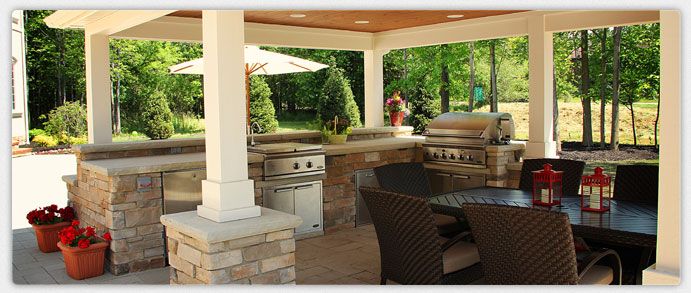
In a rainy climate, the roof is not an accessory — it is what makes the kitchen a kitchen rather than a collection of wet appliances. The options form a clear hierarchy. A solid roof structure — an extension of the house roof, a freestanding pavilion, or a properly engineered pergola with a solid top — gives true all-weather cooking: rain protection, a surface for lighting and heaters, and a defined outdoor room. Expect $8,000–$25,000 for a quality attached or freestanding solid roof over a kitchen zone, permitted and engineered for local snow and wind loads.
A louvered pergola roof ($10,000–$25,000 installed for the kitchen zone) offers the compromise: open the louvers for sun and airflow, close them for rain. Quality matters enormously here — cheap louvered systems leak at the seams and rattle in wind, while engineered systems with integrated gutters handle real rain. Even the best louvered roof is not a solid roof in a sideways downpour, so pair it with generous overhangs. Retractable awnings ($3,000–$8,000) suit the cook zone in milder rain regions but struggle with wind-driven rain and need to retract in storms — fine for Seattle, risky for the Gulf Coast.
Whatever the roof, gutters and downspouts are not optional. A roof without gutters concentrates its entire catchment into a waterfall at the drip edge — directly onto the cook, the countertops, or the patio edge where it erodes the base. Size gutters for the local deluge rate, not the average, and route downspouts away from the kitchen's foundation and the patio sub-base. In heavy-rain regions, consider oversized 6-inch gutters; the incremental cost is small and the capacity difference is large.
Drainage: The System Most Plans Forget
Every outdoor kitchen plan shows the island, the grill, the bar seating. Almost none show where the water goes — and in a rainy climate, drainage is a system to design, not a hope. Start with grading: the patio and all surrounding grade must slope away from the house and the kitchen at a minimum of 1–2% (roughly 1/8 to 1/4 inch per foot). Water that ponds against the island base wicks into the structure; water that ponds on the patio breeds mosquitoes and algae.
Next, surface drainage. Slot drains or channel drains ($25–$60 per linear foot installed) across the patio's low edge, at the base of the roof drip line, and anywhere water sheets across the surface intercept flow before it ponds. In deluge regions, size for the cloudburst — a drain that handles Portland drizzle will be decorative in a Houston thunderstorm. Tie drains into a proper outlet: daylight, a dry well, or the storm system where permitted. A drain that terminates in a soggy corner of the yard is a drain that backs up.
Then the hidden water: the island interior, storage cabinets, and appliance cavities. Rain finds every gap in an island — around the grill cutout, under the countertop overhang, through ventilation gaps. Design weep paths so water that gets in can get out: slight slopes on horizontal surfaces inside the island, weep holes at the base, and never seal the bottom of an island cavity watertight without a drain path, or you have built a bathtub. Stainless storage should be marine-grade or 304 with drainage; anything that holds water will hold rust eventually.
Materials That Survive Chronic Moisture
Material selection in a rainy climate is a durability decision first and an aesthetic decision second. The winners share traits: non-porous or properly sealed, dimensionally stable when wet, and resistant to the biological growth that chronic moisture invites.
- Island structure: steel-framed or concrete-block islands beat wood framing in wet climates — no rot, no swelling, no termite invitation. If wood framing is used, it must be pressure-treated, fully flashed, and detailed so no wood sits in standing water.
- Countertops: sealed granite, quartzite, porcelain slabs, and sealed concrete all perform well. Avoid porous unsealed stone and butcher-block-style wood tops in the rain zone; they stain, swell, and host mildew. Reseal natural stone on schedule — in the Northwest, annually is not excessive.
- Cabinetry and storage: marine-grade polymer, stainless steel (304 minimum, 316 near salt air), or properly sealed teak. Standard “outdoor” cabinets with particle-board cores delaminate in chronic moisture within a few seasons.
- Flooring: textured porcelain pavers, natural stone with a non-slip finish, or properly drained concrete. Wet-surface slip resistance is a safety spec, not a preference — polished stone plus rain plus bare feet is an injury waiting for a guest.
- Fabrics and seating: solution-dyed acrylic (the marine-fabric standard) over quick-dry foam, with storage for cushions during the wettest months. Even the best outdoor fabric lasts longer with a break from constant saturation.
Budget 15–25% more for rain-appropriate materials versus a dry-climate build — stainless and polymer storage, sealed stone, and proper flashing cost more than their fair-weather equivalents. Costs are 2026 US market ranges; get itemized local quotes. The premium pays back in the maintenance it prevents.
Appliances and Electrical in Wet Conditions
Rain changes the appliance conversation from performance to protection. Every appliance in the rain zone needs its weather story: the grill needs a quality fitted cover used religiously ($80–$250) because a grill left open in the Northwest winter becomes a rust and rodent habitat. Refrigeration must be genuinely outdoor-rated — indoor fridges moved outside fail fast in moisture, and their electrical safety margins assume dry conditions. Electronics — TVs, audio, heaters with controls — need weather-rated housings or placement fully under the solid roof, never in the drip zone.
Electrical demands extra discipline in rainy climates. All receptacles need GFCI protection and in-use weatherproof covers — non-negotiable everywhere, but inspected with particular seriousness where rain is constant. Conduit connections and boxes must be truly weathertight; chronic moisture finds the one poorly sealed fitting and corrodes it over seasons. Have a licensed electrician verify the installation, and re-check covers and seals annually — UV and temperature cycling degrade gaskets faster than owners expect.
Gas lines deserve a mention: buried gas lines in saturated soil need proper corrosion protection and bedding, and above-ground connections should be sheltered from direct rain where possible. A licensed plumber or gas fitter handles this as routine, but only if the wet-soil condition is on the plans — mention the drainage reality explicitly rather than assuming the trades will notice. Standing water around a gas connection is a corrosion accelerator; the fix is grading and drainage, designed before the line goes in.
Fighting Mold, Mildew, Moss, and Pests
In the Pacific Northwest, the maintenance battle is biological: moss on north-facing stone, mildew in every shaded crevice, algae slicking the patio. In the Southeast, add palmetto bugs, mosquitoes breeding in any standing water, and the general enthusiasm of subtropical decay. The design either helps with this fight or joins the other side.
Sunlight and airflow are the free weapons. Orient the kitchen to get morning sun on wet surfaces where the site allows — surfaces that dry daily resist growth far better than perpetually damp ones. Do not trap moisture: leave ventilation gaps in island construction, avoid fully enclosing the undersides of counters, and keep plantings cut back from the structure so air circulates. Where shade is unavoidable, choose materials with mildew-resistant finishes and plan for periodic cleaning — a pressure washer on low setting or a oxygen-bleach wash, never harsh chemicals near food surfaces.
Pest detailing is unglamorous and essential. Seal every island penetration — gas, water, electrical, drain — with proper escutcheons and sealant, because a warm island with food residue is prime rodent and insect real estate. Store all food, including grill pellets and charcoal, in sealed containers; never in the island. Empty grease systems completely and often — rancid grease in a damp climate is a pest magnet of the first order. And eliminate every saucer, cup, and low spot that holds water for more than a day; in mosquito country, the kitchen's drainage design is also its mosquito control plan.
The Rainy-Climate Build Sequence and Budget
Sequencing matters more in wet regions because water punishes open construction. The right order: permits and stormwater approvals first; then grading and drainage infrastructure (drains, dry wells, grading) before any structure goes up; then the roof structure, so subsequent work happens under cover; then utilities in their trenches; then the island, patio surface, and finishes. Building the island before the drainage is how you get a beautiful kitchen sitting in a pond every October.
Budget realistically. A rain-ready outdoor kitchen in 2026 typically runs $45,000–$110,000 for a well-equipped build — roughly 20–35% above the equivalent dry-climate kitchen — with the premium concentrated in the roof structure ($8,000–$25,000), drainage infrastructure ($3,000–$10,000 depending on site conditions), upgraded materials, and proper electrical. The line items people most often under-budget: gutters and downspouts sized for deluge, the spare conduit in the trench, and the fitted covers for every appliance.
Finally, write the maintenance calendar before the contractors leave. Twice a year: clean gutters and drains, inspect and reseal stone, check electrical covers and seals, deep-clean the grill and grease systems. Annually: service the roof (louvered systems need their mechanisms checked), inspect flashing and caulk lines, and walk the drainage in real rain to confirm water still goes where the plan says. A rainy-climate kitchen is not a higher-maintenance luxury — it is a well-designed system with a short, predictable care routine. Build the roof, the drainage, and the materials for the rain you actually get, and the kitchen will be the room you use most, ten months a year.
Frequently asked questions
Absolutely — the Pacific Northwest is one of the best regions for outdoor kitchens once the design respects the rain. The formula is a solid roof structure, steel or block island construction, sealed non-porous surfaces, real drainage, and fitted appliance covers. Owners who build rain-first report using their kitchens ten months a year; owners who build for the brochure climate fight mold and rust constantly.
A solid roof — an extension of the house roof or an engineered freestanding pavilion ($8,000–$25,000) — gives true all-weather cooking with mounting for lights and heaters. Louvered pergola roofs ($10,000–$25,000) are a good compromise in moderate rain but struggle with wind-driven downpours. Retractable awnings suit mild drizzle regions but must retract in storms. Whichever you choose, include gutters sized for local deluge rates.
Design it as a system: grade the patio and surrounding soil to slope away from the house and kitchen at 1–2%, install channel or slot drains at the patio's low edge and under the roof drip line, and tie them to daylight, a dry well, or the storm system where permitted. Inside the island, provide weep paths so water that gets in can get out — never seal an island cavity watertight without drainage.
Steel-frame or concrete-block island structures, sealed granite, quartzite, porcelain, or sealed concrete countertops, marine-grade polymer or 304 stainless storage, textured porcelain or stone flooring with wet slip resistance, and solution-dyed acrylic fabrics over quick-dry foam. Avoid wood framing in contact with moisture, porous unsealed stone, and any cabinetry with particle-board cores.
Expect roughly 20–35% above an equivalent dry-climate build — typically $45,000–$110,000 for a well-equipped kitchen in 2026. The premium concentrates in the roof structure, drainage infrastructure ($3,000–$10,000), upgraded moisture-proof materials, and proper weatherproof electrical. Costs are 2026 US market ranges; get itemized local quotes.
Maximize sun and airflow around the structure, choose mildew-resistant finishes, and clean shaded surfaces periodically. Seal every island penetration for utilities, store all food and fuel in sealed containers, empty grease systems often, and eliminate any spot that holds standing water for more than a day — in mosquito country, drainage design doubles as pest control.