Pneumatic Vacuum Elevator vs Hydraulic: Which Home Lift Wins? (2026)
Key takeaways
- Vacuum elevators lift the cab with air pressure — no pit, no shaft, no machine room — while hydraulic elevators push a piston with pressurized fluid and require both.
- Installation is the biggest practical difference: a vacuum unit typically goes in within days with minimal structural work, while a hydraulic install is a weeks-long construction project.
- Hydraulic systems carry roughly twice the weight of a vacuum cab (around 1,000 lbs versus 450 lbs) and ride faster and quieter, which matters for multi-floor or wheelchair-with-attendant use.
- Pneumatic vacuum elevator vs hydraulic maintenance costs diverge too: vacuum units need seal and turbine attention from a single specialist supplier, while hydraulic systems need regular fluid service but have a deeper national service network.
- Buy for your constraints: choose vacuum for a tight retrofit with minimal construction, hydraulic for heavier loads, higher floors, or the smoothest long-term ride.
Pneumatic vacuum elevator vs hydraulic comes down to one trade-off: the vacuum unit is the easiest home elevator to install, with no pit, no shaft and no machine room, while the hydraulic unit costs more and demands real construction but carries heavier loads, rides faster and quieter, and lasts longer under daily use.
Both are legitimate residential lift technologies — not gimmicks. Vacuum (pneumatic) elevators are purpose-built for homes and use air-pressure differentials to lift a cab inside a self-supporting transparent tube. Hydraulic home elevators use a decades-old commercial technology — an electric pump pushing hydraulic fluid into a piston — adapted for residential footprints. Because neither requires you to know the engineering before you buy, this guide compares them on the factors that actually decide the purchase: installation disruption, space demands, capacity, ride quality, safety, running costs, and long-term serviceability.
How a Pneumatic Vacuum Elevator Works
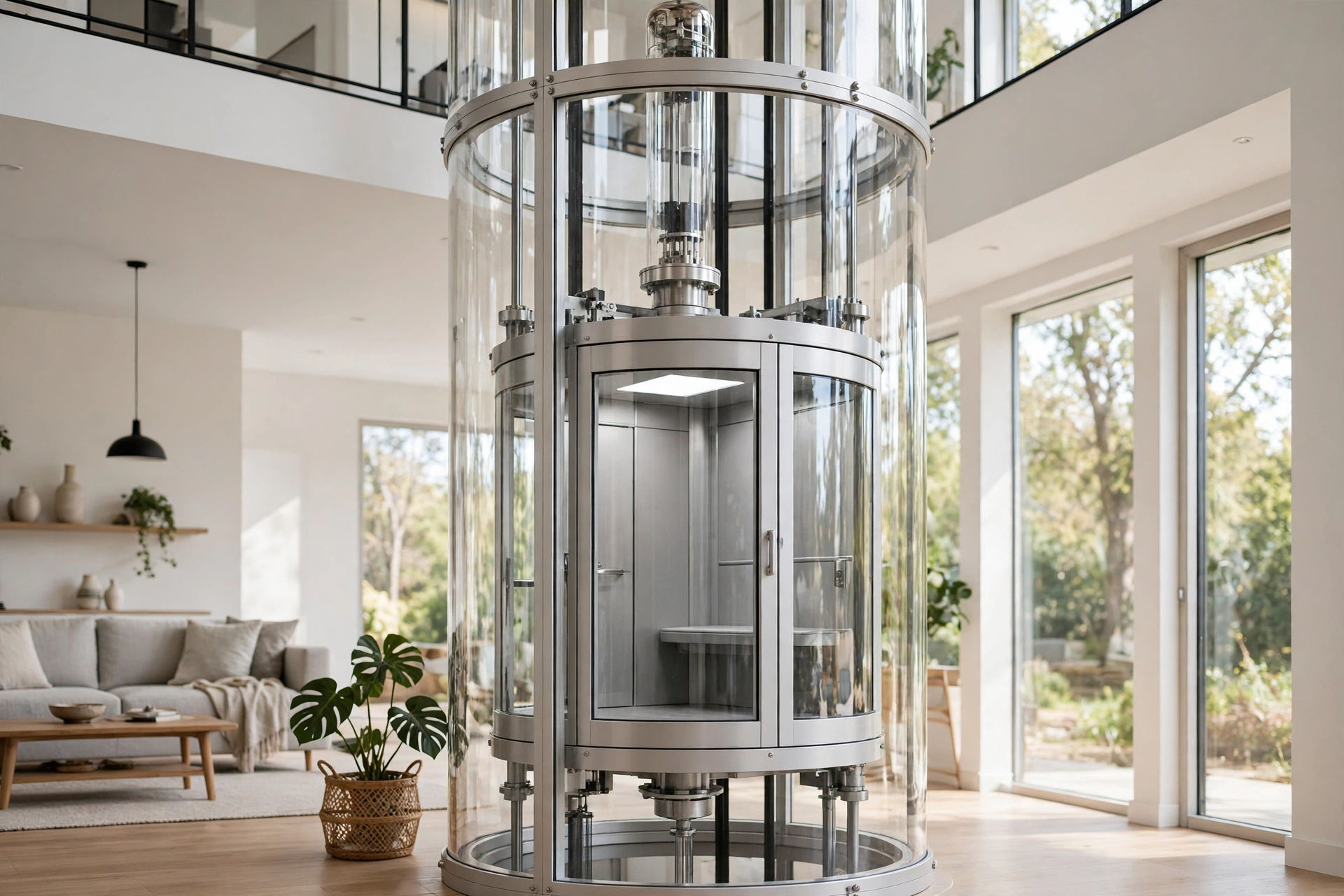
A pneumatic vacuum elevator is elegantly simple. The cab sits inside a sealed, self-supporting cylindrical shaft, usually polycarbonate and aluminum. A turbine unit on top of the shaft evacuates air above the cab, and the resulting pressure differential lifts it — air pressure literally pushes from below while the vacuum pulls from above. To descend, valves bleed air back in and the cab glides down on gravity alone, which is why the descent is nearly silent and uses very little electricity.
Because the entire system is contained in the tube, there is no machinery to hide elsewhere in the house. The turbine mounts on the shaft itself, and the only electrical requirement is typically a dedicated 220–240V circuit. Most residential vacuum units serve two to four stops, top out around 450 to 525 pounds of capacity (one or two adults), and travel at roughly half the speed of a conventional elevator. The panoramic glass tube is a design feature in its own right — many owners choose vacuum lifts partly because the cab becomes a sculptural element in the home.
CallToU Caregiver Pager with 2 Wireless Call Button for Elderly at Home

#1 Best Seller in Pagers; in-cab emergency call system — riders trapped between floors need a way to summon help
*Affiliate Disclosure: As an Amazon Associate, Elevate Home earns from qualifying purchases. Pricing and availability subject to change.
How a Hydraulic Home Elevator Works
A hydraulic home elevator is the technology behind most low-rise commercial elevators, shrunk to residential scale. An electric pump pressurizes hydraulic fluid into a cylinder, the piston pushes the cab upward, and on descent the valve releases fluid back to the reservoir so the cab lowers on gravity. The drive machinery lives in a dedicated machine room or machine closet, and the piston and guides sit in a pit beneath the lowest landing — typically requiring 6 to 12 inches of excavation plus a fully framed shaft.
Hydraulics reward that infrastructure with capability. Typical residential hydraulic units carry 750 to 1,000-plus pounds, serve up to five or six stops, and travel roughly twice as fast as a vacuum cab. The ride is exceptionally smooth and quiet because the piston drive has no cables, counterweights or gears hunting for position. With proper maintenance, hydraulic systems routinely deliver decades of service, and the technology is so established that almost any elevator service company can work on them.
Pneumatic Vacuum Elevator vs Hydraulic: Head-to-Head Comparison
The table below summarizes the differences that matter to a homeowner choosing between the two drive systems.
Installation and Construction: Where the Decision Is Usually Made
Most buyers do not choose a drive system in the abstract — they choose whatever fits the house they already live in. A pneumatic vacuum elevator is the retrofit champion: the self-supporting tube needs no pit, no machine room and no framed shaft, so installers can place it in a corner, beside a staircase or in the middle of a living space, cut one through-floor opening verified by a structural engineer, and have the unit running in days. Homes on slab foundations with no basement, where excavation is expensive or impossible, are the classic vacuum-elevator case.
A hydraulic elevator is a small construction project. The pit must be excavated and waterproofed, the shaft framed to code, and a machine room or closet built for the pump and controller. Expect general contractors, electricians and elevator mechanics coordinating over several weeks, plus fuller permit and inspection involvement. That disruption is real — but it buys you a lift that is indistinguishable from a commercial elevator in ride quality and that adds permanent, code-compliant infrastructure to the home. If you are already renovating or building, folding a hydraulic shaft into the construction is far cheaper than retrofitting it later.
Capacity, Speed and Ride Quality for Daily Living
For two adults riding between two floors a few times a day, the differences are mostly academic — both systems are safe, smooth and quiet enough for a residence. The gaps open under heavier or more frequent use.
Capacity is the hard ceiling. A vacuum cab topping out near 450 to 525 pounds accommodates one or two adults but not a power wheelchair with an attendant, a stretcher, or serious cargo. If anyone in the household uses a wheelchair, verify the specific cab interior dimensions and rated capacity before committing — this single factor disqualifies vacuum units for many aging-in-place buyers. Hydraulic units, rated to roughly 750 to 1,000 pounds or more, handle a wheelchair plus attendant comfortably.
Speed matters on multi-stop runs. At roughly half a foot per second, a vacuum elevator takes noticeably longer to climb three or four floors; hydraulic units at one to two feet per second make the same trip in roughly half the time. For a two-stop house the difference is a few seconds per ride. For a four-stop house with an elderly rider who tires easily, the slower ride plus the time spent waiting for doors becomes part of daily life.
Ride quality slightly favors hydraulics: piston drives are famously smooth and quiet in both directions. Vacuum units ride well too, though the turbine hum on ascent is audible and some riders notice the slower, more gradual motion. Neither produces anything like the clatter of an old freight elevator — the comparison is between good and excellent.
Safety Systems and Code Compliance
Both technologies are engineered to modern safety standards and require permits and inspection like any elevator installation — residential elevators in the US are governed by ASME A17.1/CSA B44 safety codes, with local authorities enforcing the details. Do not buy a lift that your installer will not permit; an unpermitted installation can void insurance and kill a resale.
The failure-mode stories differ, and both are worth understanding. A pneumatic vacuum elevator has a passive safety advantage: if power fails mid-ride, the pressure differential itself brings the cab down to the nearest landing without electricity — there is no free-fall risk because the cab cannot drop faster than air can bleed back into the tube. Hydraulic elevators rely on active safety systems: emergency lowering valves, backup power for controls, and door interlocks that must work correctly. A hydraulic fluid leak, while uncommon in maintained systems, is a mess in a machine room and an environmental concern the vacuum unit simply does not have.
One practical safety accessory every home-elevator buyer should budget for is a way to summon help from inside the cab. Elevator phones and wired intercoms are standard on commercial installs, but many residential cabs ship without one — a trapped rider who cannot be heard from another room is a genuine risk, particularly for seniors living alone. A wireless call-button system mounted inside the cab gives the rider a direct alert to a caregiver elsewhere in the house.
Running Costs, Maintenance and Long-Term Serviceability
Annual maintenance is the cost most buyers underestimate. Vacuum elevators need surprisingly little routine work — the main consumables are door seals and turbine filters — but almost all parts are single-source. When a seal needs replacing in year eight, you are calling the manufacturer or one of a handful of certified specialists, and downtime depends on their supply chain. That vendor dependence is the hidden cost of the vacuum's simplicity.
Hydraulic elevators need more scheduled maintenance — fluid level checks, fluid and filter replacement on a service interval, seal inspections, pit checks for water intrusion — and annual service bills run higher. The compensation is a deep service market: nearly any elevator company in your metro area can quote maintenance on a hydraulic residential unit, parts are standardized, and you are never hostage to one supplier's calendar. For owners planning decades in the home, that matters as much as the service price itself. Our separate breakdown of annual home elevator maintenance costs walks through the line items for both drive types.
Energy costs are minor for both — a few dollars a month at typical US residential rates — but the physics is worth noting: the vacuum elevator's gravity descent means it only spends serious electricity going up, while the hydraulic pump runs on every ascent and idles in standby. Neither will move your electric bill in a way you notice.
Which Home Elevator Should You Choose? The Verdict
Choose the pneumatic vacuum elevator when the house constrains the project: a slab foundation with no basement, no room for a machine room, no appetite for weeks of construction, or a need to be riding within days rather than months. It is also the pick when aesthetics matter — the transparent tube is genuinely beautiful — and when the riders are mobile adults who need two stops, not a wheelchair plus attendant.
Choose the hydraulic elevator when capacity and longevity are the brief: a wheelchair user who needs attendant space, three or more floors with frequent daily rides, a new build or gut renovation where the shaft costs little to add, or an owner who wants the deepest service market and the smoothest ride money can buy in a residence. It is the conservative, proven choice — the same technology office buildings have run for decades.
And if the comparison has you questioning whether a full elevator is needed at all, compare the whole category first: our home elevator vs stairlift cost guide and stairlift versus home elevator breakdown cover the cases where a stair lift solves the same aging-in-place problem for far less. If you are leaning toward a vacuum system specifically, start with our pneumatic vacuum elevator guide and the residential home elevator cost guide to sanity-check the numbers before you take dealer quotes.
Frequently asked questions
Which is better, a pneumatic vacuum elevator or a hydraulic home elevator?
Neither is universally better — they solve different problems. A pneumatic vacuum elevator is better for retrofits: no pit, no shaft, no machine room, and installation in days. A hydraulic elevator is better for capacity and longevity: roughly twice the weight rating, faster and quieter rides, and a deep national service network. Choose vacuum for a tight retrofit; choose hydraulic for heavier loads, more floors, or wheelchair-with-attendant use.
Is a vacuum elevator cheaper than a hydraulic elevator?
Typically yes, because installation — not the machine itself — is where the money goes. A vacuum unit avoids excavation, a machine room and a framed shaft, so the total installed cost usually lands well below a hydraulic install. The trade-off is lower capacity and slower travel, so compare total cost of ownership, not just the sticker price.
Do vacuum elevators need a pit or machine room?
No. The self-supporting transparent tube sits directly on the existing floor, and the turbine unit mounts on top of the shaft. You still need a through-floor opening with structural framing verified by an engineer, a dedicated 220–240V circuit, and headroom clearance at the top landing — but no excavation and no machine room.
Can a pneumatic vacuum elevator carry a wheelchair?
It depends on the cab size and rated capacity, which tops out around 450 to 525 pounds on most residential models — fine for a manual wheelchair alone, but usually insufficient for a power wheelchair plus an attendant. Verify the specific model's interior dimensions and weight rating before buying. Hydraulic elevators, rated to roughly 750 to 1,000 pounds or more, handle wheelchair-plus-attendant combinations comfortably.
How long do pneumatic vacuum elevators last compared to hydraulic?
Both can serve for decades with proper maintenance, but their longevity profiles differ. Hydraulic systems are mature technology with standardized parts and a deep service network, which tends to extend practical service life. Vacuum elevators have fewer wearing parts but are single-source for major components, so long-term serviceability depends on the manufacturer's continued support.
What should I put inside a home elevator cab for emergencies?
Every residential cab should have a reliable way to summon help: a wired elevator phone or intercom where the installation supports it, and a wireless call-button system mounted within reach so a trapped rider — especially a senior living alone — can alert a caregiver elsewhere in the house.
Keep reading
Air-Driven Lifts
Pneumatic Vacuum Elevators for Homes: 2026 Guide
Pneumatic vacuum elevators lift you on air — no pit, no shaft, no machine room. 2026 costs, space needs, capac…
Comparison
Home Elevator Cost vs Stairlift: 2026 Comparison Guide
Home elevator cost vs stairlift: compare 2026 US cost ranges, space needs, aesthetics, maintenance, and resale…
Mobility Pricing
Residential Home Elevator Cost: The 2026 Buyer's Guide
A residential home elevator costs $28,000 to $65,000 installed in 2026. Break down the true costs of shafts, m…

Home Elevator Ownership Costs
How Much Does a Home Elevator Cost to Maintain Per Year: 2026 Guide
A home elevator costs $300-$760 per year to maintain on a service contract. Full 2026 breakdown: contracts, in…
Interactive Tool
Aging in Place Renovation Cost Estimator 2026 Guide
Budget your aging-in-place renovation with our interactive estimator. Price accessible bathrooms, kitchens, el…
Transfer Equipment
100A vs 200A Automatic Transfer Switch
100 amp vs 200 amp transfer switch: service-entrance vs subpanel topology, when each is required, costs, and l…