Removable Mesh Pool Fences: Safety & Flexibility
Removable mesh pool fences deliver code-compliant safety with flexibility permanent fences can't. Mesh vs. permanent, gate requirements, and 2026 costs.
10 MIN READ · UPDATED 2026-09-23
Key takeaways
- Removable mesh fencing is a legitimate code-compliant safety barrier in most jurisdictions — not a compromise — and its removability means owners actually keep it up.
- The self-closing, self-latching gate is the critical component: it must close and latch from any position, every time, with the release out of small children's reach.
- Plan the full fence line on paper before coring — sleeves are permanent, and every path from the house to the water must cross the barrier.
- Mesh preserves sightlines better than any barrier except glass, at $15-$30/ft installed versus $40-$80 for aluminum and $100+ for glass.
- Verify local code, HOA rules, and permit requirements before ordering; keep the permit and compliance paperwork with your insurance records.
A permanent pool fence is forever — which is exactly the problem when your kids outgrow the toddler years, your entertaining style changes, or you simply want the backyard to feel open again. Removable mesh pool fencing gives you a legitimate safety barrier that meets code in most jurisdictions and then disappears in under an hour when the season of life changes. Installed costs typically run $15 to $30 per linear foot, putting most backyards at $1,500 to $4,500. Here is how mesh compares with permanent fencing, what safety standards actually require, and how to avoid the installation mistakes that compromise the whole point.
How Removable Mesh Fencing Works
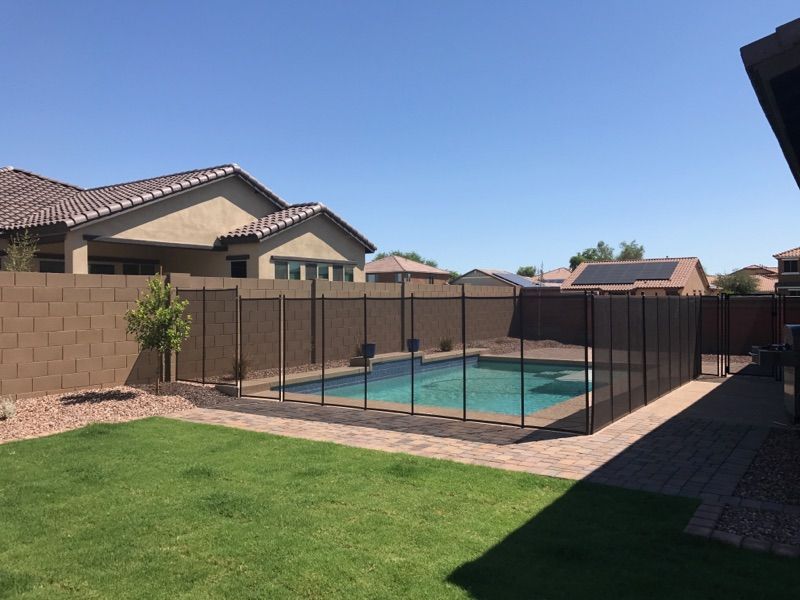
The system is elegantly simple. Small sleeves are cored into the pool deck at intervals, and fence poles drop into those sleeves. Between the poles stretches a climb-resistant mesh fabric — typically a PVC-coated polyester weave tensioned to stay taut. The sections connect to form a continuous barrier, and at least one section includes a self-closing, self-latching gate. When you want the fence gone, you lift the poles out of their sleeves, roll up the mesh sections, and cap the deck holes with flush plugs that sit level with the deck surface.
The mesh itself is engineered for the job: the weave is too fine and too flexible to offer footholds, which is what "climb-resistant" means in practice. Quality mesh is UV-stabilized to survive years of sun without becoming brittle, and the border binding and pole sleeves are reinforced because those are the stress points. Poles are usually aluminum or a fiberglass composite — strong, light, and corrosion-proof around chlorinated water and salt systems alike.
What surprises most buyers is how solid the installed fence feels. Properly tensioned, a mesh fence does not sag, flap, or feel temporary; adults lean on it comfortably. The removability lives entirely in the sleeve-and-pole connection, which is why the quality of the deck coring and the fit of the poles matters more than any other single factor. A fence that wobbles was installed badly, not designed badly.
Mesh vs. Permanent Fencing: The Honest Tradeoffs
Safety first: a properly installed mesh fence with a self-closing gate provides a legitimate barrier that satisfies pool barrier codes in the vast majority of US jurisdictions. It is not a lesser option chosen from guilt — it is a mainstream choice recommended by many pool safety organizations specifically because its removability means people actually keep it up. The best barrier is the one that stays installed, and a fence the homeowner resents is a fence that develops a permanently propped-open gate.
Against aluminum or wrought-iron fencing, mesh wins on cost (often half the price per foot), on views (the fine weave is far more transparent than pickets), and on flexibility. It loses on permanence and on the crisp architectural look — a well-designed aluminum fence is a landscape feature, while mesh is deliberately visually quiet. Against glass panel fencing, mesh wins enormously on cost and loses on the luxury aesthetic; glass is a design statement at $100-plus per foot, mesh is a practical safety decision.
The real tradeoff is psychological and social. Some buyers worry mesh "looks cheap" next to a high-end pool and landscape. In practice, quality mesh in a neutral color recedes visually in a way picket fences don't, and most guests register "there's a fence" without forming opinions about it. If your priority is an uninterrupted view of the water from the house, mesh is arguably the best choice at any price — it preserves sightlines better than every alternative except glass.
Safety Standards and the Gate That Matters Most
The fence is only as good as its gate, and this is where cheap installations fail. Pool barrier standards — driven by the International Swimming Pool and Spa Code and widely adopted local amendments — require the barrier to be at least 48 inches high in most jurisdictions (some require 60), with no gaps that would allow passage, and with a gate that is self-closing and self-latching. The latch release must be positioned where small children cannot reach it, typically 54 inches above the deck on the pool side of the gate.
Test the gate the way a determined four-year-old would: does it swing fully closed from any open position, including barely ajar? Does the latch engage every single time without a push? Can it be jiggled open? A gate that needs a nudge to latch is a gate that will stand open after a distracted adult passes through with an armful of towels. Quality mesh-fence gates use spring or magnetic closers rated for thousands of cycles; confirm the closer is adjustable so it can be tuned as the fence settles.
Beyond the fence itself, remember that the barrier is one layer of a safety system, not the whole system. Door alarms on house doors opening to the pool area, a safety cover or pool alarm, and above all active supervision form the layered protection that safety experts recommend. No fence — mesh, iron, or glass — replaces watching children around water. Frame the purchase as one layer done right, not as the complete solution.
Installation: Sleeves, Decks, and Layout
Installation day centers on coring the deck. A rotary hammer with a core bit cuts clean holes for the sleeves, which are set in an anchoring compound and must end up perfectly plumb — a sleeve that leans even slightly makes its pole lean, and a leaning pole makes the mesh pucker. Spacing is typically around three feet between poles, closer around gates and corners. On concrete and paver decks this is straightforward; on travertine or natural stone, the installer should use a wet core bit and take care not to crack the stone, and some owners choose to have spare pavers on hand.
Layout deserves more thought than it usually gets. The fence should create a complete barrier between the house and the water with no gaps at stairs, planters, or equipment areas — walk the entire perimeter and confirm every path to the water crosses the fence line. Keep the fence line a few feet back from the pool's edge so there is deck space to walk inside the barrier, and think about where furniture, the grill, and traffic flow will live. Moving a sleeve after it is set means patching the deck, so finalize the layout on paper first.
Expect a professional crew to complete a typical backyard in half a day to a full day. DIY kits exist and the work is not technically complex, but the coring is dusty, the layout is unforgiving, and gate installation rewards experience. Given that this is life-safety equipment, professional installation is worth the premium for most owners — roughly a third to half of the total project cost. Costs are 2026 US market ranges; get itemized local quotes.
Living With It: The Daily Realities
Day to day, a mesh fence is nearly invisible in the routine — you open the self-closing gate, it shuts behind you, and you stop thinking about it. The maintenance is light: hose off the mesh occasionally, check tension seasonally (quality systems have adjustable tensioning), and inspect the gate closer and latch a few times a year. In windy areas, confirm the fence line isn't taking a beating from prevailing gusts; persistent wind load loosens sleeves over time.
Removal is genuinely as easy as advertised: one adult can pull the poles and roll the sections of a typical backyard fence in 30 to 60 minutes, and reinstallation takes about the same. Most owners remove the fence for large parties, for the off-season in climates where the pool closes, or when the kids are old enough that the household decides the barrier has served its purpose. Store rolled sections somewhere dry and out of the sun — a garage wall with hooks is ideal — and keep the deck plugs in a labeled bag so they don't migrate.
One honest caveat: the deck sleeves are permanent. When the fence is removed, the flush plugs are discreet but visible on close inspection — small circles in the deck every few feet. Most owners stop noticing them within a week, but if your deck is a showpiece travertine installation, discuss sleeve placement and plug color-matching with the installer beforehand. Some installers can align sleeves with paver joints to make them nearly disappear.
HOA, Code, and Insurance Considerations
Before ordering, verify three layers of rules. First, your local building or pool code: confirm the required barrier height, gate specifications, and whether removable fencing is explicitly permitted — it is in the vast majority of jurisdictions, but a few local amendments favor permanent barriers, and you want this answer from the building department, not the fence salesperson. A permit is commonly required for pool barriers; the installer often handles it.
Second, your HOA. Some associations restrict fence types, colors, or visibility from the street. Mesh's low visual profile usually helps here, but get written approval before installation — "everyone else has one" is not approval. Third, your homeowner's insurance: most carriers simply require a compliant barrier and may offer a small premium consideration for documented safety equipment, while a non-compliant or missing barrier can complicate a claim. Keep your installation receipt, permit, and any compliance certificate together.
If you are buying a home with an existing mesh fence, inspect it like a home inspector would: pole fit in sleeves, mesh tension and UV condition, gate closer function, latch height and reliability. A neglected mesh fence with a lazy gate is worse than no fence in one specific way — it creates a false sense of security. Budget for a professional service visit or partial replacement if anything is questionable.
2026 Cost Ranges
Installed by a professional, removable mesh fencing typically runs $15 to $30 per linear foot, with most residential projects landing between $1,500 and $4,500 all-in. Self-closing gates add $300 to $700 each depending on width and hardware quality. Complex layouts with many corners, steps, or elevation changes run toward the top of the range because each demands custom fitting.
DIY kits cut the cost roughly in half — $8 to $15 per foot for materials — but remember you are installing life-safety equipment with a rented core drill, and gate installation is the part most worth paying a pro for even in an otherwise DIY project. Removal and reinstallation, if you hire it out seasonally, typically costs a few hundred dollars per visit.
Compared with $40 to $80 per foot for aluminum and $100-plus for glass, mesh is the value leader by a wide margin — and unlike the cheapest permanent options, it doesn't compromise the view or lock you into a layout forever. For families with young children, it is frequently the highest-return safety dollar in the entire backyard. Costs are 2026 US market ranges; get itemized local quotes.
Frequently asked questions
A properly installed mesh fence with a self-closing, self-latching gate meets the same barrier codes as permanent fencing in most jurisdictions. Safety organizations often recommend it specifically because owners keep it installed — a resented permanent fence with a propped-open gate protects no one.
It installs on concrete, pavers, travertine, and most stone decks by coring holes for the mounting sleeves. Natural stone needs careful wet-coring to avoid cracking. Very thin or unstable surfaces may need reinforcement — discuss your specific deck with the installer during the quote.
One adult can typically remove or reinstall a standard backyard fence in 30 to 60 minutes — lift poles from sleeves, roll the mesh sections, cap the holes with flush plugs. Most owners do it seasonally or for large events, storing rolled sections in the garage.
Most US jurisdictions require at least 48 inches, with some requiring 60 inches — confirm with your local building department, as requirements vary. The gate latch release typically must sit at least 54 inches above the deck on the pool side, out of small children's reach.
In the vast majority of US jurisdictions, yes, when properly installed with the required height and a self-closing, self-latching gate. A few local amendments favor permanent barriers, so verify with your building department before purchasing — not with the salesperson.
Quality UV-stabilized mesh typically lasts 7-12 years before the fabric shows meaningful degradation, longer in shaded installations. Border binding and stress points wear first. Budget for eventual mesh panel replacement rather than a whole new system — the sleeves and poles usually outlast the fabric.