What Size Air Purifier Do I Need? CADR vs Room Square Footage (2026)
Key takeaways
- Use the AHAM 2/3 rule: your air purifier's Smoke CADR rating must equal at least two-thirds (67%) of your room's total square footage for standard 8-foot ceilings.
- Ceiling height changes the math: rooms with 10-foot or vaulted ceilings require a 1.25x to 1.5x CADR multiplier to maintain adequate air turnover.
- Target 4.8 to 5.0 Air Changes per Hour (ACH) for allergy, asthma, and wildfire smoke relief; retail 1–2 ACH manufacturer claims are insufficient.
- Always size up 20% to 30%: running a larger unit on quiet medium speed delivers the same clean air as a smaller unit screaming at max fan speed.
To choose the right size air purifier, ignore the broad square-footage claim on the front of the retail box. Instead, calculate your required Clean Air Delivery Rate (CADR) using the AHAM 2/3 rule: your unit's Smoke CADR score must equal at least two-thirds (67%) of the room's square footage for a room with standard 8-foot ceilings. For example, a 300-square-foot master bedroom requires an air purifier with a minimum Smoke CADR of 200 CFM (Cubic Feet per Minute) to deliver 4.8 air changes per hour. If your room features 10-foot ceilings, vaulted rafters, or you suffer from acute pet allergies or asthma, multiply your baseline square footage by 1.25 to 1.5 before calculating CADR.
Retail packaging routinely advertises theoretical coverage areas based on 1 to 2 Air Changes per Hour (ACH)—meaning the unit takes 30 to 60 minutes to cycle the air volume just once. In real-world living spaces with open doors, active HVAC return drafts, and shedding pets, 2 ACH leaves microscopic dander and fine particulate matter (PM2.5) suspended in your breathing zone for hours. This engineering guide breaks down the ANSI/AHAM AC-1 testing standard, provides exact room-by-room CADR formulas, and reveals why sizing up by 25% produces a dramatically quieter and longer-lasting air cleaning system.
The ANSI/AHAM AC-1 Standard: Understanding CADR
The Association of Home Appliance Manufacturers (AHAM) establishes the authoritative testing benchmark for portable air cleaners: ANSI/AHAM AC-1. Rather than simply measuring raw fan airflow (CFM), AHAM measures the volume of filtered air free of specific particle sizes that a unit delivers per minute in a sealed test chamber.
Every certified air cleaner receives three independent CADR ratings:
- Smoke CADR (0.09 to 1.0 micron): The critical metric for wildfire smoke, tobacco, vape aerosols, and microscopic viruses. Smoke particles are the hardest to capture mechanically, making this the universal baseline for overall purifier sizing.
- Dust CADR (0.5 to 3.0 microns): Measures capture of fine household dust, pet dander, and mold spores.
- Pollen CADR (5.0 to 11.0 microns): Measures coarse botanical allergens, which are large and fall out of suspension quickly unless fan intake velocity is sufficient.
Because Smoke CADR represents the most demanding filtration threshold, engineers always size whole-room air purifiers to the Smoke rating. If a purifier clears smoke effectively, it will effortlessly capture heavier dust and pollen particles.
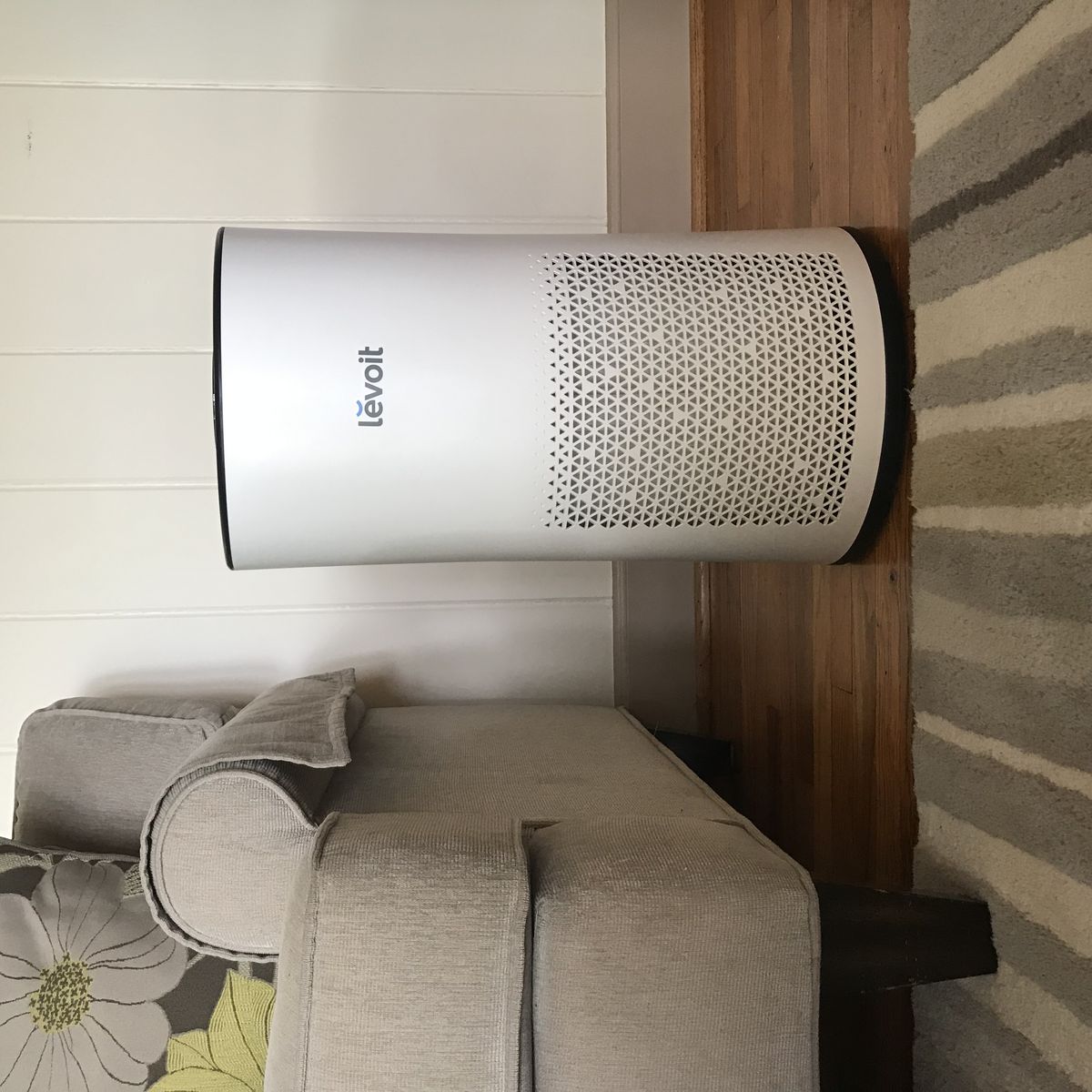
Levoit Core 300 True HEPA Air Purifier

AHAM-verified compact air purifier delivering 143 CFM CADR for bedrooms and nurseries
*Affiliate Disclosure: As an Amazon Associate, Elevate Home earns from qualifying purchases. Pricing and availability subject to change.
The CADR Sizing Formula: Step-by-Step
Calculating the exact size purifier required for any rectangular or open-concept living space takes three simple steps:
Step 1: Calculate Floor Area
Length (ft) × Width (ft) = Room Area (sq ft).
Example: 15 ft × 20 ft = 300 sq ft.
Step 2: Apply the AHAM 2/3 Rule
Room Area (sq ft) × 0.67 = Minimum Smoke CADR (CFM).
Example: 300 sq ft × 0.67 = 201 CFM Smoke CADR.
Step 3: Adjust for Ceiling Height
If ceilings exceed 8 feet, apply the height adjustment factor: (Actual Ceiling Height ÷ 8) × Baseline CADR.
Example: In a room with 10 ft ceilings: (10 ÷ 8) × 201 = 251 CFM Smoke CADR.
Air Changes per Hour (ACH): What Real Clean Air Requires
Air Changes per Hour (ACH) measures how many times the total volume of air in a room passes through the True HEPA filter media every 60 minutes. The appropriate ACH depends entirely on your health goals and environmental load:
When cross-referencing portable air cleaners with central systems, note that upgraded central filters like those detailed in our air purifier vs HVAC filter upgrade comparison cycle air only when the blower motor runs. A dedicated portable unit maintains continuous 4.8 ACH localized circulation directly in the bedroom or living space.
The Noise & Fan Speed Rule: Why You Must Size Up 20% to 30%
Here is the practical reality that manufacturer specification sheets never mention: CADR ratings are measured exclusively at maximum fan speed.
On maximum speed, typical portable air purifiers produce between 52 and 65 decibels (dBA) of aerodynamic noise—the equivalent of an electric box fan or running dishwasher sitting next to your bed. Most people cannot sleep or work with that level of acoustic fatigue, so they immediately drop the fan down to Low or Medium.
When you drop an air purifier from High to Low speed, airflow and CADR decline by 60% to 75%. A unit rated for 300 sq ft on Turbo delivers only 90 CFM on Low—turning your 4.8 ACH medical-grade clean room into an anemic 1.5 ACH space.
The Pro Sizing Move: Buy an air purifier rated for a room 20% to 30% larger than your actual square footage. A unit sized for 500 sq ft can run on whisper-quiet Medium speed (around 28 to 32 dBA) and effortlessly deliver the 200 CFM of clean air your 300 sq ft master bedroom requires, without keeping you awake at night.
Room-by-Room Sizing Matrix & Verified Hardware
For homes struggling specifically with shed fur and pet dander, review our dedicated guide to the best air purifiers for pet hair and odor, which examines how washable mesh pre-filters prevent pet hair from prematurely blinding True HEPA media.
Air Purifier Placement: Maximizing Delivery Dynamics
Even an accurately sized air purifier will fail to clear a room if choked by improper spatial placement. Observe these four mechanical placement guidelines:
- Maintain 18 to 24 Inches of Clearance: Cylindrical and rear-intake purifiers need unobstructed airflow from all sides. Jamming a unit flush against drywall or stuffing it behind an armchair cuts effective intake CFM by up to 40%.
- Avoid HVAC Supply Registers: Do not place your purifier directly underneath a central AC or furnace supply diffuser. High-velocity supply air creates a micro-plume that pushes unconditioned room air away from the purifier's intake grill.
- Orient Exhaust Toward Breathing Zones: Position the unit so filtered air sweeps toward your bed headboard or office desk, establishing a clean-air microclimate where you spend the most hours.
- Keep Windows Closed During High-Pollen and Smoke Events: If outdoor air infiltration is high, no portable purifier can outpace ambient particulate ingress. Review our operational guide on HVAC settings during wildfire smoke events for whole-structure pressure management.
The Final Sizing Verdict
When selecting your next air cleaner, verify the AHAM Smoke CADR score on the product datasheet. Multiply your room's square footage by 0.67 for standard ceilings, or by 0.85 for 10-foot ceilings, and buy a machine that meets or exceeds that number. By sizing up slightly, you guarantee continuous 4.8 ACH air purification while keeping fan acoustics quiet enough to sleep through every night.
Winix 5500-2 Air Purifier with True HEPA

A strong alternative to our top pick — compare features and reviews before you buy.
*Affiliate Disclosure: As an Amazon Associate, Elevate Home earns from qualifying purchases. Pricing and availability subject to change.
Frequently asked questions
What CADR rating do I need for a 12x12 bedroom?
A 12x12 bedroom is 144 square feet. Applying the AHAM 2/3 rule (144 × 0.67), you need a minimum Smoke CADR of 97 CFM to achieve 4.8 air changes per hour with standard 8-foot ceilings. A compact unit like the Levoit Core 300 (143 CFM CADR) easily handles this space.
Can an air purifier be too big for a room?
No, an air purifier cannot be too big mechanically. An oversized purifier simply cleans the air faster, allowing you to run it on low, whisper-quiet fan speeds while maintaining superior filtration. The only constraints to sizing up are initial equipment purchase price and physical floor footprint.
Is CADR more important than True HEPA certification?
Both are equally vital. True HEPA (H13) certifies the physical quality of the filter media (capturing 99.97% of particles down to 0.3 microns), while CADR measures the volume of air the fan motor actually pulls through that filter per minute. A True HEPA filter with an undersized, weak fan will not clean a room effectively.
How do 10-foot ceilings affect air purifier sizing?
Ceilings that are 10 feet high add 25% more cubic air volume to your room compared to standard 8-foot ceilings. To compensate and maintain 4.8 air changes per hour, multiply your baseline square footage CADR calculation by 1.25.
Keep reading
Tested Roundup
Best Air Purifiers for Pet Hair, Dander, and Odor: 2026 Tested Guide
We break down the top air purifiers for pets in 2026. Compare washable pre-filters for hair, True HEPA for mic…
Air Quality
Air Purifier vs HVAC Filter Upgrade: Guide
Air purifier vs HVAC filter upgrade compared: what each removes, real installed and operating costs, and the r…
Wildfire Smoke
HVAC Settings for Wildfire Smoke: 2026 Guide
Wildfire smoke HVAC settings: the right filter strategy, recirculation mode, and pressurization steps to prote…
Energy Calculator
Appliance Electricity Cost Calculator & Formula: How to Calculate Your Electric Bill
Calculate how much any household appliance costs to run per hour, month, or year. Learn the exact kWh formula,…
Drainage Setup
Dehumidifier Drain Hose vs. Water Tank: Continuous Drainage, Pumps, and Basements Without Drains
Drain hose or water tank? Compare continuous gravity drainage, built-in pumps, and manual buckets for basement…
Transfer Equipment
100A vs 200A Automatic Transfer Switch
100 amp vs 200 amp transfer switch: service-entrance vs subpanel topology, when each is required, costs, and l…