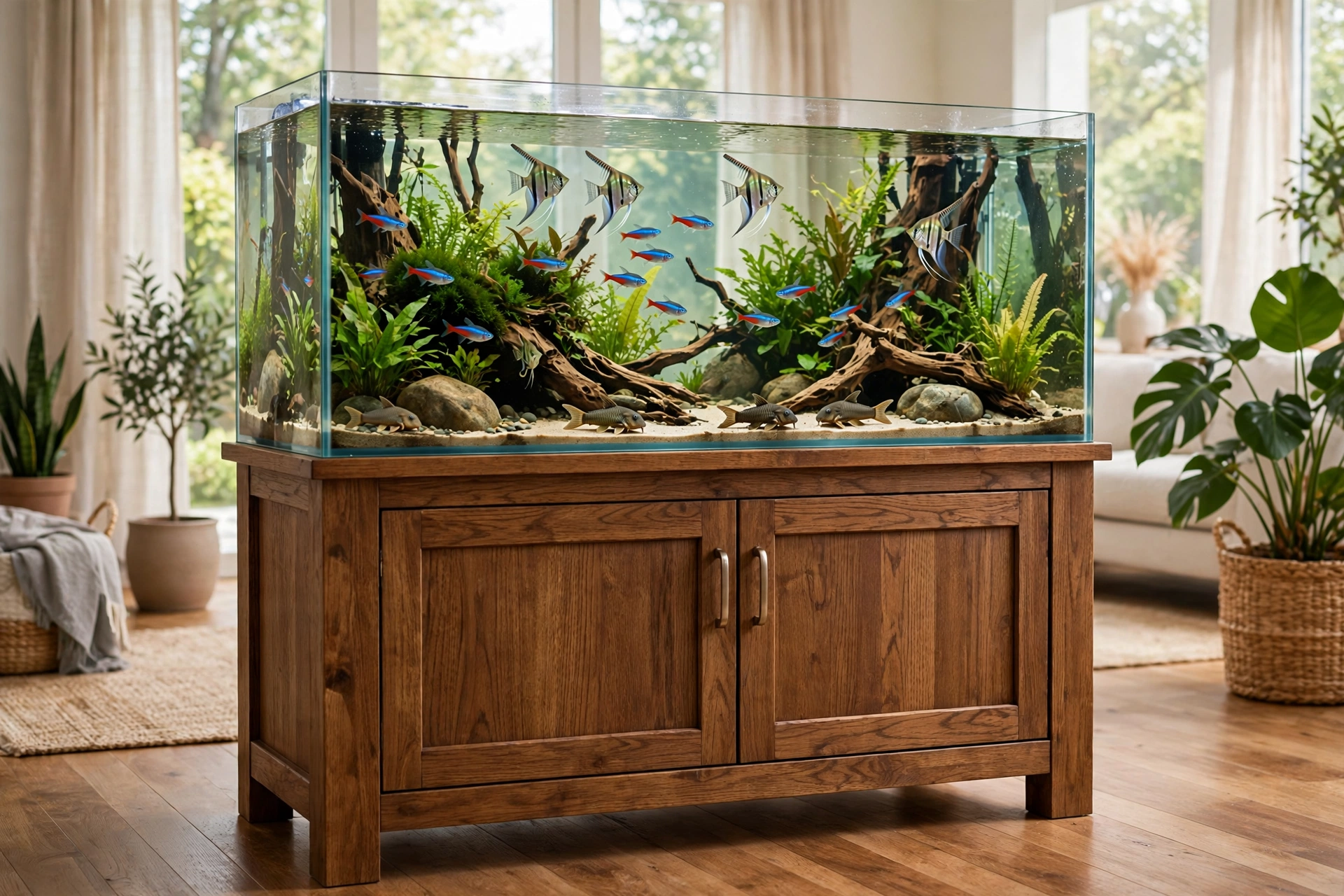
How Much Does a Large Aquarium Weigh? Floor Load Guide for Homeowners
Key takeaways
- A filled 55-gallon aquarium weighs roughly 550 to 650 pounds — water alone is about 460 lbs at 8.34 lb per US gallon.
- Living-area floors are designed for a 40-psf average live load (IRC Table R301.5), but a big tank concentrates 150+ psf over its small footprint.
- Place tanks perpendicular across multiple floor joists, near a load-bearing wall or support beam — never parallel on a single joist at mid-span.
- At 125 gallons (~1,400+ lbs) or on any upper floor, get a structural engineer's sign-off before filling; sistering joists is the standard fix.
- Protect the room too: leak sensors under the stand, a waterproof mat, and confirmed insurance coverage for sudden water damage.
A filled 55-gallon aquarium weighs roughly 550 to 650 pounds — about the weight of three grown adults standing on a four-square-foot patch of your living room floor. The water alone accounts for around 460 of those pounds (a US gallon of water weighs 8.34 pounds); the rest is glass, substrate, rockwork, and the stand. Whether that load is safe has less to do with your floor's overall strength than with where the weight sits and how it spreads — and this guide walks through the real numbers, the building-code context, and the placement rules that keep a big tank from becoming an expensive problem.
Homeowners usually underestimate aquarium weight because a tank looks like furniture. Furniture it is not. A bookshelf full of books might reach 200 pounds; a medium-large fish tank doubles or triples that over a smaller footprint. If you're planning anything 55 gallons and up, treat the setup as a structural load first and a decorating decision second.
The 10-Pound-Per-Gallon Rule (and the Real Math)
Aquarists use a rough rule of thumb: budget 10 pounds per gallon for a filled, decorated, furnished tank. It's deliberately conservative, and it's the number to use when you're sizing the load for your floor. Here's what goes into it:
- Water: 8.34 lb per US gallon at room temperature. This is the one number that never changes — 55 gallons is 459 pounds of water, full stop.
- Glass and silicone: a typical empty 55-gallon glass tank weighs around 78 pounds; the glass weight climbs faster than the volume as tanks get taller.
- Substrate and decor: 1 to 1.5 pounds of gravel or sand per gallon is standard aquascaping practice, plus rock and driftwood. Call it 50 to 100 pounds on a 55-gallon setup.
- The stand: 50 to 90 pounds for a solid wood or steel cabinet stand sized for the tank.
Add those up for a 55-gallon and you land at roughly 600 pounds — right in line with the 10-lb-per-gallon rule (550 lbs) plus a safety margin. The table below shows the same math across common tank sizes, using typical empty-glass weights and mid-range substrate and stand weights:
These are typical ranges, not manufacturer specs — glass thickness, bracing, and substrate depth vary. When in doubt, weigh or look up your specific tank's empty weight and add water at 8.34 lb/gal plus your substrate. Rounding up is the correct instinct here.
The saltwater footnote: a reef tank runs slightly heavier than freshwater — salt water weighs about 8.55 lb per gallon, and live rock is dense. Add roughly 3 percent to the water column and be generous with rock weight estimates.
Herture 55-75 Gallon Fish Tank Stand, Heavy Duty Aquarium Stand with Power Outlets

Heavy-duty 55-75 gal cabinet aquarium stand, 4.4 stars from 800+ ratings, Prime; flat full-perimeter base spreads the concentrated tank load across the floor — the exact stand style this floor-load guide recommends.
*Affiliate Disclosure: As an Amazon Associate, Elevate Home earns from qualifying purchases. Pricing and availability subject to change.
What Your Floor Is Actually Built to Hold
Here is where homeowners get tripped up. The International Residential Code (IRC) — the model code most US jurisdictions build their residential rules on — assigns the living areas of a home (rooms other than sleeping rooms and attics) a design live load of 40 pounds per square foot (Table R301.5). Bedrooms are designed to 30 psf. That is the average load the floor framing is engineered to carry across a room, on top of the dead load of the structure itself (typically around 10 psf for wood framing).
Now do the aquarium math against that 40-psf figure. A standard 55-gallon tank measures 48 by 13 inches — a footprint of about 4.3 square feet. Put 650 pounds on 4.3 square feet and the localized load is roughly 150 pounds per square foot, nearly four times the room's design average. A 125-gallon tank at ~1,465 pounds over a 6-square-foot footprint pushes past 240 psf in that spot.
That does not automatically mean the floor fails — code design loads are averages, floors have safety margins, and a load spread across several joists behaves very differently from one balanced on a single joist. But it does mean a big tank is a concentrated load, and concentrated loads are exactly what floor framing is worst at handling casually. The placement rules in the next section exist because of this mismatch.
Two structural realities matter more than the psf number:
- Joist direction decides everything. Floor joists are strong along their length and weak between them. A tank sitting parallel to a single joist loads that one member; the same tank sitting perpendicular across five or six joists distributes the weight the way the floor was designed to carry it.
- Distance from support matters. A joist carries load best near the walls or beams holding it up, and worst at mid-span. The center of a long-spanning room is the worst possible spot for a heavy tank; a spot near a load-bearing wall or over a support beam is the best.
Where to Place a Big Tank: 6 Rules That Actually Matter
1. Span joists, never ride one. Position the tank so its long side runs perpendicular to the floor joists, spreading the load across as many members as possible. If you have a basement or crawlspace, go look — the joists are visible from below, and knowing their direction takes five minutes.
2. Hug a load-bearing wall. Place the tank against an exterior wall or an interior wall that sits over a beam or foundation wall below. Load capacity is highest at the supports and lowest at mid-span, so avoid the middle of a room with a long joist span.
3. Ground floor on a slab wins. A concrete slab-on-grade has no meaningful weight limit for any home aquarium — the load transfers straight to compacted soil. If you have the choice, the ground floor over slab or the basement is always the safest answer, especially at 75 gallons and up.
4. Inspect the framing below. From the basement or crawlspace, look for notched or drilled joists (common where plumbers and electricians ran lines), water damage, rot, or insect damage. A compromised joist under a 900-pound tank is a different situation than a healthy one. While you're down there, check that the space itself is dry and sound — crawlspace moisture problems weaken wood over time and are worth addressing before adding load.
5. Use a real stand with a flat, full-perimeter base. Four spindly legs concentrate the entire load onto four small points; a cabinet stand with a flat base spreads it across the stand's whole footprint. Never put a large tank on repurposed furniture — dressers, bookshelves, and TV consoles are not engineered for hundreds of pounds of dynamic water weight. A heavy-duty cabinet stand rated for your tank size, with the load spread over its full base, is the single best purchase in this project.
6. Finalize the spot before filling. Never, ever move a filled or partially filled tank. Glass seams and silicone joints tolerate static load well and shear stress poorly — shifting a heavy tank is how tanks crack. Plan the location, set the stand, level it with shims, then fill in place.
When the Math Says "Call a Structural Engineer"
For tanks up to 75 gallons on a ground floor with good placement, most modern wood-framed homes handle the load without drama. Past that, bring in professional judgment. Specifically:
- 125 gallons and up (~1,400+ lbs): this is structural-engineering territory. An engineer can confirm joist capacity, recommend sistering joists (bolting a second joist alongside the existing ones), or specify a support post and beam in the basement or crawlspace below.
- Any large tank on an upper floor: second-story bedrooms have a lower design load (30 psf) and longer spans are common. A 55-gallon upstairs deserves a careful look; a 75-plus upstairs deserves an engineer.
- Older homes or damaged framing: if the house predates modern codes, has visibly sagging floors, or the joists show notching, rot, or insect damage, get an assessment before the tank — not after the drywall cracks.
- Warning signs after setup: new floor bounce, doors that start sticking, or drywall cracks appearing near the tank wall mean the load is telling on itself. Drain the tank down and call a professional.
The typical engineered fix — sistering the joists under the tank location or adding a support post beneath — is straightforward carpentry and far cheaper than repairing a failed floor or a 90-gallon flood. Think of it as cheap insurance.
Filling It Up: Water Weight, Spills, and Floor Protection
A 55-gallon first fill means moving roughly 460 pounds of water into the tank, usually in buckets or with a hose and pump. Most people do it in 5-gallon bucket trips — about eleven of them. Plan the route: water sloshes, buckets drip, and a trail of wet footprints across hardwood is how floors get damaged long before any structural question arises. Lay towels, use a Python-style siphon or a small transfer pump for big tanks, and fill slowly so the stand settles evenly.
That first fill also means committing 55 gallons of your household tap water to the tank all at once, so it's worth checking whether your tap water is safe for aquarium plants before you start hauling buckets — chlorine and chloramine levels, in particular, are much easier to deal with before the tank is full and cycling. If your water needs treatment, a whole-house chlorine removal setup handles it at the tap for every future water change too.
Then protect the room around the tank, because water damage is the far more common aquarium disaster:
- Water alarms. A five-dollar leak sensor under the stand and near the filter catches a slow seam leak weeks before it ruins a floor. For whole-room protection, automatic leak detection with shutoff valves on the supply line is the gold standard.
- A drip tray or waterproof mat under the stand catches the routine splashes of water changes and filter maintenance.
- Know your insurance position. Standard homeowners policies typically cover sudden water damage but exclude slow leaks and often exclude damage from "wear" — read the fine print before the tank goes in, not after. Our guide to water leak insurance claims walks through what's usually covered.
Aquarium Floor-Load Checklist
- Estimate total weight at 10 pounds per gallon (water is 8.34 lb/gal; glass, substrate, and stand make up the rest).
- Choose the ground floor or basement when possible; slab-on-grade removes the question entirely.
- Place the tank perpendicular across floor joists, near a load-bearing wall or support beam — never at mid-span on a single joist.
- Use a rated cabinet stand with a flat, full-perimeter base; never repurposed furniture.
- At 125 gallons or on any upper floor, get a structural engineer's sign-off before filling.
- Level the stand, fill in place, and never move a filled tank.
- Put leak sensors under the stand and confirm your insurance covers sudden water damage.
A big aquarium is one of the heaviest things a homeowner will ever deliberately put on a wood floor. Respect the weight, spread it across the framing the way the framing was designed to carry it, and the tank becomes a non-event structurally — leaving you free to worry about the fun parts, like aquascaping and keeping the algae in check.
Frequently asked questions
Can a 55-gallon aquarium go on the second floor?
Usually yes, with careful placement — but it deserves more caution than the same tank on a ground floor. Bedrooms are designed to a lower live load (30 psf) than living areas (40 psf), and second-floor joists often span longer distances. Place the tank perpendicular across multiple joists near a load-bearing wall, confirm the framing is sound from below if accessible, and consider a structural engineer's opinion for anything 75 gallons or larger upstairs.
How much weight per square foot is a 75-gallon fish tank?
A filled 75-gallon setup weighs roughly 850 to 950 pounds. Over a typical 48-by-18-inch footprint (6 square feet), that's about 140 to 160 pounds per square foot of localized load — roughly four times the 40-psf design live load of a living-area floor. That's why spanning multiple joists near a support wall matters far more than the room's average capacity.
Do I need to reinforce my floor for a 125-gallon aquarium?
In most cases, yes — or at least get it evaluated. A filled 125-gallon tank approaches 1,500 pounds, which is a genuine concentrated structural load. The common professional fix is sistering the floor joists beneath the tank location or adding a support post and beam in the basement or crawlspace below. An hour of a structural engineer's time is cheap compared to a failed floor or a 125-gallon flood.
Will an aquarium damage hardwood floors?
The weight itself rarely damages hardwood — the finish and the moisture do. Routine splashing during water changes, condensation on the glass, and slow drips from filter maintenance will stain and warp wood floors over time. Use a waterproof mat under the stand, wipe up spills immediately, and place leak sensors so a slow seam leak can't sit undetected for weeks.
Can I put a fish tank on a dresser or bookshelf instead of a stand?
No — not for anything over about 20 gallons. Household furniture is engineered for distributed, static loads far below aquarium weights, and tall narrow pieces concentrate the load onto small feet. A 55-gallon tank on a dresser is roughly 650 pounds on furniture rated for a fraction of that. Use a stand rated for your tank size with a flat, full-perimeter base that spreads the load.
Keep reading
Leak Protection
Leak Detection & Auto Shutoff: 2026 Guide
Compare automatic water shutoff valves vs leak sensors for 2026: how flow detection works, installed costs, in…
Protection
Water Leak Insurance Claims: Process & Pitfalls
Water leak insurance claims: what's covered, how to document damage, the denial traps to avoid, and how to neg…
Filtration
Whole-House Chlorine Removal: 2026 Guide
Whole house chlorine removal systems explained: chlorine vs chloramine, catalytic carbon sizing, costs, and wh…

Humidity
Crawlspace Encapsulation Cost: 2026 Guide
Crawlspace encapsulation cost guide 2026: what's included, cost bands by size ($5,000–$15,000), dehumidifier p…
Transfer Equipment
100A vs 200A Automatic Transfer Switch
100 amp vs 200 amp transfer switch: service-entrance vs subpanel topology, when each is required, costs, and l…
Pillar 01 · Energy Resilience
10kWh vs 13.5kWh vs 20kWh Home Battery: Which Size Is Right? (2026)
10kWh vs 13.5kWh vs 20kWh home battery compared: usable capacity, backup runtime, solar pairing, and which tie…