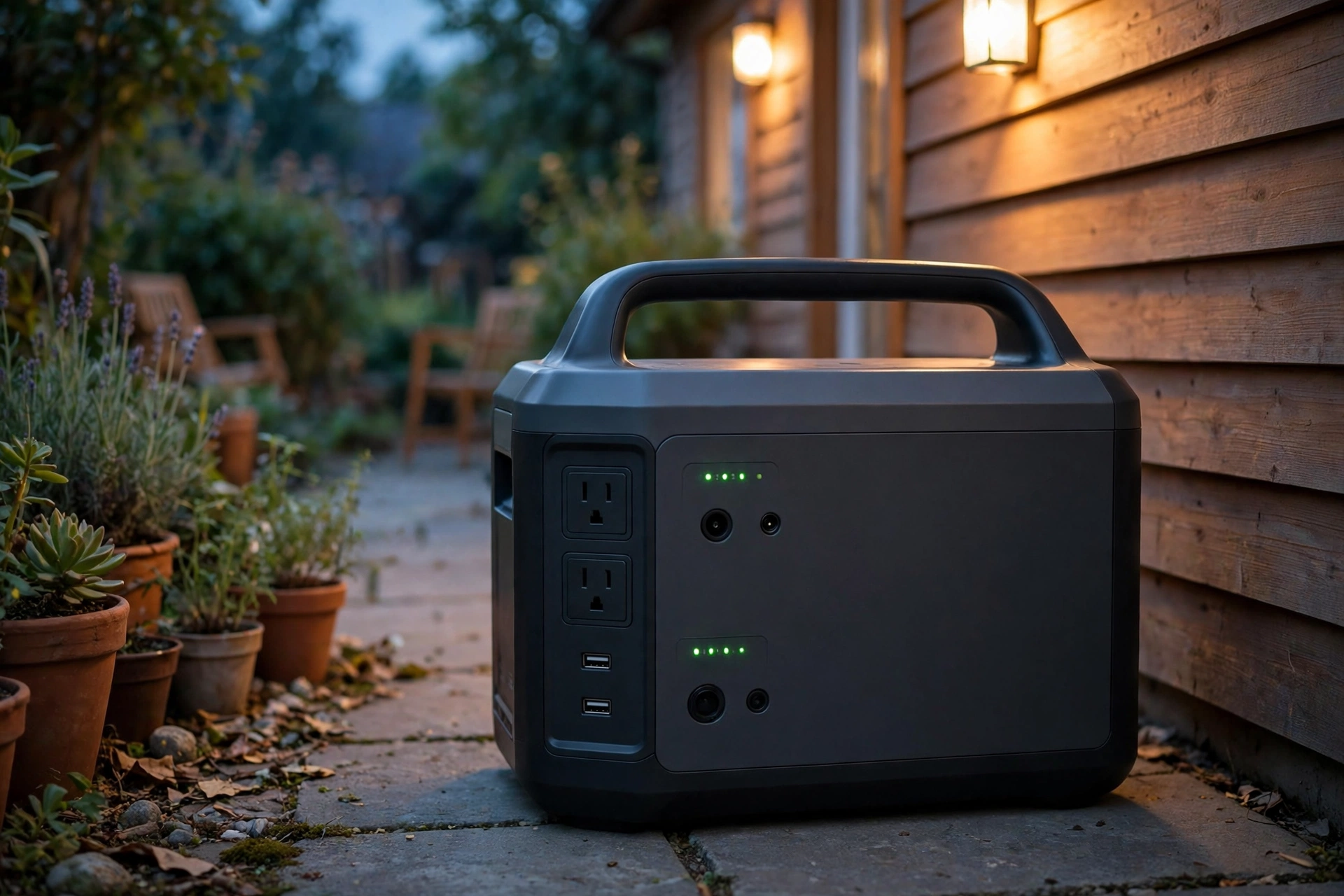
Best Portable Power Station for Home Backup: 2026 Buyer's Guide
Key takeaways
- Best overall: a 1,000Wh-class LiFePO4 station with a 1,800W+ pure sine wave inverter — enough to carry a refrigerator, router, lights, and phones through a 12–24 hour outage.
- Size for the fridge first: most full-size refrigerators draw 100–400W, so 1,000–1,500Wh covers the essentials overnight; sump pumps and window ACs need 2,000Wh or more.
- Buy lithium iron phosphate (LFP) chemistry only — 3,000–4,000 charge cycles vs. ~800 for older NMC packs, which decides whether the unit is still useful in year five.
- Fast recharge is a real backup feature: a unit that refills from empty to 80% in under an hour can top back up between storm bands or before the next outage window.
- Portable stations can't run central air, electric heat, or a well pump — if those are non-negotiable, step up to an installed home battery instead.
The best portable power station for home backup for most households in 2026 is a 1,000Wh-class LiFePO4 unit with a 1,800-watt (or better) pure sine wave inverter, expandable with an extra battery when longer outages demand it — the configuration that keeps a refrigerator, internet gear, lights, and phone charging alive through a typical overnight outage without fuel, fumes, or a pull cord. Our top pick in this configuration is the EcoFlow DELTA 3 Plus: 1,024Wh of lithium iron phosphate storage, 2,400W of AC output with X-Boost for heavy loads, a 10-millisecond UPS-grade switchover, and the option to double capacity to 2,048Wh with the Smart Extra Battery.
This guide is written for the buyer standing in front of a storm forecast — or a utility outage map — trying to decide between a portable power station, a gas generator, and an installed home battery. It covers the sizing math that actually decides runtime, the seven specifications that separate the units worth buying from the ones that disappoint, a head-to-head comparison of the four 1kWh-class units that dominate the 2026 market, and the safety and storage rules that keep the investment working for a decade. Cost framing throughout is qualitative and category-level; specific pricing changes constantly and is handled on the retailer's page.
What size portable power station do you actually need?
Almost everyone overbuys or underbuys here, because the two numbers that matter — watt-hours (how much energy the battery holds) and watts (how much power it can deliver at once) — get blurred together in marketing. The sizing question splits cleanly: watt-hours decide how long things run; watts decide which things can run at all.
Start with the load list for a realistic outage night, using the running wattages reviewers and manufacturers publish for 2026 models:
The practical takeaway: the 1,000–1,500Wh class is the sweet spot for home backup. It covers the fridge, the network, lighting, medical basics, and device charging through the 8–12 hours of a typical US outage — the EIA's recorded average is now about 11 hours per household per year — with headroom to spare. If a sump pump or window AC is on your must-run list, target 2,000Wh or more, or a unit that accepts an expansion battery. For a deeper walkthrough of the math, see how to size home battery backup.
EF ECOFLOW Portable Power Station DELTA 3 Plus 1024Wh with Extra Battery

Best-overall pick in the article's comparison table; 1kWh-class sweet spot for home backup, LFP, UPS mode — matches buyer intent exactly
*Affiliate Disclosure: As an Amazon Associate, Elevate Home earns from qualifying purchases. Pricing and availability subject to change.
The 7 specs that actually decide whether a power station is worth buying
Manufacturers bury shoppers in port counts and app screenshots. Seven specifications decide real-world satisfaction; everything else is noise.
1. Usable watt-hours, not headline watt-hours. Battery capacity ratings measure the cells, but inverter losses and the battery management system's cutoff reserve mean roughly 85% of the headline number reaches your appliances. Treat a 1,024Wh unit as ~870 usable Wh when planning.
2. Continuous AC output in watts. The inverter must exceed your largest simultaneous load. A refrigerator's compressor draws 2–3x its running wattage for a few seconds at startup — this is why a 1,800W continuous inverter (with higher surge rating) is the minimum for fridge duty, and why units with X-Boost-style resistive-load modes handle heaters and kettles that would trip weaker inverters.
3. Pure sine wave output. Non-negotiable for anything with a motor, a compressor, or sensitive electronics. Every unit worth buying in 2026 is pure sine wave; treat anything else as disqualified.
4. Battery chemistry: LFP or walk away. Lithium iron phosphate (LiFePO4/LFP) delivers 3,000–4,000 full cycles to 80% capacity — roughly a decade of regular outage use. Older NMC chemistries fade after ~800 cycles. Every 2026 top pick uses LFP; check the spec sheet, not the marketing page.
5. AC recharge speed. A unit that refills to 80% in 40–60 minutes can recover between storm bands, on a lunch-break generator run, or during a brief grid restoration. Slow-recharging units (4+ hours) leave you exposed to back-to-back outages.
6. Solar input. Recharging from the wall is fine before the storm; after landfall, solar input (typically 400–500W on 1kWh-class units, more on 2kWh+ units) is the only refill path. Pair with a 200–400W rigid or portable panel and the station becomes a multi-day asset rather than a one-night asset.
7. UPS/EPS switchover time. If the station sits between the wall and your router, NAS, or medical gear, a true UPS-grade 10–20ms switchover keeps them alive through the transition. Slower 30ms+ switchover restarts sensitive equipment. Decide this before you buy, not after the first outage reveals it.
Best portable power stations for home backup in 2026, compared
The 1kWh-class market in 2026 has consolidated around four serious contenders. All use LFP chemistry, pure sine wave inverters, and app monitoring; the differences are output power, recharge speed, expansion, and weight. Our overall recommendation is the EcoFlow DELTA 3 Plus — verified live on Amazon with a 4.6-star owner rating — for its combination of 2,400W output, 10ms UPS switchover, sub-hour recharge, and expandability.
Two buying cautions. First, model-year churn is fast in this category — confirm the exact capacity, ports, and warranty on the live retail listing before ordering, since sellers sometimes leave older-generation units in search results. Second, bundles matter: a 1kWh unit paired with its brand's extra battery usually costs less per watt-hour than jumping to the next size class, and it keeps the unit portable when you detach the pack. If you're weighing a portable station against a wall-mounted system, portable power station vs installed home battery walks through the cost and wiring tradeoffs in detail.
Portable power station vs gas generator vs installed home battery
These three answer different outage questions, and buyers who compare only on price end up with the wrong tool:
The generator's decisive disadvantage is carbon monoxide: portable generators kill through CO poisoning every storm season, and safe operation means running them outdoors, 20+ feet from the house, with a transfer switch or interlock for anything beyond extension cords. If you're comparing fuel options, read generator carbon monoxide safety and dual-fuel portable generator guide before deciding.
Real runtime math: how long will it actually run your fridge?
Marketing runtime claims assume a tiny load. Do the math yourself — it takes thirty seconds and prevents the most common disappointment:
Runtime (hours) ≈ (watt-hours × 0.85) ÷ load watts. The 0.85 accounts for inverter conversion losses and the battery management reserve.
A modern full-size refrigerator draws ~150W on average once you account for its duty cycle (it cycles the compressor roughly a third to half of the time). On a 1,024Wh station: (1,024 × 0.85) ÷ 150 ≈ 5.8 hours if the fridge ran continuously — but duty cycling stretches real-world performance to 12–18 hours, matching what storm-season testers report. Add a router (15W), a few LED bulbs (30W), and phone charging (20W) and you land in the same 12–24 hour window.
Two rules fall out of the formula. First, every watt you shave off standby loads buys runtime: unplug the TV's standby draw, dim the lights, skip the toaster. Second, heating and cooling loads dominate everything — one space heater (1,500W) drains a 1kWh station in under 40 minutes. Portable stations are for preservation (food, connectivity, medical basics), not comfort (heating, cooling). For whole-home sizing with time-of-use rate arbitrage on top, see battery time-of-use arbitrage math and expanding home battery storage.
Safe setup, storage, and solar pairing
Portable power stations are among the safest backup options precisely because there is no fuel, no exhaust, and no combustion — LFP chemistry is the most thermally stable lithium formulation in consumer use, and quality units carry UL 2743 / UL 2054 certifications plus multi-layer battery management (overcharge, over-discharge, short-circuit, and thermal protection). Still, five rules keep the investment safe and ready:
Store at 50–80% charge, not full and not empty. LFP tolerates full charges far better than NMC, but long-term storage at 100% still accelerates calendar aging; storage near 0% risks deep-discharge damage. Top up every 3–6 months.
Keep it cool and dry. Garages and utility rooms are ideal. Avoid sustained heat above ~40°C/104°F (attics, hot cars) and never charge a frozen-cold unit below 0°C/32°F until it warms — LFP charging below freezing plates lithium and permanently damages cells.
Pair solar thoughtfully. A 200–400W panel keeps a 1kWh unit topped through a sunny outage day; oversizing beyond the station's solar input rating wastes the panel, not the station. Rigid panels on a ground mount outperform briefcase panels for sustained outage use.
Use the UPS mode for what matters. If the unit offers a 10–20ms UPS mode, keep the router/modem and any medical gear on it year-round — the station doubles as surge-grade protection and is always at full charge when the outage starts.
Don't backfeed the panel. A portable station plugs into appliances via extension cords or a proper manual transfer switch — never a double-male “suicide cord” into a wall outlet. Backfeeding endangers lineworkers and is illegal in every US jurisdiction.
The verdict
For the homeowner who wants outage insurance without the noise, fumes, maintenance, and fuel logistics of a generator — and without the five-figure cost and electrician visit of an installed battery — a 1,000Wh-class portable power station is the right tool, and the EcoFlow DELTA 3 Plus is the best-executed version of it in 2026: strong output, fast recharge, genuine UPS behavior, and an expansion path to 2,048Wh when one night of capacity isn't enough. Size it for the fridge, store it at partial charge, pair it with a solar panel if your outage risk runs multi-day, and it will quietly do the job every storm season for a decade.
Frequently asked questions
How long will a 1,000Wh portable power station run my refrigerator during an outage?
A modern full-size refrigerator averaging ~150W with duty cycling typically runs 12–18 hours on a 1,000Wh-class station, based on the formula (watt-hours × 0.85) ÷ load watts. Adding a router, LED lights, and phone charging keeps you in the same 12–24 hour window. The exact number depends on the fridge's age, ambient temperature, and how often the door opens.
Can a portable power station power my whole house?
No. Portable power stations top out around 2–3kW of continuous output, which covers essentials but not central air, electric heat, electric water heating, or well pumps. If whole-house coverage is the goal, an installed home battery with a critical-loads subpanel — or a standby generator — is the right category, not a portable station.
Is a portable power station better than a gas generator for home backup?
For overnight essentials, yes: it's silent, safe to run indoors, needs no fuel storage, and requires essentially no maintenance. A gas generator wins on raw wattage and indefinite runtime (as long as fuel lasts), but it must run outdoors due to carbon monoxide risk and needs oil changes and exercise runs. Many households end up with both.
Can I recharge a portable power station with solar panels during an outage?
Yes — this is one of their biggest advantages over generators. Most 1kWh-class 2026 units accept 400–500W of solar input, so a 200–400W panel can substantially refill the unit over a sunny day. Pairing a panel turns a one-night asset into a multi-day outage tool. Check the unit's solar input voltage and wattage limits before buying panels.
What size portable power station do I need to run a CPAP machine overnight?
A CPAP drawing 30–60W needs roughly 240–480Wh for an 8-hour night including inverter losses, so even a compact 500Wh-class unit covers it with margin — though most home-backup buyers choose 1,000Wh+ so the same unit also carries the refrigerator. Turn off the heated humidifier to roughly halve the draw.
Should I buy an extra battery or just a bigger power station?
An extra battery for the same platform usually costs less per watt-hour than jumping to the next size class, and it keeps the base unit portable when you detach the pack. Buy the expansion if your outage risk includes multi-day events or a sump pump; buy the bigger standalone unit if you want one grab-and-go box with no accessories.
Keep reading
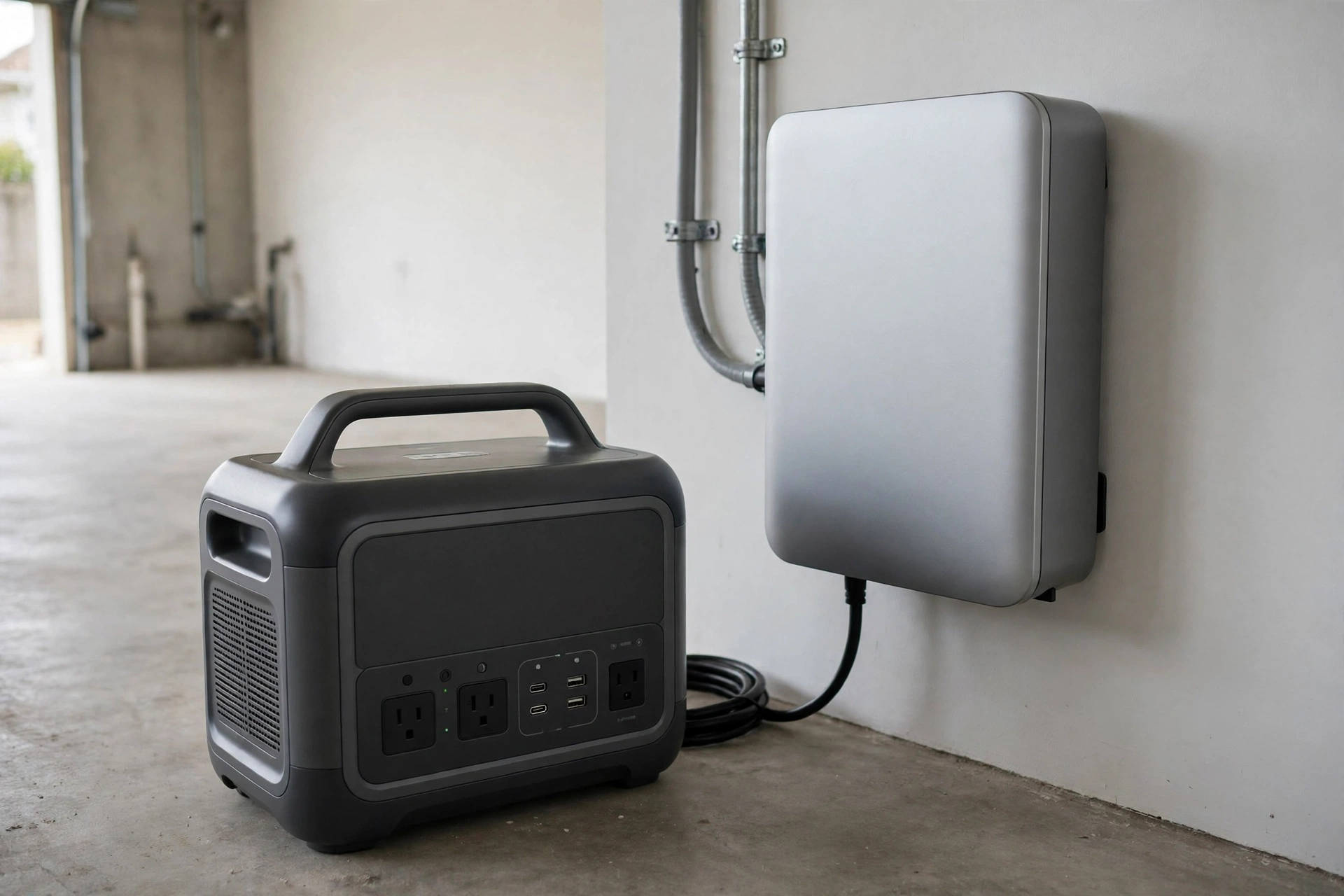
Backup Power Compared
Portable Power Station vs Installed Home Battery: Costs & Tradeoffs
Portable power station vs home battery: honest cost-per-kWh math, real runtime numbers, and when the $1,500 po…
System Sizing
How to Size a Home Battery Backup System: Partial vs Whole Home, Worked Math (2026)
Size a home battery step by step: critical loads, kWh math, surge checks, multi-day outages, and the partial v…
Battery Money
Battery Time-of-Use Arbitrage: The Real Math
Home battery time of use arbitrage savings, worked honestly: real 2026 TOU spreads, efficiency losses, cycle-l…
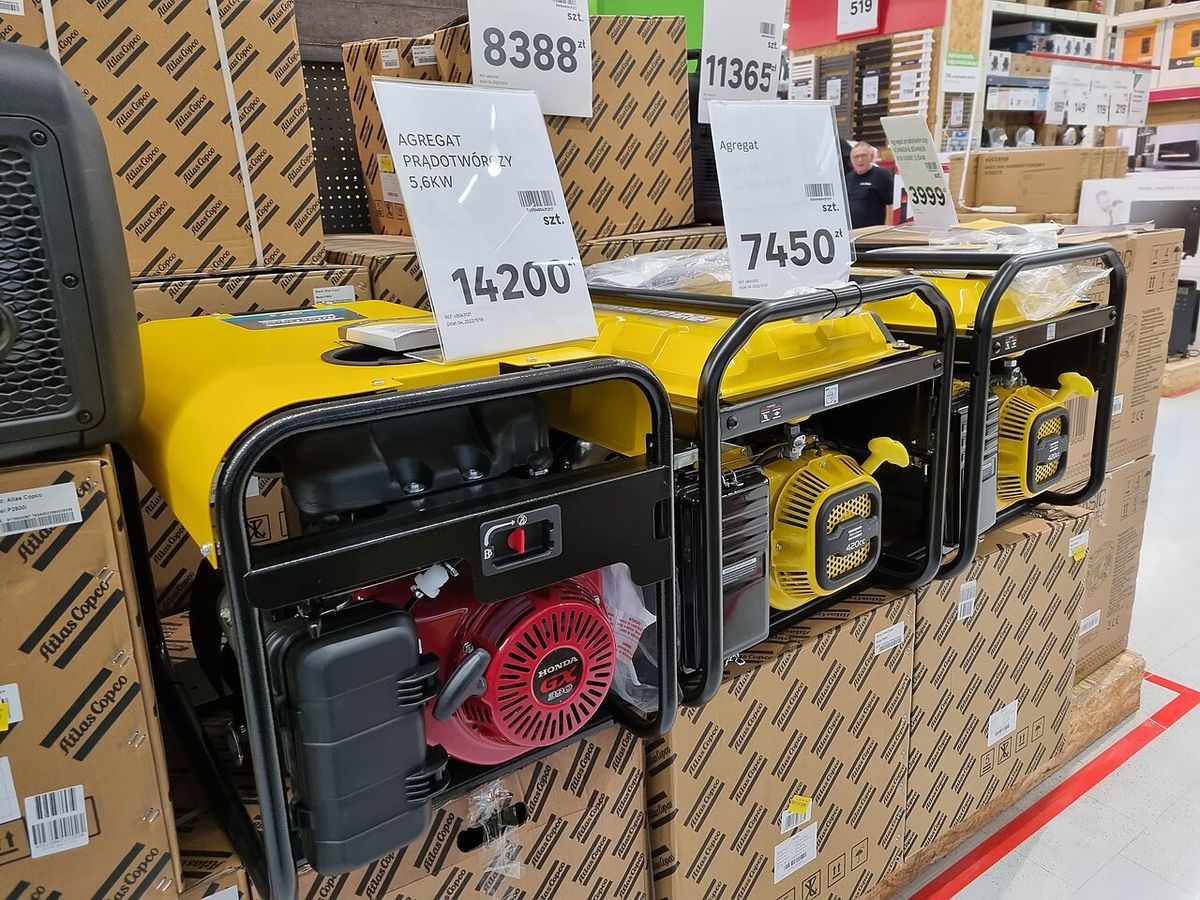
Generator Safety
Generator Carbon Monoxide Safety Guide
Generator carbon monoxide safety: the 20-foot placement rule, exhaust direction, CO detector placement, and th…
Expansion
Adding a Second Home Battery: 2026 Guide
Adding a second home battery in 2026: modular vs add-a-box expansion, inverter headroom, rewiring, permits, an…
Interactive Tool
Home Battery Size Calculator: What Size Do You Need?
How many kWh of battery storage do you need? Our free home battery size calculator estimates your backup need,…