Portable Power Station vs Installed Home Battery: Costs & Tradeoffs
Portable power station vs home battery: honest cost-per-kWh math, real runtime numbers, and when the $1,500 portable beats the $15,000 installed system.
10 MIN READ · UPDATED 2026-09-22
Key takeaways
- Cost per kWh of storage is surprisingly similar ($600-$1,300); the installed premium buys automation, inverter capacity, and solar integration.
- Portables cover 4-24 hour outages for plug-in loads; installed batteries cover multi-day outages for whole circuits and refill daily from solar.
- Portable wins for renters, reliable grids, sub-$5,000 budgets, and as a bridge purchase before a future installed system.
- Installed is mandatory for hardwired critical loads: sump pumps, well pumps, furnace blowers, medical devices, and security systems.
- Match the tool to your actual outage history, not outage anxiety; the hybrid approach (portable now, installed later) suits many households.
When the power goes out, you have two philosophies to choose from: a portable power station you wheel out of the closet, or a battery bolted to your wall that takes over automatically. The portable route costs $1,000 to $4,000; the installed route costs $12,000 to $28,000. But cost per kilowatt-hour tells a more complicated story than the sticker prices suggest, and for some households the cheap option is genuinely the smarter buy. This head-to-head compares the two on cost per kWh, real runtime, convenience, and the specific situations where portable wins outright.
The Core Difference: Appliance vs Infrastructure
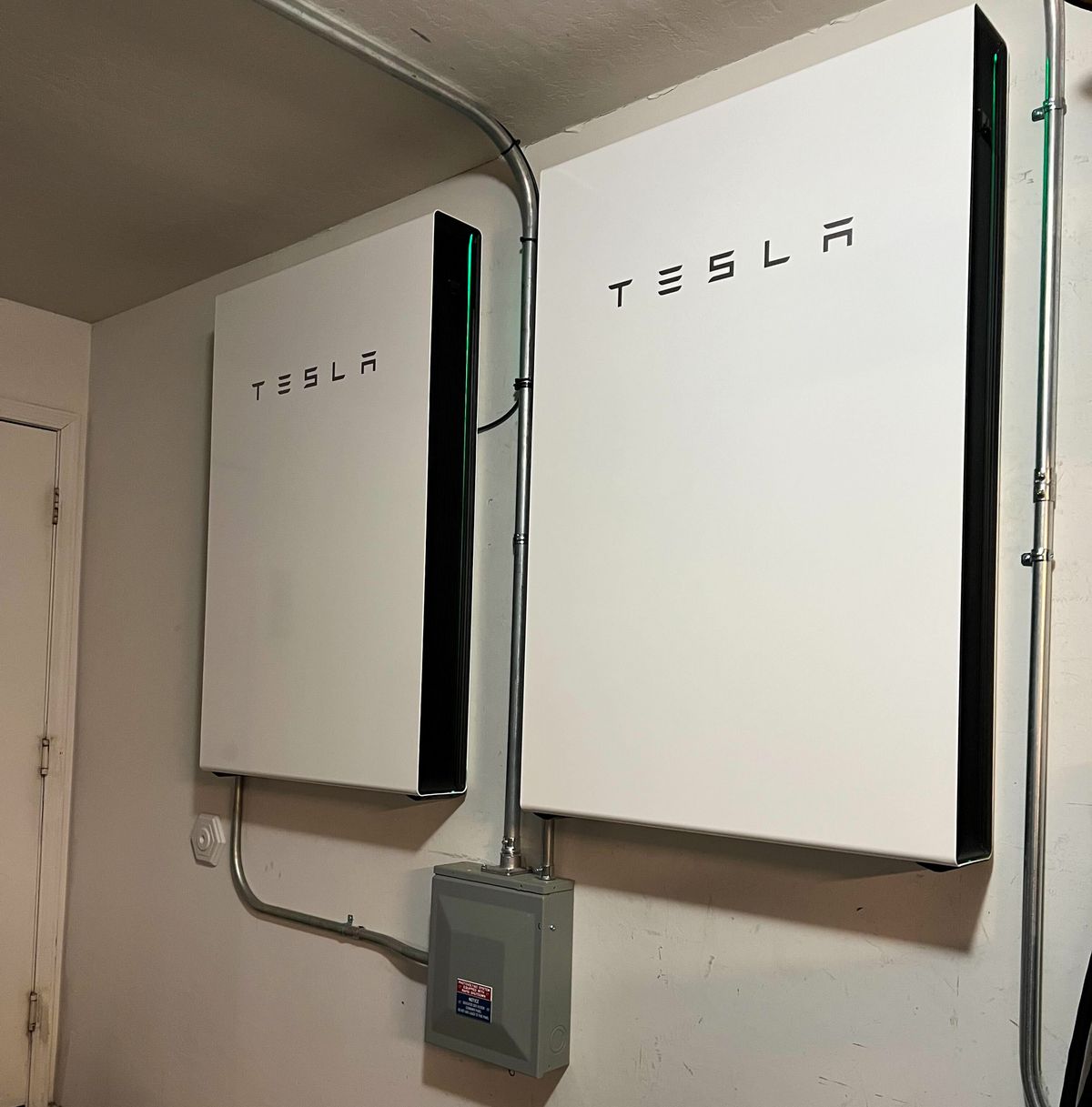
A portable power station is an appliance: a lithium battery, inverter, and charger in a rolling suitcase, typically 1 to 3.6 kWh of storage with 1.8 to 3.6 kW of inverter output, recharged from a wall outlet, car, or portable solar panels. You buy it online, it arrives in a box, and it works in ten minutes. An installed home battery is infrastructure: 10 to 40+ kWh of storage hardwired into your electrical panel through an automatic transfer mechanism, recharged from the grid or rooftop solar, and it switches over in milliseconds when the grid fails — no extension cords, no decisions, no being home.
That distinction drives everything else. The portable station backs up what you plug into it: the fridge (via a cord), phones, laptops, a lamp, maybe a CPAP. The installed battery backs up circuits: the fridge stays cold because it's wired in, the furnace blower runs, the well pump cycles, the Wi-Fi never drops. If your outage priority list fits on one extension cord, portable is a real option. If it includes hardwired loads — furnace, sump pump, hardwired lighting, garage door — portable can't reach them without an electrician installing an inlet box, at which point you've started building infrastructure anyway.
There's also a middle category worth knowing: large portables in the 3.6 to 5 kWh range with 240-volt output and the ability to parallel two units. These can run a well pump or a small mini-split for a few hours and, with a manual transfer inlet, feed a subpanel. They blur the line but don't erase it: you're still the transfer switch, and runtime is still measured in hours, not days.
Cost per kWh: The Honest Math
Start with the raw numbers. A quality 2-kWh portable station costs roughly $1,200 to $1,800 in 2026 — about $600 to $900 per kWh of storage. A 3.6-kWh unit runs $2,500 to $3,800, or $700 to $1,050 per kWh. An installed home battery at 13.5 kWh costs $12,000 to $18,000 installed, which is $900 to $1,300 per kWh — surprisingly similar on a per-kWh basis. The installed premium isn't really in the battery cells; it's in the inverter capacity, the transfer equipment, the electrician's labor, permits, and the solar integration that makes the storage refill itself daily.
But cost per kWh of usable backup tells a different story. The portable's kWh must cover your loads through manual cord management, and its smaller inverter caps what you can run at once — typically one major appliance at a time. The installed battery's kWh works automatically across your whole backed-up panel, and its 5 to 11.5-kW inverter handles simultaneous loads. Per outage-hour of whole-house comfort, the installed system is far cheaper. Per dollar of "keep the fridge cold and phones charged for a day," the portable wins easily.
Add the recurring-value dimension: an installed battery paired with solar earns daily value through time-of-use arbitrage, demand-charge shaving, and net-billing optimization — often $500 to $1,500 a year depending on your utility. Portable stations earn nothing between outages; they're insurance that sits in a closet. Over a 10-year life, that daily value can close much of the installed system's price gap in high-rate utility territories. Costs are 2026 US market ranges; get itemized local quotes.
Runtime Reality: What Each One Actually Runs
Translate storage into runtime with a realistic load. A refrigerator draws about 100 to 200 watts averaged over its compressor cycles — roughly 2 to 4 kWh per day. A 2-kWh portable station keeps a fridge cold for 12 to 20 hours, plus phones and a few LED lights. Add a CPAP (about 0.3 to 0.5 kWh per night) and you're still fine for one night. Try to add a microwave (1.5 kW for 10 minutes: 0.25 kWh) and the portable handles it, as long as the inverter's surge rating covers the startup draw.
Now scale up. A home's essential circuits — fridge, freezer, furnace blower or mini-split, sump pump, lighting, Wi-Fi, a few outlets — average 1.5 to 3 kW through an outage evening. A 13.5-kWh installed battery covers 5 to 9 hours of that; a 27-kWh two-battery system covers 10 to 18 hours. With rooftop solar refilling 20 to 40 kWh on a clear day, the installed system can cycle indefinitely through multi-day outages. The portable station, recharged only by a wall outlet that's dead or by a few hundred watts of portable solar panels, is a one-night solution that then needs a working grid or a long, sunny panel session to recover.
The honest runtime verdict: portable stations cover short outages (4 to 24 hours) for a short list of plug-in loads. Installed batteries cover multi-day outages for whole circuits, and solar pairing extends them indefinitely. If your utility's outage history shows mostly sub-12-hour events, portable runtime is genuinely sufficient — which is why the "when portable wins" section below matters.
Installation, Permits, and Hassle Factor
This is portable's biggest structural advantage: zero installation. No electrician, no permit, no utility interconnection paperwork, no HOA architectural review. Renters can own one. Condo dwellers with no garage wall to mount a battery can own one. You can take it camping, to a tailgate, or to a relative's house during their outage. An installed battery is the opposite: a half-day to two-day professional install, electrical permits, possible main-panel upgrades ($2,000 to $5,000 if your panel is full or undersized), utility interconnection applications that take weeks in some territories, and HOA or fire-code placement rules to satisfy.
The hassle equation flips during the outage itself. The portable requires you to be home, awake, and willing to run cords through the house — ideally before the fridge warms up. In a storm outage at 2 a.m., that means stumbling around with a flashlight. The installed battery requires nothing: the transfer is automatic and silent, the sump pump keeps cycling while you sleep, and the security system never blinks. For households with medical devices, sump pumps in flood zones, or anyone who travels frequently, that automaticity isn't a luxury — it's the entire point.
Maintenance is a wash: both are lithium systems with 10-year-ish warranties and minimal upkeep. Portables need their charge kept between 20 and 80 percent in storage and a top-up every few months; installed batteries self-manage. One caution on portables: leaving a lithium station baking in a 130°F garage all summer degrades it. Store it climate-controlled, like the expensive electronics it contains.
When Portable Wins Outright
Portable is the right answer more often than the battery industry admits. It wins for renters and condo owners who can't install anything permanent. It wins for households whose utility rarely fails — if your last outage was three years ago and lasted six hours, a $1,500 station is rational insurance while a $15,000 battery is a hobby. It wins as a bridge: buy the portable now, install the whole-home system during your planned panel upgrade or solar project next year, and keep the portable as the travel and garage unit afterward.
It also wins for specific load profiles. A home office worker whose critical loads are a laptop, monitor, router, and phone needs about 0.5 kWh for a full workday — a small portable handles it with room to spare. A household with a gas furnace (blower: ~500 watts), gas water heater, and a fridge can ride a day-long outage on a 2-kWh station. And portable wins decisively for anyone who needs power away from the house: job sites, RVs, boats, and backyard events are all places a wall-mounted battery can't follow.
Finally, portable wins on redundancy economics. Two 2-kWh stations ($2,400 to $3,600 total) give you a spare if one fails, and you can lend one to a neighbor. Redundancy in installed systems means buying a second $12,000+ battery. For the budget-conscious, a portable plus a small inverter generator ($800 to $1,500) covers a remarkable range of outage scenarios for under $5,000 total — the classic resilient-household starter kit.
When Installed Is Worth Every Penny
Installed wins when the loads can't be reached by an extension cord. Sump pumps, well pumps, furnace blowers, hardwired smoke and security systems, garage doors, and electric water heaters all need panel-level backup. If losing any of those during an outage means flooding, freezing pipes, or a security gap, the installed battery isn't optional — it's the only product that does the job. Medical devices that run overnight (oxygen concentrators, for example, draw 300 to 600 watts continuously) similarly demand automatic, all-night coverage.
Installed wins on solar synergy. A portable station charges from portable panels at a few hundred watts — meaningful for phones, marginal for a fridge. An installed battery charges from your 8 to 15-kW rooftop array at full speed, refilling a day's worth of outage consumption in a few sunny hours. In wildfire-shutoff country and hurricane zones where outages last days, that daily refill is the difference between riding it out and evacuating.
And installed wins on household reality: nobody has to be home, nobody has to be awake, nobody has to remember the plan. The transfer happens in milliseconds, the app shows state of charge, and life continues. For dual-income households that travel, for aging parents living independently, and for anyone who's ever come home to a warm fridge and a flooded basement, that automaticity justifies the premium. A licensed electrician should design the backed-up loads panel; the most common regret we hear is backing up too much and draining the battery by noon, or too little and discovering the gap mid-outage.
Making the Call: A Decision Framework
Run this five-question filter. One: can your critical loads be served by extension cords, or are any hardwired? Hardwired critical loads point to installed. Two: how long do your utility's outages actually last? Under 12 hours and infrequent points to portable; multi-day or seasonal (fire shutoffs, hurricanes, ice storms) points to installed. Three: does anyone depend on powered medical equipment or a sump pump? Yes points to installed, no exceptions. Four: do you own rooftop solar or plan to add it? Solar strongly favors installed, since the battery becomes a daily-use asset. Five: what's the budget reality? Under $5,000 total means portable (possibly plus a small generator); $12,000-plus opens the installed conversation.
Most households land in one of three buckets. The portable bucket: renters, condo owners, reliable-grid suburbs, sub-$5,000 budgets — buy a 2 to 3.6-kWh station from an established brand, store it climate-controlled at partial charge, and test it twice a year. The installed bucket: homeowners with hardwired critical loads, solar, medical needs, or multi-day outage risk — get three itemized quotes from licensed installers and size from measured load data. The hybrid bucket: a portable now for the office and fridge, an installed system later during the next electrical project, and the portable redeployed as the mobile unit. That's not indecision; it's staged resilience spending.
Whichever you choose, buy for your actual outage history rather than your outage anxiety. Pull your utility's reliability reports, ask neighbors how the last storm really went, and match the tool to the threat. The most expensive backup system is the one sized for a disaster that never comes — and the cheapest is the one that's dead or missing when the lights go out.
Frequently asked questions
Roughly comparable: quality portables run $600-$1,050 per kWh of storage, while installed home batteries run $900-$1,300 per kWh installed. The installed premium buys inverter capacity, automatic transfer equipment, professional installation, and solar integration, not cheaper cells.
Yes. A fridge averages 100-200 watts, or 2-4 kWh per day, so a 2-kWh portable station keeps it cold for 12-20 hours plus phones and lights. Use a heavy-duty extension cord, keep the fridge closed, and don't plug in other major appliances at the same time.
Not practically. Portables deliver 1.8-3.6 kW and 1-5 kWh, enough for plug-in loads but not hardwired circuits like furnaces, sump pumps, or water heaters, and runtime is measured in hours. Whole-house backup requires an installed battery with an automatic transfer switch.
No. Portable power stations are appliances: no electrician, no permit, no utility interconnection, and no HOA approval in most cases. That zero-installation advantage is a major reason renters and condo owners choose them.
Most quality lithium (LiFePO4) stations are rated for 3,000-4,000 cycles to 80% capacity, which translates to roughly 10 years of occasional outage use. Store it climate-controlled at 20-80% charge and top it up every few months to maximize lifespan.
For indoor-safe, silent, maintenance-free backup of electronics and a fridge, the portable station wins. For multi-day outages or running large loads like a well pump, a small inverter generator ($800-$1,500) delivers far more energy per dollar. Many resilient households own both.