Best Whole Home Battery for Time of Use Rates 2026: Picks That Earn Their Keep
Key takeaways
- On a time-of-use rate, the spread between your peak and off-peak price matters more than the battery brand: a wide, long peak window is what makes a battery pay.
- A battery earns on time-of-use rates only if it can schedule itself: automatic peak-window discharge, solar self-consumption, and usable capacity you can actually cycle daily.
- Size to your evening peak window, not your whole house: most homes need 8 to 15 kWh of usable capacity to cover the 4 to 9 p.m. peak, not a battery sized for a multi-day outage.
- Round-trip efficiency is a hidden tax on every cycle: at 90 percent efficiency, roughly a tenth of the energy you buy to charge never comes back out.
- Switching to the right rate plan can be worth as much as the hardware: the same battery on a better time-of-use plan can save hundreds more per year.
The best whole home battery for time of use rates 2026 is the one whose scheduling, usable capacity, and efficiency match your utility's peak window — because on a time-of-use (TOU) rate, a battery earns money by charging when electricity is cheap and discharging when it is expensive, and that daily arbitrage only works if the battery does it automatically, every day, without you thinking about it.
Time-of-use rates are now the default for millions of US households. Instead of one flat price all day, your utility charges more during the evening peak — typically 4 to 9 p.m., when everyone gets home, cooks, and runs the air conditioner — and less overnight and midday. A battery turns that price shape into savings: it fills up on cheap off-peak power (or from your solar panels at midday) and covers your home during the expensive peak, so you buy as little peak power as possible. Done well, it also keeps your lights on in an outage. Done badly — wrong size, no scheduling, a battery that cannot cycle daily — it is an expensive box on the wall.
This guide is for the ratepayer, not just the outage prepper. If your main goal is surviving a multi-day blackout, read our guide to batteries for outage-prone areas instead. Here, the question is narrower and more commercial: which battery actually earns its keep on a TOU rate, how big it needs to be, and what to check before you buy. The detailed arithmetic lives in our companion piece on time-of-use arbitrage math; this guide turns that math into buying decisions.
Start With Your Rate Plan, Not a Brand
Every TOU decision starts with one document: your utility's tariff sheet. It tells you the peak window (which hours, which days, summer versus winter), the peak price, the off-peak price, and whether weekends or holidays are treated differently. Two homes with the same battery can have wildly different payback simply because their tariffs differ. The variable that matters most is the spread — the gap between peak and off-peak prices — multiplied by how many hours the peak lasts and how many days a year it applies.
A high peak price alone does not guarantee big savings. What pays is a wide spread sustained over a long window. A plan with a modest peak price but a very cheap overnight rate and a five-hour evening peak can beat a plan with a dramatic peak price that lasts only two hours or applies only on weekdays. Before comparing batteries, compare plans: most utilities offer several TOU options, and some offer EV or battery-specific plans with cheaper overnight charging. Choosing the right plan is free, and it can be worth as much per year as the hardware choice itself.
Also check how your utility treats solar exports. Under older net metering, exported solar earned full retail credit, so a battery's TOU value was mostly about the evening peak. Under newer net billing tariffs, exports earn far less, which makes storing midday solar for evening use much more valuable — the battery is no longer just shifting cheap grid power, it is rescuing solar energy that would otherwise be nearly worthless. If you have solar, or plan to add it, this changes the math in the battery's favor.
EF ECOFLOW 12kWh Power Station: DELTA Pro Ultra with Extra Battery, 120/240V 7200W AC Output, LiFePO4 Home Battery Backup Expandable to 90kWh

Expandable 12kWh LFP home battery (7200W 120/240V, expandable to 90kWh) with Smart Home Panel option for automatic time-of-use scheduling — the fast-start pick for TOU ratepayers; verified live via browser fallback render 2026-10-25
*Affiliate Disclosure: As an Amazon Associate, Elevate Home earns from qualifying purchases. Pricing and availability subject to change.
How TOU Arbitrage Actually Pays: The Math in Plain English
Strip away the marketing and TOU savings come down to one daily equation: the value of the energy you avoid buying at peak, minus the cost of the energy you bought to charge, minus the losses. A battery is not a perfect bucket. Round-trip efficiency — the energy that comes out divided by the energy that went in — is typically around 85 to 92 percent for modern lithium iron phosphate (LFP) systems. That means for every 10 kWh you push in, you get roughly 8.5 to 9.2 kWh back. The rest is lost as heat and conversion overhead, and you paid for it.
Work through an illustrative example. Suppose your peak window is five hours, your off-peak price is 12 cents per kWh, your peak price is 32 cents, and you cycle 10 kWh of usable capacity each day at 90 percent efficiency. Charging 11.1 kWh at off-peak costs about $1.33; discharging 10 kWh at peak avoids about $3.20 of purchases; the net is roughly $1.87 per day, or around $680 over a full year of daily cycling. Shrink the spread to 10 cents and the same battery nets roughly $0.60 a day — barely $220 a year. Widen it to 30 cents and the net approaches $2.90 a day. Same battery, three very different paybacks. That is why the tariff sheet comes first and the brand comes second.
Two honest caveats belong in any TOU article. First, these are illustrative figures, not a quote: your tariff, your usage, and your battery's real efficiency decide the actual number. Second, on rate arbitrage alone, many batteries do not pay for themselves within their warranty period — the savings are real but modest in narrow-spread territories. A battery's full value also includes outage protection, solar self-consumption under net billing, and, in some territories, participation in virtual power plant programs. Judge it on the whole package, not on arbitrage alone, and be skeptical of any payback claim that ignores efficiency losses or assumes a full cycle every single day of the year.
Installed Whole-Home Batteries vs Portable Power Stations for TOU
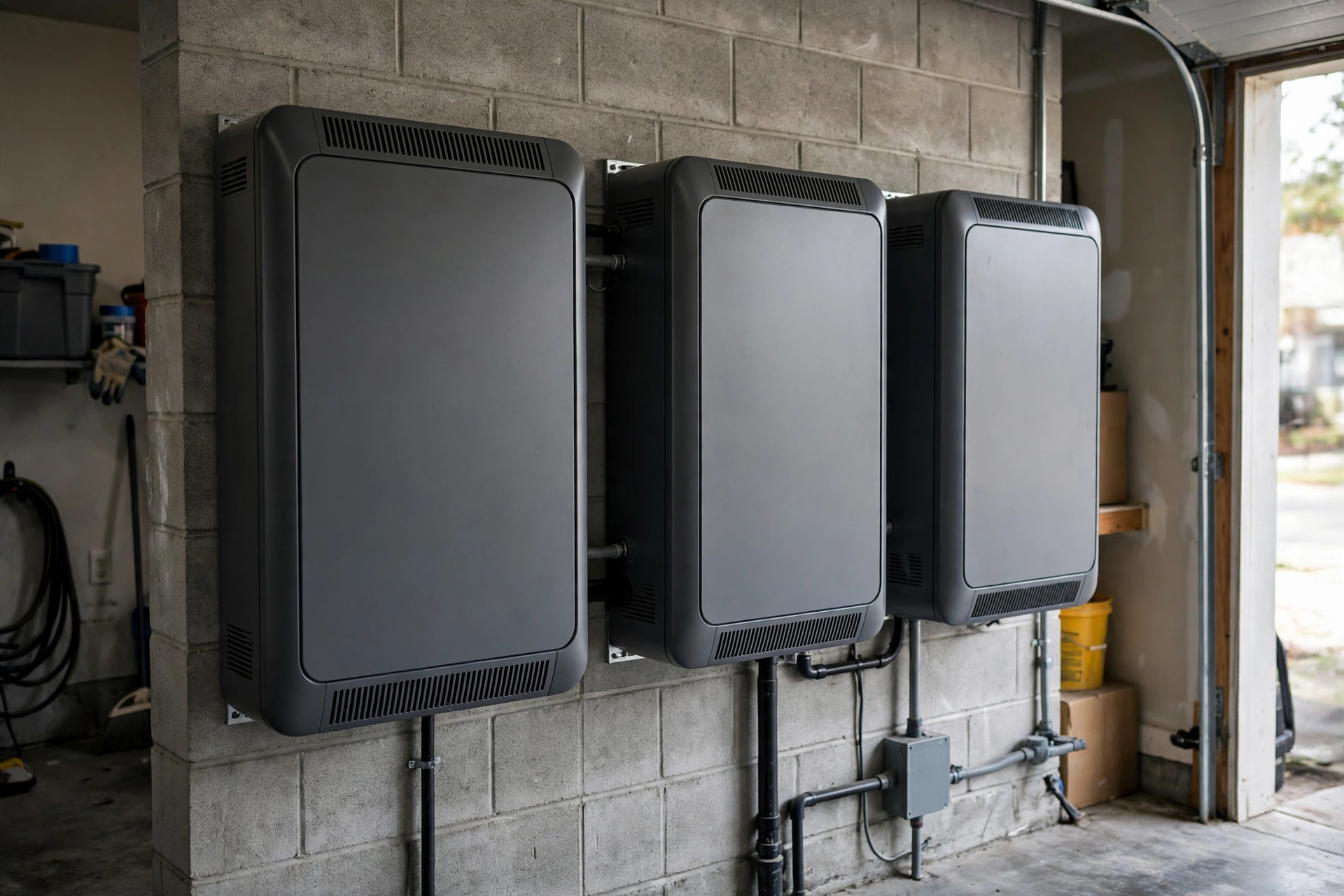
For TOU purposes, batteries fall into two families, and the right one depends on your home and your timeline. Installed whole-home batteries — wall-mounted units wired through a backup panel or smart panel — switch automatically, can run 240-volt loads, and integrate with solar inverters for true self-consumption. They are the right answer when you own the home, your peak loads are large, and you want the battery to manage itself for a decade. Their trade-offs are professional installation, permits, and a fixed location.
Large portable power stations are the newer TOU option, and they suit a different buyer: renters, people who need backup within days rather than months, or homeowners who want to start with one unit and expand later. The best of them now offer 120/240-volt output, expansion batteries that stretch capacity dramatically, and app-based scheduling that can charge overnight and discharge during the peak. Paired with a transfer switch or a smart home panel, a large portable can cover critical circuits during the peak window. What it cannot do as well as an installed system is whole-home automatic backup at high power, and its daily TOU cycling still depends on you setting the schedule correctly in the app.
Our pick for the TOU buyer who wants to start now rather than wait out an install queue is the large portable class, and the strongest example in it is the EcoFlow DELTA Pro Ultra platform: a modular LFP system that expands from a single unit to a very large bank, delivers 120/240-volt output for heavier peak loads, and — paired with its Smart Home Panel — can automate the charge-at-night, discharge-at-peak routine that TOU savings depend on. It is also the rare portable that can genuinely cover a home's evening peak rather than just a few essentials. The card above the comparison table has the live listing; the rest of this guide explains how to judge whether this class, or an installed system, fits your tariff.
The 5 Features That Decide TOU Value
1. Automatic TOU scheduling. This is the single most important feature, and it is non-negotiable. A battery that requires you to remember to switch modes every evening will miss days, and missed days are lost savings. Look for time-based controls that let you set charge windows and discharge windows by time of day, with different schedules for weekdays and weekends, and — for solar homes — a self-consumption mode that prioritizes storing midday solar over exporting it. If the manufacturer cannot show you the scheduling screen before you buy, treat that as a warning sign.
2. Usable capacity, not nameplate capacity. Batteries advertise a headline kilowatt-hour figure, but what you can actually cycle daily is lower: depth-of-discharge limits, a reserve kept for outages, and inverter overhead all shave it. For TOU math, use the usable figure. A battery that keeps 10 percent in reserve for blackouts gives you 90 percent of its nameplate for daily arbitrage — size and value it on that basis, and decide deliberately how much reserve you want to hold back versus cycle for savings.
3. Round-trip efficiency. Efficiency is the quiet tax on every cycle, and small differences compound: over ten years of daily cycling, a few percentage points of efficiency are worth real money. LFP chemistry, modern inverters, and DC-coupled solar charging all tend to help. Ask for the round-trip figure at the power levels you will actually use, not just a headline number measured under ideal conditions.
4. Continuous power output. Capacity tells you how long the battery lasts; power tells you what it can run at once. During the evening peak, your home may draw several kilowatts simultaneously — cooking, cooling, laundry, EV charging. A battery with plenty of capacity but low continuous output will trip or force you to shed loads right when you most want to avoid peak purchases. Match output to your peak-hour load profile, and remember that 240-volt loads like electric ranges, dryers, and well pumps need a system that can deliver 240 volts, not just 120.
5. Cycle life and warranty terms that match daily use. TOU arbitrage means cycling nearly every day — roughly 300 or more cycles a year. A warranty written around occasional outage use may not reflect that reality. Look for LFP chemistry, a cycle rating in the thousands, a warranty measured in both years and throughput, and clear terms on what counts as degradation. A battery that degrades to 70 percent capacity in year six changes your peak coverage, and your savings, whether the warranty admits it or not.
Sizing Your Battery to Your Peak Window
Do not size a TOU battery like an outage battery. An outage battery is sized for days; a TOU battery is sized for hours — specifically, for the energy your home uses during the peak window on a typical day. Pull a recent bill or your utility's hourly usage portal, add up your consumption during the peak hours, and that is your target usable capacity. Most homes land between 8 and 15 kWh for a four-to-five-hour evening peak, with larger or all-electric homes landing higher, especially if the peak window includes cooking and EV charging.
Two sizing refinements save buyers from the most common mistakes. First, if your peak window is longer than your battery's coverage, the battery still helps — it just covers the first part of the peak, so prioritize the most expensive hours if your tariff has multiple peak tiers. Second, consider load shifting before upsizing: moving EV charging, dishwasher, and laundry runs out of the peak window shrinks the battery you need, and shifting is free. Our capacity-tier comparison walks through the 10, 13.5, and 20 kWh classes in detail, and our expansion guide covers starting small and adding capacity later — a sensible path when you are unsure of your peak profile.
Rate-Plan Moves Worth More Than Hardware
Before spending anything on hardware, spend an hour on your rate plan. Utilities typically offer several TOU variants, and the differences are large: one plan's overnight rate may be far cheaper, another's peak window may end an hour earlier, and EV or battery plans may add super-off-peak overnight windows designed for charging. The same battery can save hundreds more per year on one plan than another, purely because the spread and window are better. Ask your utility for a plan comparison based on your actual hourly usage — many will run one on request — and re-check annually, because tariffs change and new plans appear.
Solar owners should also check export rules and any battery-specific tariffs or incentives in their state. Some utilities and states offer battery rebates, demand-response payments, or virtual power plant programs that pay you for letting the grid draw on your battery during grid stress events. Those programs can add income on top of TOU savings, but they also cycle your battery more and may limit your control during events — read the terms before enrolling. Note also that the federal residential clean energy credit ended for expenditures after December 31, 2025, so older articles promising that credit are out of date; check current IRS guidance and your state's current incentive programs rather than relying on last year's advice.
Common TOU Battery Mistakes
The most expensive mistake is buying capacity for outages when your goal is rates, or vice versa — the two jobs size differently, and a battery oversized for your peak window wastes money while a battery undersized for your outage needs disappoints when the grid fails. Decide which job is primary. The second mistake is ignoring the reserve: holding back 20 percent for outages on a battery you sized exactly to your peak means you will still buy peak power every evening. The third is forgetting that tariffs change — a battery bought for today's spread may face a narrower spread in three years if your utility redesigns its rates, so favor modular systems you can expand or repurpose rather than betting everything on one tariff. Finally, do not let a salesperson's payback slide substitute for your own math: run the daily equation above with your tariff, your usage, and a realistic efficiency figure before signing anything.
The Verdict: Which Battery for Which TOU Home
If you own your home, have large peak loads, and want a set-and-forget system that also backs up the whole house, an installed whole-home battery integrated with your solar inverter is the strongest long-term TOU answer — automatic scheduling, high output, and deep solar self-consumption. If you rent, need backup within days, or want to prove the TOU concept before committing to an install, a large expandable portable in the DELTA Pro Ultra class is the pragmatic pick: it covers a real evening peak, its app and panel options handle the scheduling, and expansion batteries let you grow into a bigger peak profile later. If your spread is narrow — under about 10 cents — be honest with yourself: buy the battery for outages and solar self-consumption, and treat TOU savings as a bonus rather than the justification. And whatever you buy, pair it with the best rate plan you can get and with load shifting out of the peak — those two free moves can matter as much as the hardware. For the broader picture on costs and incentives, see our state rebate guide and, if you charge an EV at home, our off-peak EV charging guide.
Frequently asked questions
What is the best whole home battery for time of use rates?
The best battery is the one whose automatic TOU scheduling, usable capacity, and continuous output match your utility's peak window. Installed whole-home batteries suit owners with large peak loads, while large expandable portables like the EcoFlow DELTA Pro Ultra suit renters and buyers who want to start fast and expand later.
How much can a home battery save on time of use rates?
It depends almost entirely on your peak/off-peak spread. As an illustration, cycling 10 kWh daily at 90 percent efficiency nets roughly $0.60 a day on a 10-cent spread, about $1.87 a day on a 20-cent spread, and about $2.90 a day on a 30-cent spread. Your tariff sheet and actual usage decide the real figure.
How big a battery do I need to cover the evening peak?
Add up your home's energy use during the peak window, typically 4 to 9 p.m. Most homes need 8 to 15 kWh of usable capacity for that window; lights-and-fridge homes need less, while all-electric homes with cooking, cooling, and EV charging need 20 kWh or more, or load shifting out of the peak.
Can a battery work on time of use rates without solar panels?
Yes. Without solar, the battery charges from the grid overnight at off-peak rates and discharges during the peak. With solar, it can also store midday solar that would otherwise export at low net-billing value, which usually improves the economics further.
Does daily time-of-use cycling wear out a home battery faster?
Daily cycling does add wear, which is why cycle life matters for TOU buyers: look for LFP chemistry, a cycle rating in the thousands, and a warranty stated in both years and throughput. A battery rated for occasional outage use only may not be the right pick for daily arbitrage.
Keep reading
Battery Money
Battery Time-of-Use Arbitrage: The Real Math
Home battery time of use arbitrage savings, worked honestly: real 2026 TOU spreads, efficiency losses, cycle-l…
Pillar 01 · Energy Resilience
Best Home Battery for Outage Prone Areas 2026: Picks for Every Outage
Best home battery for outage prone areas 2026: installed vs portable picks, sizing math, and the verdict for s…
Pillar 01 · Energy Resilience
10kWh vs 13.5kWh vs 20kWh Home Battery: Which Size Is Right? (2026)
10kWh vs 13.5kWh vs 20kWh home battery compared: usable capacity, backup runtime, solar pairing, and which tie…
Expansion
Adding a Second Home Battery: 2026 Guide
Adding a second home battery in 2026: modular vs add-a-box expansion, inverter headroom, rewiring, permits, an…

2026 Policy
Home Battery Rebates & Incentives: 2026 Guide
Home battery rebates and incentives for 2026: what survived the 25D end — SGIP, state rebates, utility BYOB pr…
Rate Plans
EV Off-Peak Charging: Time-of-Use Rates Guide (2026)
EV off-peak charging on time-of-use rates explained: typical windows, 2026 per-kWh ranges, overnight charging …