How to Make Stairs Safer for Elderly: 12 Upgrades (2026)
Key takeaways
- Poor lighting, slippery treads, and missing handrails cause most stair falls among older adults, and every one of these is fixable for less than the cost of a single emergency room visit.
- Motion-sensor stair lights that switch on automatically in the dark are the single highest-impact, lowest-effort upgrade, because most nighttime falls happen when someone can't see the step edge.
- Non-slip treads plus high-contrast strips on each nosing address the two most common fall mechanisms at once: slipping and misjudging the edge of a step.
- Handrails should be on both sides of the staircase, securely anchored, and easy to grip; a single wobbly rail on one side is not enough for someone with declining balance.
- When the problem is the person's strength or balance rather than the condition of the stairs, no modification beats a stairlift assessment: it removes the climbing entirely.
Learning how to make stairs safer for elderly loved ones starts with three fixes that prevent the vast majority of falls: light every step automatically, add traction and visible edges to each tread, and install sturdy handrails on both sides. Stairs are one of the most dangerous places in any home for an older adult, but unlike moving to a single-story house, most of the effective upgrades cost little, require no rewiring, and can be finished in a weekend.
About one in four American adults over 65 falls each year, according to the CDC, and the staircase combines everything that makes a fall likely: a change in level, narrow landing zones, and the need for balance, vision, and leg strength all at once. Add poor lighting or a slippery tread, and a familiar staircase becomes a hazard. The good news is that stair safety is one of the few aging-in-place problems with a clear, evidence-backed fix list. This guide walks through twelve upgrades in order of impact, from the five-minute changes to the bigger decisions. Pair it with our broader aging-in-place fall-proofing checklist for the rest of the house.
Why stairs are so dangerous for older adults
Stair falls rarely have a single cause. Vision changes make it harder to judge where a step begins and ends, especially on stairs painted or carpeted in a uniform color. Muscle loss and joint pain change how someone plants their foot, so a tread that felt secure at fifty feels treacherous at eighty. Add a few common hazards — a burned-out bulb in the stairwell, a worn smooth patch in the middle of a wooden tread, a handrail that flexes when pulled — and the margin for error disappears.
The encouraging part: research on home fall prevention consistently finds that fixing environmental hazards works. Unlike aging itself, a staircase can be re-engineered. Start with the upgrades that address the most common failure modes — not seeing the step, slipping on it, and having nothing solid to grab — and work outward from there.
WILLED Stair Lights Indoor 4-Pack, Warm White Rechargeable Night Light, Wireless Motion Sensor Night Light, Battery Stick-On Lights for Stairway, Hallway, Kitchen, Closet, Cabinet, Bedroom (4-Pack)

Core upgrade #1 in the article (motion-sensor stair lights) is a shoppable DIY product with strong caregiver buyer intent; best-selling 4-pack with 4.5 stars and 4,717 ratings.
*Affiliate Disclosure: As an Amazon Associate, Elevate Home earns from qualifying purchases. Pricing and availability subject to change.
Upgrade 1: light every step with motion-sensor stair lights
The most dangerous time on stairs is at night, when someone gets up groggy and the overhead switch is three steps away. Overhead stairwell lights cast shadows that hide the nosing (the front edge) of each step, and they stay on all night or get left off entirely. Motion-sensor stair lights solve this precisely: small wireless LED units stick to the wall or riser of each step and switch on automatically in the dark when they detect movement, then switch off again after a short delay.
Because they are battery-powered and rechargeable, they need no electrician and no new wiring — you mount them with adhesive magnetic plates in about five minutes per stair. Look for warm-white light (around 2700–3000K) that is easy on sleepy eyes, a motion range that covers the full flight, and a model that only activates in darkness so it doesn't run during the day. Placing one light per step, or at minimum every other step, eliminates the shadowed nosings where most nighttime missteps happen.
Upgrade 2: brighten the overhead lighting and put switches at both ends
Stair lights handle the night; the overhead fixture handles the day. Many stairwells are lit by a single dim bulb that casts more shadow than light. Replace it with the brightest bulb the fixture allows and choose a frosted or shaded fixture that spreads light evenly rather than throwing harsh glare. If your staircase has switches at only one end, add a second switch or replace them with wireless smart switches so nobody ever has to climb in the dark to find one. In a home with more complex lighting needs, our aging-in-place lighting design guide covers fixture placement in detail.
Upgrade 3: add non-slip treads to bare stairs
Polished wood, tile, and stone look beautiful and are treacherous underfoot, especially in socks. Adhesive non-slip treads or stair strips add a grippy texture to the center of each tread where feet actually land. Choose treads rated for indoor use with a strong adhesive that won't creep over time, and replace any tread whose edges start to curl — a peeling edge is itself a trip hazard. On carpeted stairs, skip the treads and instead make sure the carpet is tightly secured, low-pile, and free of wrinkles or worn-through patches, which are more dangerous than bare wood.
Upgrade 4: mark step edges with high-contrast strips
Misjudging the edge of a step is the single most common cause of stair falls. On stairs of a uniform color, aging eyes struggle to tell where one tread ends and the riser begins. High-contrast strips — bright tape or adhesive nosing applied to the front edge of each step — give the eye an unmistakable target. This is one of the cheapest interventions in this guide and one of the most effective: vision researchers have shown that edge highlighters dramatically improve step visibility. Apply them to the very front lip of the nosing on every step, including the top and bottom transitions, which are where most missteps occur.
Upgrade 5: install secure handrails on both sides
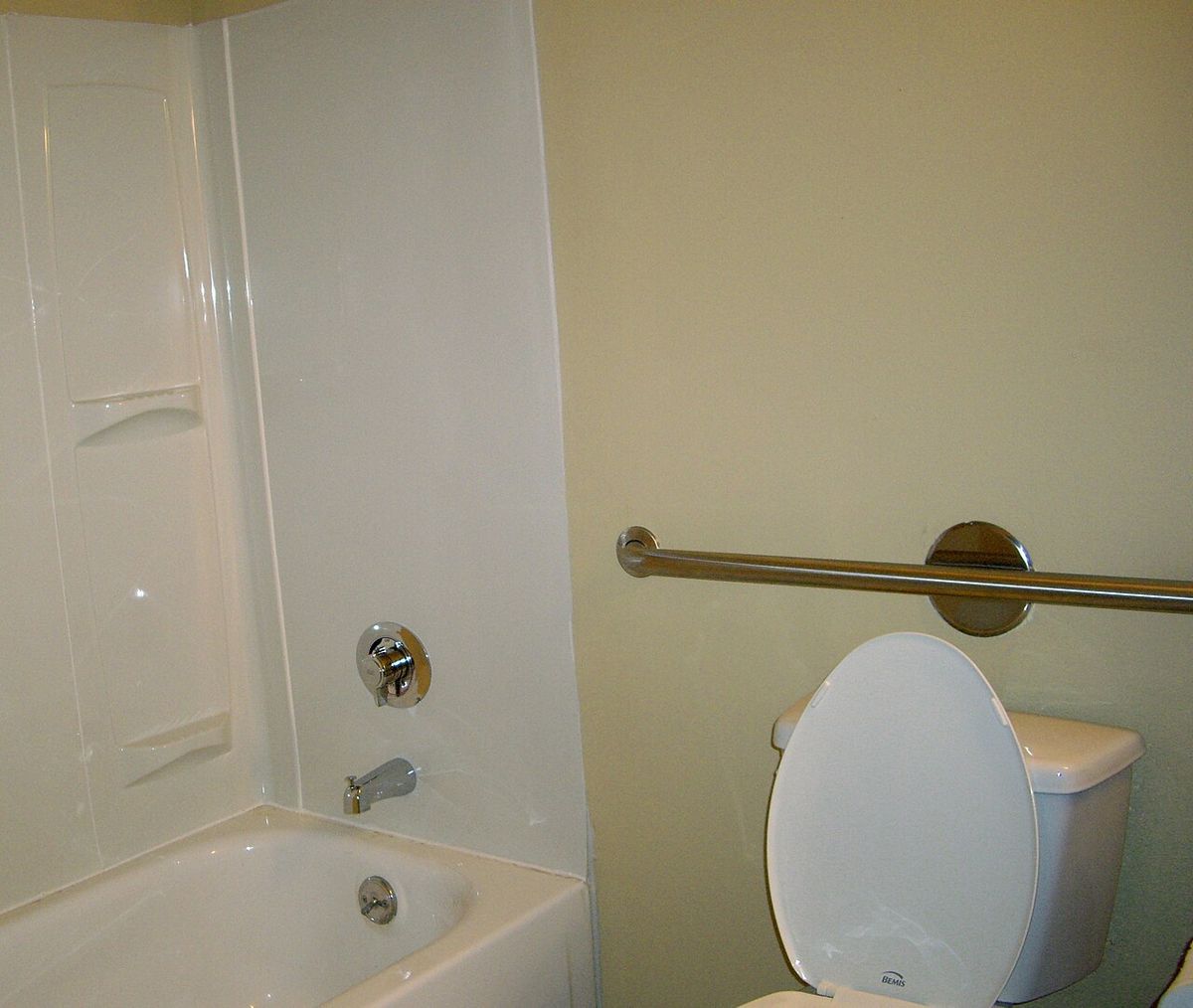
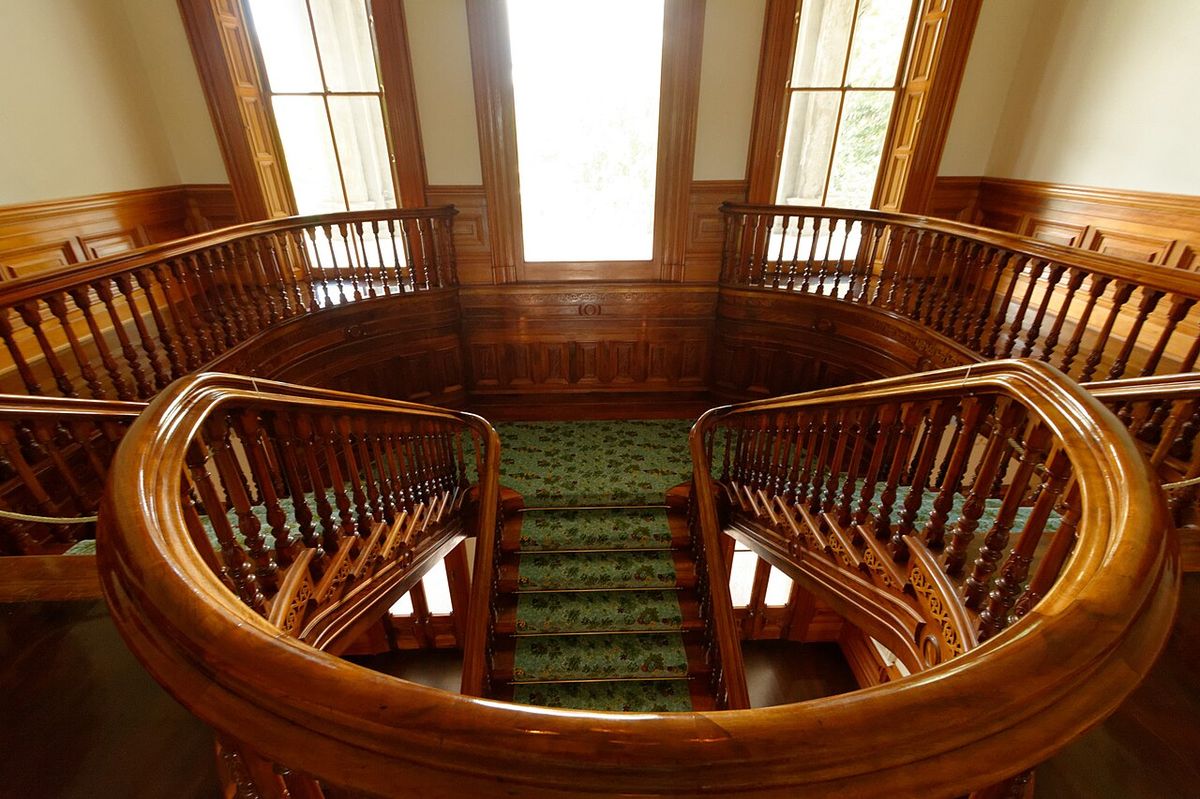
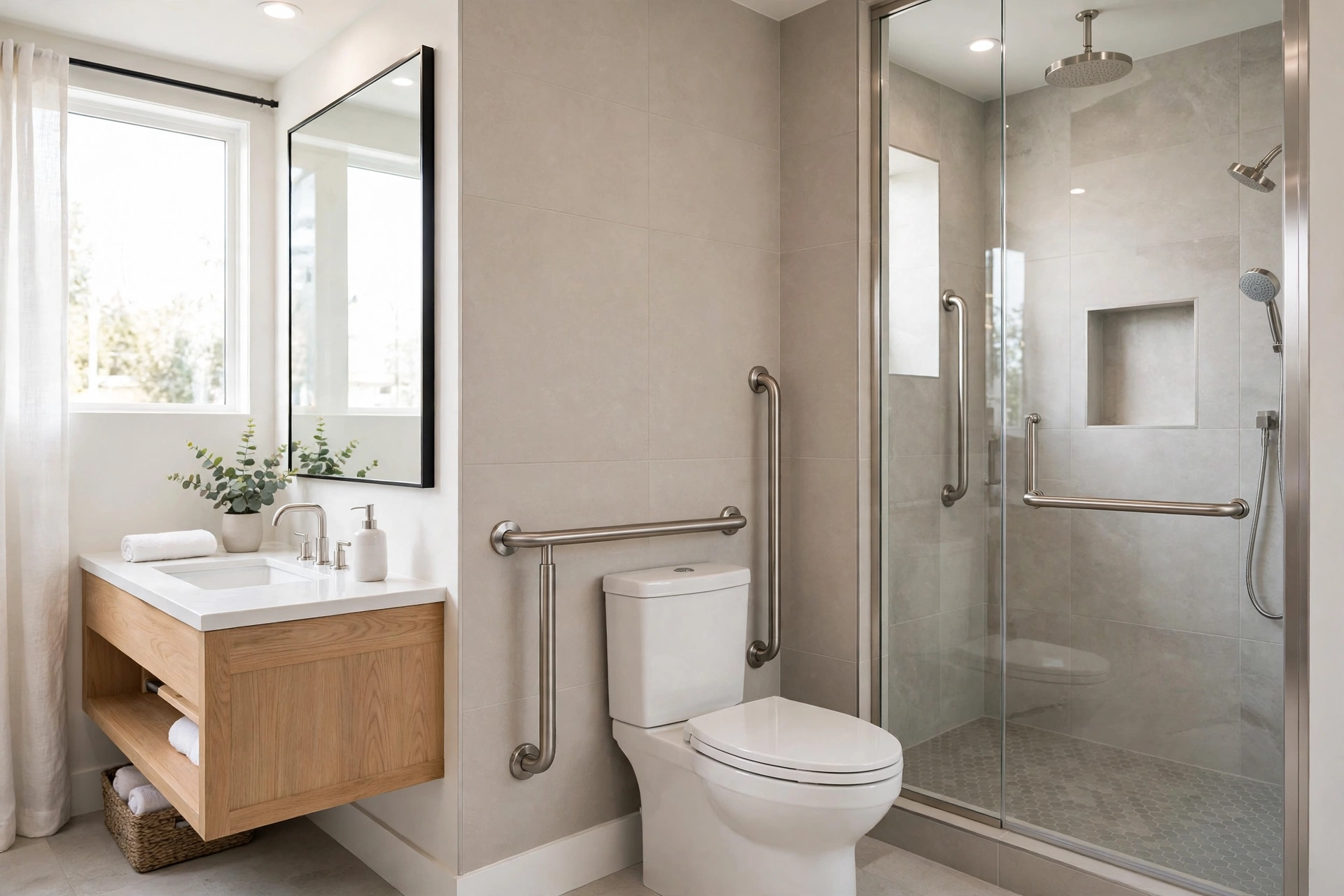
A handrail is only as good as its mounting. Grab any rail on your staircase and pull hard: if it flexes, the screws have loosened or it was anchored into drywall instead of studs. Both sides of the stairs need a continuous rail at a comfortable height, round or oval in profile so a hand can wrap around it. Where the wall configuration makes a wall-mounted rail impossible, a freestanding stair rail can be bolted to the treads instead. For the detailed comparison of rail styles and grab bar options, see our stair handrails vs grab bars guide, and if the person rents, our grab bar alternatives for renters covers no-drill solutions.
Upgrade 6: remove rugs, clutter, and trip hazards from the staircase
Walk the staircase and look at it the way a tired person at 2 a.m. would. Loose runners at the top or bottom landing, shoes left on the steps, laundry baskets waiting to be carried up, pet toys, and charging cables draped across treads all turn a safe staircase into an obstacle course. Remove every loose rug from the landings, relocate anything stored on or under the stairs, and give pets their own sleeping spot away from the stairwell. This upgrade costs nothing and takes ten minutes.
Upgrade 7: repair worn carpet, loose nosings, and uneven risers
Stairs built decades ago often hide structural wear: a nosing that has rounded off from years of foot traffic, a tread that creaks and gives slightly underfoot, or risers that vary in height by more than a small amount. Uneven risers are especially dangerous because the body calibrates its stepping rhythm to the first riser and stumbles when a later one differs. Walk the stairs slowly, testing each tread for movement, and have a carpenter or handyman re-secure, re-nose, or shim anything that moves. Small repairs like these are far cheaper than a fall.
Upgrade 8: block the stairs when they are no longer a safe option
For someone with cognitive decline, the safest staircase is one they cannot use unsupervised. A sturdy safety gate at the top and bottom of the stairs, pressure-mounted or hardware-mounted depending on the doorway, prevents nighttime wandering and confused attempts at climbing. Gates should be tall enough that they cannot be stepped over and should latch reliably. This is a caregiver decision, not a design decision — if the person cannot consistently follow stair safety rules, restricting access is the responsible call.
Upgrade 9: require proper footwear on stairs
Socks on polished wood are a classic recipe for a fall, and loose slippers with worn soles are barely better. Establish a household rule: closed, well-fitting shoes or slippers with non-slip rubber soles on the stairs, always. Keep a pair of grippy house shoes at the top and bottom of the staircase so there is never an excuse to climb in socks. It sounds trivial; it is one of the simplest behavioral changes with outsized effect.
Upgrade 10: keep hands free while climbing
Carrying laundry, a tray, or a grandchild while climbing leaves one hand off the rail — exactly when a stumble needs both hands to catch it. Add a small basket or tote at the top and bottom of the stairs so items can be ferried one trip at a time without occupying the hands, or use a backpack for anything that must go up and down. For households where this is a daily pattern, a dumbwaiter or stair chair for goods is worth considering. The rule is simple: one hand on the rail, always.
Upgrade 11: build leg strength and balance with targeted exercise
Environmental fixes work best when the body cooperates. Physical therapists consistently recommend leg-strengthening and balance exercises — sit-to-stands, step-ups, heel raises, and programs like Tai Chi or the Otago exercise program — to reduce fall risk. These don't replace stair modifications, but they widen the margin for error when a misstep happens. Ask the person's doctor for a referral to a physical therapist who can prescribe a home program matched to their ability level.
Upgrade 12: get a stairlift when the person, not the stairs, is the problem
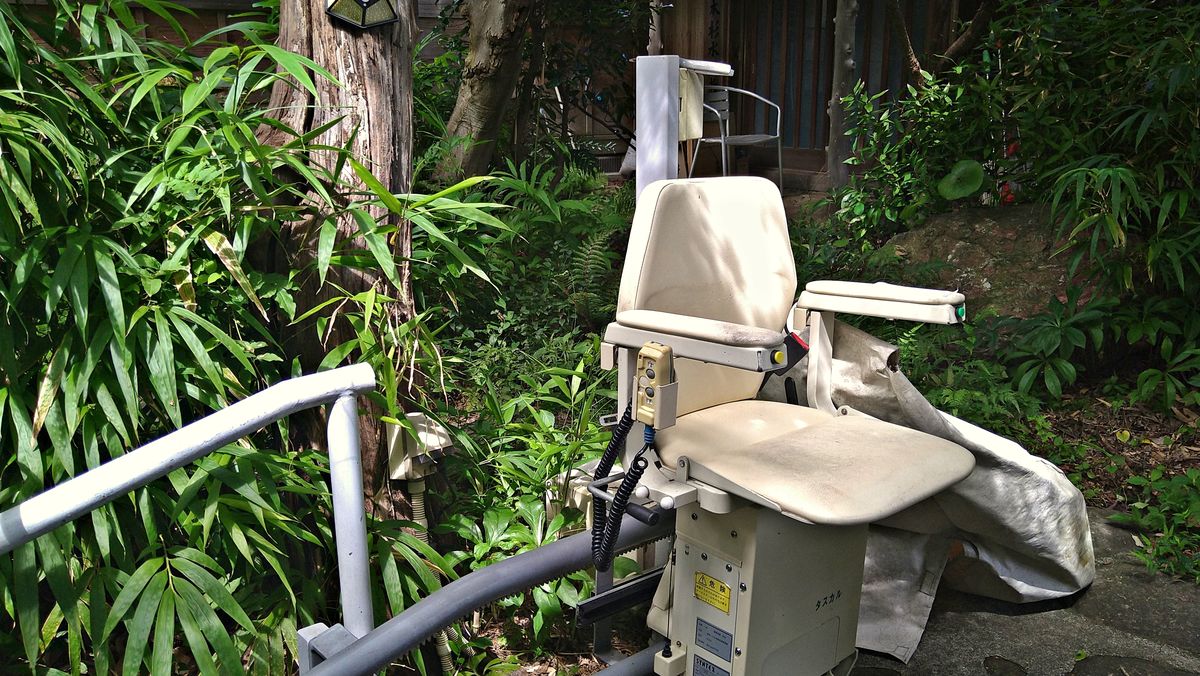
There is a point where no combination of lights, treads, and rails makes climbing safe — when balance, joint pain, dizziness, or a neurological condition makes the act of climbing itself the danger. That is the signal for a stairlift assessment, not more hardware. A stairlift removes the climbing entirely: the person sits, rides, and arrives. Our stair lift brand comparison and curved stairlift cost guide cover what to buy and what to budget, and our stairlift vs home elevator guide helps when the stairs are curved or the home layout is complex. Treat this as a mobility decision made with the person's doctor and an occupational therapist.
All 12 stair safety upgrades compared
Not every home needs all twelve. Use this comparison to prioritize by effort and impact:
| Upgrade | Effort | What it fixes |
|---|---|---|
| Motion-sensor stair lights | Weekend afternoon, no tools | Nighttime falls from unseen step edges |
| Brighter overhead lighting, switches at both ends | An hour or an electrician visit | Shadowed stairs and climbing in the dark |
| Non-slip treads | An afternoon of peeling and sticking | Slipping on bare wood, tile, or stone |
| High-contrast step-edge strips | Under an hour | Misjudging where each step begins and ends |
| Handrails on both sides, re-anchored | Half day with a handyman | Nothing solid to grab during a stumble |
| Remove rugs, clutter, trip hazards | Ten minutes, free | Tripping on objects left on the stairs |
| Repair worn carpet, loose nosings, uneven risers | A carpenter visit | Structural surprises mid-step |
| Safety gates top and bottom | An hour to install | Unsafe use by someone with cognitive decline |
| Proper non-slip footwear rule | A conversation and a pair of shoes | Sliding in socks or loose slippers |
| Keep hands free (baskets, backpack) | Minutes to set up | Stumbles while carrying things |
| Strength and balance exercise program | Ongoing, with a PT | Weak recovery from a misstep |
| Stairlift | Professional assessment and install | Climbing that is fundamentally unsafe |
Start at the top of the list and work down. Most families find that the first six upgrades — lighting, traction, contrast, rails, decluttering, and repairs — eliminate the hazards behind the large majority of stair falls, and they can all be done without a contractor's schedule.
Frequently asked questions
What is the most common cause of falls on stairs for elderly adults?
Misjudging the edge of a step is the most common cause, followed by slipping on smooth treads. Poor lighting, worn stair surfaces, missing or loose handrails, and declining balance all contribute. Most stair falls involve several of these factors at once, which is why a combination of better lighting, non-slip treads, contrast strips, and sturdy handrails prevents more falls than any single fix.
Do non-slip stair treads actually work for seniors?
Yes. Non-slip treads or adhesive strips meaningfully reduce the risk of slipping, especially on wood, tile, or polished stone stairs. They work best as part of a package: good lighting so each step is visible, contrast strips so the edge is obvious, and handrails to grab. They install in minutes with adhesive backing and should be replaced if their edges start to curl.
Should handrails be on both sides of the stairs?
Yes, both sides whenever possible. Older adults often favor one side as their strength changes, and a rail on only one side forces them to cross over or climb unprotected. Each rail must be anchored into studs or blocking, not just drywall, and should be round or oval in profile so a hand can wrap around it securely.
Are carpeted stairs safer than hardwood stairs for the elderly?
Firmly attached, low-pile carpet provides better traction than bare wood or tile, so well-maintained carpeted stairs are safer. But loose, wrinkled, or worn-through carpet is more dangerous than bare stairs. If the carpet is old, either re-secure and repair it or remove it and add non-slip treads to the bare wood instead.
When should I consider a stairlift instead of stair modifications?
Consider a stairlift when the problem is the person's ability to climb, not the condition of the stairs. If balance problems, leg weakness, joint pain, dizziness, or a neurological condition make climbing fundamentally unsafe, lights and rails can't fix that. A stairlift eliminates the climbing entirely. An occupational therapist or the person's doctor can help make the call.
Keep reading
Safety
Stair Handrails vs Grab Bars: 2026 Guide
Stair handrails vs grab bars for 2026: code requirements, placement, stylish non-medical options, costs, and a…
Mobility
Curved Stairlift Cost Guide: 2026
Curved stairlift cost guide for 2026: why custom rails cost more, lead times, new vs refurbished math, rentals…
Renter Safety
Best Grab Bar Alternatives for Renters: No-Drill Safety That Protects Your Deposit (2026)
Renting and need bathroom safety? The best grab bar alternatives for renters that need no drilling, ranked by …
Safety
Fall-Proofing Your Home: Room-by-Room Checklist
Fall-proofing your home room by room: prevention-focused fixes for stairs, bathrooms, kitchens, and outdoors. …
Interactive Tool
Aging in Place Renovation Cost Estimator 2026 Guide
Budget your aging-in-place renovation with our interactive estimator. Price accessible bathrooms, kitchens, el…
Transfer Equipment
100A vs 200A Automatic Transfer Switch
100 amp vs 200 amp transfer switch: service-entrance vs subpanel topology, when each is required, costs, and l…