Holiday Lighting Automation: Design & Control
Permanent vs seasonal holiday lighting for luxury homes: pixel systems, design principles, smart control, and 2026 costs. The complete guide.
10 MIN READ · UPDATED 2026-09-23
Key takeaways
- Permanent roofline pixel systems ($6,000–$18,000+) eliminate annual ladder work and double as year-round architectural accent lighting.
- Specify individually addressable commercial-grade pixels, color-matched slim tracks, and native smart-home platform integration.
- The best displays are static, architectural, and restrained — light that follows the home's lines at slightly-below-maximum brightness.
- Seasonal pro service ($2,500–$8,000/season) suits maximum spectacle; vet designers by driving past prior work at night and get takedown dates in writing.
- Clear HOA rules on year-round accent use before installing permanent tracks, and have a licensed electrician handle the line-voltage supply work.
Every December, affluent neighborhoods divide into two camps: the houses with the breathtaking, perfectly synchronized light displays, and the houses whose owners spent a miserable weekend on a ladder only to produce something... fine. The difference is rarely taste — it is infrastructure. Permanent holiday lighting systems, professionally designed seasonal installs, and proper automation have turned holiday lighting from an annual chore into a year-round architectural asset. Here is how the options compare, what great design looks like, and what to budget.
Permanent vs. Seasonal: The Decision That Shapes Everything
Permanent holiday lighting — low-profile tracks or channels mounted along rooflines, eaves, and ridges, holding individually addressable LED pixels — has quietly become the default choice for upscale homes. Once installed, the system disappears during the day (tracks are typically color-matched to trim) and produces any holiday scheme on demand: warm white elegance for Christmas, team colors for the Super Bowl, pastels for Easter, subtle amber for autumn evenings. No ladders, no tangled strings, no storage bins.
Seasonal professional installs remain the right answer when you want maximum spectacle for minimum commitment — elaborate tree wraps, wreath programs, pathway luminaries, and the kind of layered design that would look excessive permanently mounted. The best seasonal designers treat your home like a venue: they install in November, maintain through the season (replacing failed strands before you notice), and remove and store everything in January. You pay annually, but you never touch a ladder or a storage tote.
The honest comparison: permanent systems cost more up front but approach zero marginal cost per holiday — you will use them for occasions you would never have decorated for before, which is arguably the real value. Seasonal service costs less to start but recurs every year, and availability of top designers books out months ahead. Many luxury homes now do both: permanent roofline pixels for architecture plus a seasonal designer for trees, entries, and grounds.
Permanent Systems: What to Specify
Not all permanent lighting is equal, and the specification details separate the stunning from the sad. Individually addressable pixels — where each LED can be a different color — are the standard for quality systems; cheaper "zone" systems that change color in large sections look flat and dated by comparison. Look for commercial-grade pixels with UV-stable housings, because bargain LEDs yellow and fail within a few seasons of sun exposure.
Track design determines daytime invisibility. The best installations use slim aluminum channels painted to match your fascia and soffit, with pixels recessed so the daytime profile is a clean line, not a row of visible bulbs. Insist on seeing a daytime photo of the installer's previous work before committing — anyone can show you pretty nighttime shots; the craft is in what you see at noon in July.
Power and control infrastructure matters more than the lights themselves. A proper system has weatherproof power injection points spaced to prevent voltage drop (which shows as color shift toward the end of long runs), a central controller with both app and automation-platform integration, and surge protection on the low-voltage side. Ask whether the controller integrates with your existing smart home platform — native integration with the major ecosystems beats a standalone app you will forget to open.
Control, Scenes, and Automation
The control layer is where holiday lighting graduates from decoration to architecture. At minimum, you want scheduling (on at sunset, off at midnight, with astronomical clock accuracy), per-holiday scene presets, and remote control for the inevitable "we're hosting Thanksgiving and I want the house lit" moment from the airport. The best systems expose every pixel group to your home automation platform, so holiday scenes become part of whole-home scenes — "entertaining" mode can include the roofline in warm white alongside interior lighting.
Animation deserves restraint. Chasing, twinkling, and color-cycling effects are fun for exactly one viewing; the displays that impress neighbors year after year are mostly static, elegantly composed, and architecturally aware — light that follows and flatters the home's lines rather than fighting them. Save the animation for specific moments (a New Year's countdown, a touchdown celebration) and keep the default scenes calm. Your neighbors will thank you, and so will your HOA.
Music synchronization is the showpiece feature — lights dancing to a broadcast soundtrack — and it is wonderful in exactly one context: a dedicated show night or a charity drive. As a nightly default it is a nuisance. If you want it, specify a system that supports it but default it to off, and check local noise ordinances before broadcasting audio outdoors. The classy move is a synchronized show on two or three announced evenings per season, static elegance every other night.
Consider geofencing as the quiet luxury of holiday control: the display shifts to its full “evening show” scene when the household is home and drops to a minimal security glow when everyone is away. It saves energy, extends LED life, and means the house always looks intentionally lit rather than abandoned — a small automation with an outsized effect on how the home feels.
Design Principles for a Luxury Look
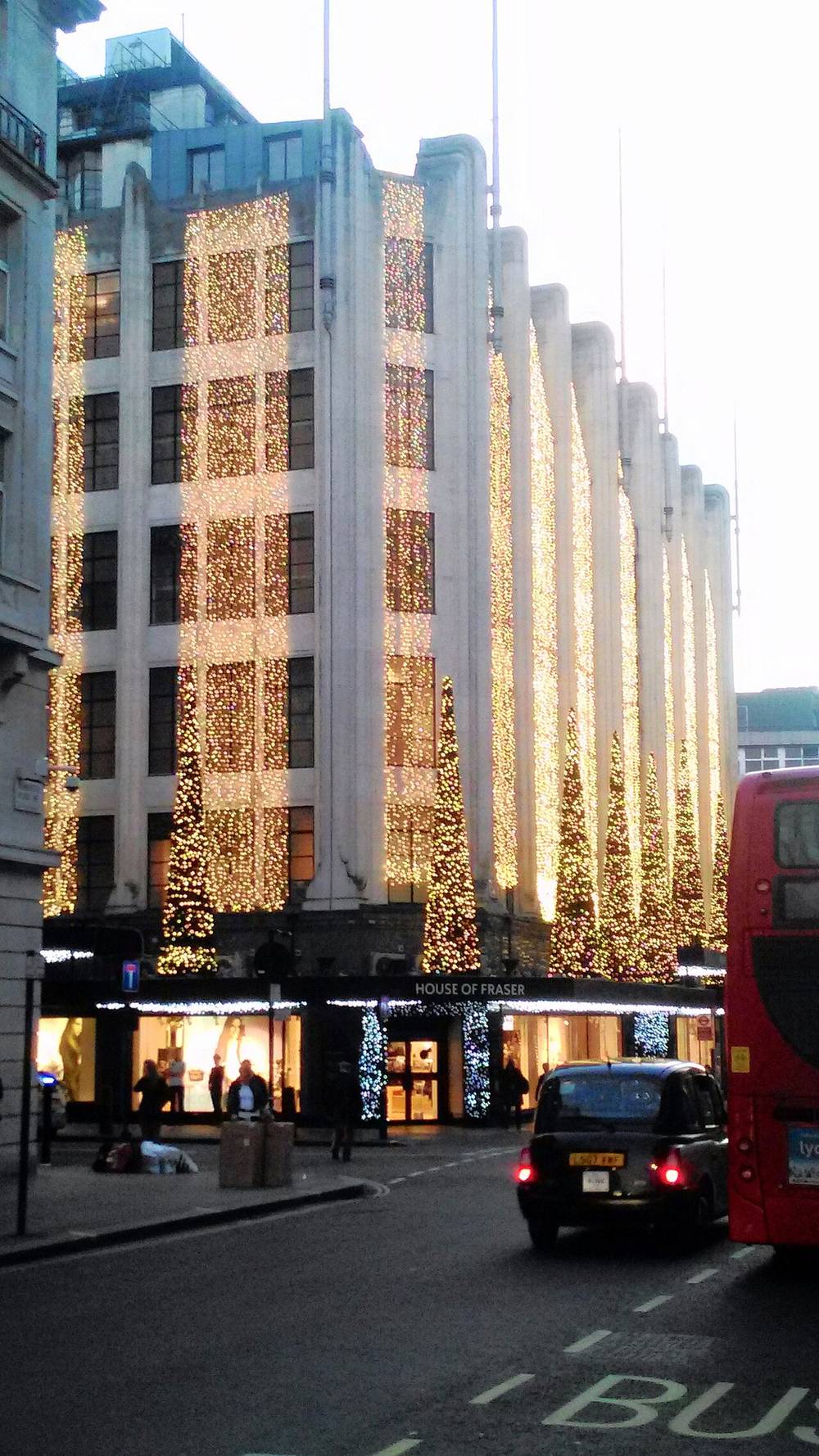
Professional holiday lighting designers follow rules that separate magazine-worthy from merely bright. Architectural honesty first: light should trace and celebrate the home's actual lines — rooflines, columns, window frames, entryways — not impose arbitrary patterns. A colonial wants crisp white roofline tracing and wreaths; a modernist home wants restrained linear accents that echo its geometry. Fighting the architecture with unrelated motifs always looks cheaper than it cost.
Layering creates depth: roofline plus trees plus entry plus pathways reads as designed, while roofline alone reads as installed. The layers should share a color story — warm whites (2700-3000K equivalent) with one accent color is the timeless formula; full rainbow is a choice that dates quickly. Restraint with brightness matters enormously: slightly dimmer than maximum almost always looks more expensive, because it reads as glow rather than glare. Quality systems dim smoothly; cheap ones do not.
The entry deserves disproportionate attention — it is where guests actually look. A pair of lit urns or trees flanking the door, a wreath scaled generously to the door size (undersized wreaths are the most common design error), and warm path lighting guiding the eye to the entrance will outperform any amount of roofline spectacle. Design from the street view backward: stand where visitors and neighbors actually stand, and compose for that vantage point.
One more professional habit worth stealing: photograph the display from the street each season and compare year over year. Small refinements — dimming one over-bright tree by ten percent, warming the entry color temperature slightly, re-aiming a path light — compound into a display that looks effortlessly perfect. The best holiday lighting never looks “designed” at all; it looks inevitable, as if the house simply glows that way.
Seasonal Pro Installs: Getting Your Money's Worth
If you go seasonal, the designer selection is everything. The best firms do a daylight site visit, photograph your home from multiple angles, and present a rendered or sketched proposal — not a verbal "we'll make it look great." Ask for addresses of previous seasons' work and drive by at night; portfolios are curated, streets are honest. Confirm what happens when strands fail mid-season (the answer should be "we monitor and replace within days, included") and who carries liability if a ladder goes through a window.
Scope the contract precisely: design fee versus installation labor, takedown and storage (climate-controlled storage extends LED life significantly), mid-season service visits included, and the removal deadline. January removals that slip into March are a neighborhood eyesore and sometimes an HOA violation — put the date in writing. Also clarify who owns the lights: some firms lease their inventory (lower annual cost, no asset), others sell you the strands and store them (higher first year, lower renewal).
Book early. Top seasonal designers in major metros are fully committed by September, and October bookings get the leftover crews. If you are reading this in November hoping for this season, manage expectations or pay rush premiums — and use the experience to book next year's design consultation in August, when the best firms do their planning.
What It Costs in 2026
Permanent roofline pixel systems professionally installed typically run $15-$35 per linear foot, putting a complete installation on a 3,000-4,000 square foot home at $6,000-$18,000 depending on linear footage, track finish work, controller sophistication, and smart home integration. Premium installations with custom color-matched tracks, extensive ridge and gable coverage, and full automation integration can reach $20,000-$30,000 on large or complex homes.
Seasonal professional design-install-takedown service generally costs $2,500-$8,000 per season for a comprehensive luxury-home display, with elaborate designs (extensive tree wrapping, grounds, multiple structures) reaching $10,000-$20,000. First-year costs run higher when you are purchasing the light inventory; renewal years drop if the firm stores your strands. DIY-grade materials for the same visual impact would cost a fraction in parts — and an enormous amount in ladder time, which is the actual product you are buying.
Costs are 2026 US market ranges; get itemized local quotes. Permanent systems need a licensed electrician for the line-voltage supply work (the low-voltage pixel wiring is typically the lighting contractor's scope), and both permanent and seasonal work should carry the installer's liability insurance — verify it, especially for roof work. Budget 10-15 percent for the controller and integration if you want the system in your smart home platform rather than a standalone app.
Electrical, HOA, and Practical Considerations
Permanent systems need dedicated, GFCI-protected outdoor circuits sized for the pixel load plus headroom — your electrician should plan for the system's maximum draw, not its typical scene. Outdoor-rated enclosures for controllers and power supplies, proper grounding, and surge protection are non-negotiable; holiday lighting that shares an overloaded general-purpose circuit is how nuisance breaker trips happen on Christmas Eve. Permits are generally not required for low-voltage lighting, but the line-voltage supply work follows normal electrical permit rules.
HOAs are the wildcard. Many associations regulate holiday decoration timing (up by X, down by Y), brightness, and animation — and a permanent system that can display team colors in July may technically violate "holiday decorations only in December" rules even when showing tasteful architectural accent lighting. Get written clarification before installing: specifically, whether year-round subtle accent use of the system is permitted. This conversation goes much better before the tracks are on the roof than after a violation letter.
Finally, think about the other 11 months. The underappreciated superpower of permanent pixels is architectural accent lighting year-round — a soft warm wash on the facade for summer entertaining, amber for autumn, team colors for game day. Owners who use the system monthly rather than annually report the highest satisfaction by far, and it transforms the ROI conversation: this is not a Christmas expense, it is a landscape and facade lighting system that happens to do Christmas brilliantly.
Frequently asked questions
Quality installations are nearly invisible in daylight — slim aluminum tracks color-matched to your fascia and soffit, with pixels recessed inside. The daytime appearance is the true craft differentiator between installers, so always ask to see noon-in-July photos of prior work, not just nighttime glamour shots.
Commercial-grade pixels typically last 5–10 years depending on sun exposure, heat, and build quality, with individual pixel failures replaceable rather than requiring a whole new run. UV-stable housings and proper voltage design (power injection to prevent end-of-run dimming) are the biggest longevity factors. Budget for occasional pixel replacement as routine maintenance.
That's their best feature. Individually addressable pixels can display any color scheme for any occasion — Halloween, Diwali, Fourth of July, game days, or simple warm-white architectural accent lighting on an ordinary evening. Owners who use the system year-round consistently report the highest satisfaction and the easiest ROI justification.
Most HOAs permit the hardware but regulate its use — decoration windows, brightness, and animation are the common controls. The gray area is year-round accent lighting, which some associations classify as holiday decoration regardless of how tasteful it looks. Get written clarification on off-season use before installation, not after a violation notice.
For permanent systems, yes — a licensed electrician should install the dedicated GFCI-protected circuits, outdoor controller enclosures, and surge protection. The low-voltage pixel wiring itself is usually the lighting contractor's work. For seasonal pro installs, verify the firm's insurance covers roof work; for DIY seasonal lights, never overload circuits or staple through wire insulation.
Each addressable pixel can display its own color independently, enabling gradients, effects, and per-holiday scenes from one installation. Regular LED strings (even color-changing ones) change in large zones or all together, which looks flat by comparison. Addressable is the standard for permanent architectural systems; strings remain fine for seasonal tree and shrub work.