Smart Home Tech for Pets: 2026 Guide
Smart home tech for pets in 2026: pet cameras, automatic feeders, smart fountains, and electronic pet doors — real installed costs and our buying advice.
10 MIN READ · UPDATED 2026-09-22
Key takeaways
- Budget $600–$1,500 in equipment for a complete pet tech setup; through-wall pet door installation can add $800–$2,000.
- Temperature and humidity sensors with phone alerts are the highest-value pet purchase — pets can't open doors during HVAC failures.
- Buy feeders for jam-resistant mechanisms and battery backup, not cameras and gimmicks; verify the schedule works without Wi-Fi.
- Microchip-reading pet doors beat collar-tag models: no tag to lose, no battery to die, and the chip doubles as ID.
- Prefer devices that work locally or come from established vendors — orphaned pet gadgets die when their cloud shuts down.
Your dog does not care about your smart home. But the camera that lets you check on her from the office, the feeder that never misses breakfast, and the pet door that keeps raccoons out while letting her in — those matter a great deal to the person paying for them. Pet technology has matured from gimmicky treat-tossing toys into a serious category of connected home gear, and in 2026 the best options integrate cleanly with the rest of your smart home instead of living as orphaned apps. This guide covers pet cameras, automatic feeders, and electronic pet doors for owners who want reliability over novelty, including real installed costs and what to skip.
Pet Cameras: What Separates Good From Gimmicky
A pet camera is the foundation of connected pet care, and the difference between a good one and a cheap one shows up exactly when it matters: at night, in a noisy house, when you need to know whether that thump was the dog or the dishwasher. Look for 2K or better resolution, true color night vision rather than grainy infrared-only images, and two-way audio with echo cancellation so your voice does not come through as a distorted bark that startles the animal you are trying to calm. Person-and-pet detection matters more than generic motion alerts; without it you will get pinged every time a curtain moves. The best cameras distinguish pets from people and let you set activity zones around crates, beds, and doorways.
Pan-and-tilt cameras earn their keep in larger rooms because a fixed lens pointed at an empty couch tells you nothing about the dog asleep under the dining table. Treat-tossing models are fun, but treat them as a bonus, not a buying criterion — the mechanism jams, the novelty fades, and you are paying a premium for a feature you will use for two weeks. What actually matters over years of ownership is the app's reliability, whether clips are stored locally on an SD card or require a subscription, and how the camera behaves when your internet drops. Cameras with local storage keep recording during outages; cloud-only models go blind.
Privacy deserves a serious paragraph because pet cameras sit inside your home, often pointed at living areas. Choose cameras from established vendors with two-factor authentication, end-to-end encrypted streams where available, and physical shutter or privacy-mode options. If the camera supports your home platform — Apple Home, Google Home, or Home Assistant — you gain local control and automations, like having the living room camera arm automatically when the security system arms. Budget $80–$200 per camera for quality standalone pet cameras in 2026, plus $5–$15 per month per camera if you want cloud clip history. A two-camera setup covering the main pet areas typically runs $200–$450 before any subscription.
Automatic Feeders Worth Trusting
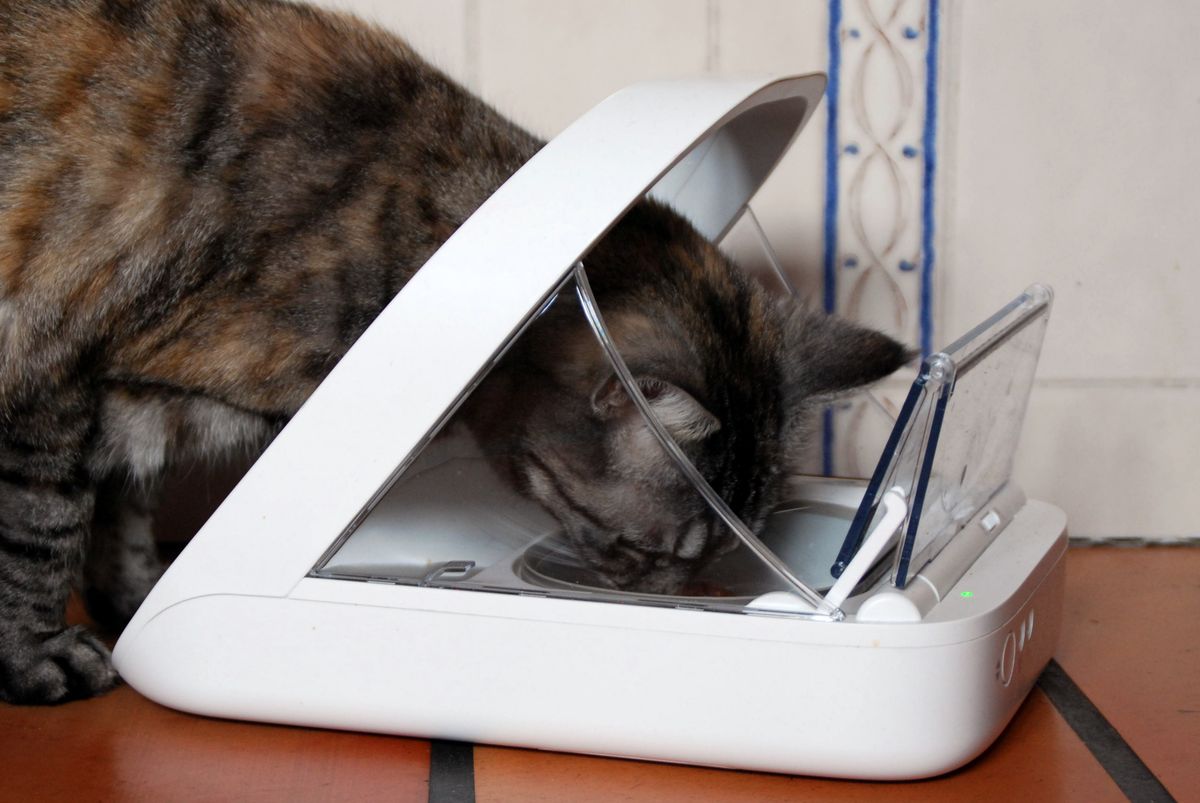
An automatic feeder is the single piece of pet tech that changes daily life the most, and it is also the one where cheaping out has the most obvious consequence: a jammed auger and a hungry animal. The failure modes are mechanical, so buy for mechanism quality. Gravity feeders have no electronics to fail but offer zero portion control and invite overeating. Motorized hopper feeders with scheduled dispensing are the standard for dogs and cats; the ones worth buying have jam-resistant dispensing mechanisms, sealed food storage to keep kibble fresh, and battery backup so a power blip does not skip a meal. For cats, portion control down to small increments matters because feline obesity is genuinely a health problem; for large dogs, capacity and a chew-resistant build matter more.
Smart features should serve the feeding, not distract from it. Useful: app-based scheduling with multiple daily meals, slow-feed dispensing modes, low-food alerts, and a manual feed button for the times the schedule is wrong. Marginal: built-in cameras (a separate pet camera pointed at the bowl is better and cheaper), voice recording playback (most pets learn to ignore it within days). Wet-food feeders with ice packs exist for cats on wet diets, but they are a different product category with real hygiene demands — sealed compartments, dishwasher-safe trays, and realistic expectations about how long chilled food stays safe at room temperature.
Plan for $120–$300 for a quality smart feeder in 2026, with premium dual-hopper or large-capacity models reaching $350. That price buys reliability; the $40 feeder with 2-star reviews buys a service call to your neighbor when it jams mid-vacation. If you travel, the feeder plus a pet camera pointed at the bowl is the minimum viable remote-feeding setup — the camera confirms the meal actually dispensed, which is the part the feeder's app cannot verify. Costs are 2026 US market ranges; get itemized local quotes if you are having anything hardwired or built in.
Smart Water Fountains and Hydration Monitoring
Cats in particular drink more from moving water, and a good fountain genuinely increases water intake — which matters for urinary health. The 2026 generation of smart fountains adds water-level sensing, filter-life tracking, and pump-failure alerts to your phone, solving the two classic fountain problems: discovering the pump has been running dry for a day, and forgetting the filter until the water looks questionable. Stainless steel or ceramic models beat plastic for hygiene and durability; plastic fountains develop biofilm faster and some cats develop chin acne from plastic contact. Whatever you buy, commit to the maintenance: filters every 2–4 weeks, full disassembly and cleaning weekly.
Hydration monitoring — fountains and bowls that track how much your pet drinks — is genuinely useful for senior pets and animals with kidney or urinary conditions, where a change in water intake is an early warning sign. The data is approximate rather than clinical-grade, so treat trends as prompts to call your vet, not as diagnoses. Pair the fountain with a water sensor on the floor beneath it; fountains leak, pumps fail, and a $30 leak sensor under a fountain on hardwood floors is cheap insurance. Expect $60–$150 for a quality smart fountain, plus $5–$10 per month for replacement filters depending on the model and your water hardness.
Electronic Pet Doors Done Right
A standard pet flap is an open invitation to raccoons, stray cats, and weather. Electronic pet doors fix this with selective entry: the door reads your pet's implanted microchip or a collar tag and unlocks only for them, staying sealed against everything else. Microchip-reading doors are the better choice — no collar tag to lose, no battery in a tag to die, and the chip your pet already has for identification does double duty. Look for doors with a secure locking mechanism rather than a simple magnetic flap, weather sealing rated for your climate, and a manual override for power outages.
Installation is where pet doors get expensive and where planning pays off. A flap in a hollow-core interior door is a Saturday project. A flap in an exterior wall, a sliding glass door panel, or a custom door is skilled work: cutting a weathertight opening in an exterior wall means dealing with framing, insulation, flashing, and siding, and a botched job leaks air and water for years. Sliding-door inserts avoid cutting anything but eat into your doorway width and rarely match the door's energy performance. For renters or historic homes where cutting is off the table, window-mounted or panel inserts are the compromise.
Expect $150–$400 for the door unit itself, with microchip models at the higher end. Professional installation adds $200–$600 for door-mounted units and $800–$2,000 for through-wall installations, depending on wall construction. If your home is in an HOA, check the rules before cutting an exterior opening — some associations restrict visible exterior modifications. And size the door for the pet you will have in five years, not just the puppy in front of you; replacing an installed pet door because the dog outgrew it is an avoidable expense.
Environmental Safety: Heat, Air, and Alerts
The most valuable pet tech is the boring kind: the sensor that texts you when the house gets too hot. Pets left home during a summer power outage or HVAC failure are at genuine risk, and a $50 temperature and humidity sensor with phone alerts is the highest-value purchase in this entire guide. Place sensors at pet height in the rooms where animals actually spend the day — heat stratifies, and a thermostat at five feet on the hallway wall does not know what the crate in the sunroom feels like. Set alerts for both high and low thresholds, and make sure at least one sensor can reach you during an internet outage; sensors that report through a local hub with cellular backup keep working when the Wi-Fi does not.
Smoke and carbon monoxide protection deserves the same seriousness. Standard detectors protect people who can leave; pets cannot open doors, so early warning plus a plan matters more. Smart smoke and CO detectors that push alerts to your phone buy you the chance to call a neighbor or rush home. If you have a monitored security system, confirm that smoke and CO sensors trigger the same dispatch response whether you are home or not — some panels treat them differently. Air quality monitors add a third layer: wildfire smoke seasons now affect large parts of the country, and a PM2.5 sensor that triggers your HVAC fan or a portable purifier automatically is a meaningful upgrade for brachycephalic breeds and senior animals.
None of this replaces the fundamentals: a reliable HVAC system, a neighbor with a key, and your vet's number saved in your phone. The sensors are the notification layer on top of a plan. Budget $150–$400 for a solid environmental monitoring setup — two or three temperature sensors, a leak sensor under the fountain, and smart smoke/CO coverage in pet areas — which is modest money against the value of the animals it protects.
Costs, Installation, and What to Skip
Add it up and a well-built pet tech setup for a typical home runs $600–$1,500 in equipment: two cameras, a quality feeder, a smart fountain, environmental sensors, and an electronic pet door, self-installed where reasonable. Add $800–$2,000 if the pet door needs through-wall professional installation, and $5–$30 per month in subscriptions for cloud clip storage and app features. That is the honest all-in number for 2026, and it is worth comparing against the cost of a single emergency vet visit or a week of pet-sitting — the tech pays for itself quickly if you travel or work long hours.
What to skip: single-purpose gadgets with their own apps that duplicate what your cameras and sensors already do, subscription-locked features on hardware you already bought, and anything marketed primarily as a toy. The pet tech graveyard is full of companies that sold a cute device and shut down the cloud service two years later — prefer devices that work locally or from vendors large enough to still exist in five years. Check that feeders, cameras, and doors work during internet outages for their core functions; a feeder that cannot dispense on schedule without Wi-Fi is a liability, not a convenience.
Start with the unglamorous trio — temperature sensor, camera, feeder — and expand only where you see a real gap. The goal is not a home full of blinking pet gadgets; it is the quiet confidence that when you are away, the animals are fed, watered, comfortable, and watched. Costs are 2026 US market ranges; get itemized local quotes for any hardwired or built-in work, and use licensed professionals for anything involving electrical or exterior-wall modifications.
Frequently asked questions
A complete setup — two pet cameras, a quality automatic feeder, a smart fountain, and environmental sensors — runs $600–$1,500 in equipment, plus $5–$30 per month for cloud storage and app subscriptions. Professional through-wall pet door installation adds $800–$2,000. Start with a temperature sensor, camera, and feeder for under $400 if you want the essentials first.
Only the good ones. Quality feeders have battery backup and store their schedule locally, so meals dispense even with no power or Wi-Fi. Cheap feeders lose their schedule when the power blips. Before buying, confirm that scheduled dispensing works offline — a feeder that needs the cloud to serve breakfast is a liability when you travel.
For most owners, yes. Microchip doors read the ID chip your pet likely already has, so there's no collar tag to lose and no tag battery to replace. They unlock only for your registered pets and stay sealed against raccoons, strays, and weather. Collar-tag models work fine too, but add a maintenance item and fail open (or closed) when the tag is lost.
Mid-range and premium cameras now offer pet-specific detection that distinguishes animals from people and ignores curtains, shadows, and light changes. Set activity zones around crates, beds, and doorways to cut false alerts further. Without pet detection you'll get notified constantly, which trains you to ignore the alerts that matter.
A temperature and humidity sensor with phone alerts, placed at pet height in the rooms animals actually use. Pets left home during a summer power outage or HVAC failure are at real risk of heatstroke, and a $50 sensor that texts you is the cheapest meaningful protection in connected pet care. Pair it with smart smoke and CO detectors that alert your phone when you're away.
It can do both. Cutting into an exterior door typically voids that door's warranty, and many HOAs restrict visible exterior modifications — check your CC&Rs before cutting. Sliding-door panel inserts and window-mounted units avoid permanent changes entirely. For through-wall installs, hire a professional; a botched opening leaks air and water for years.