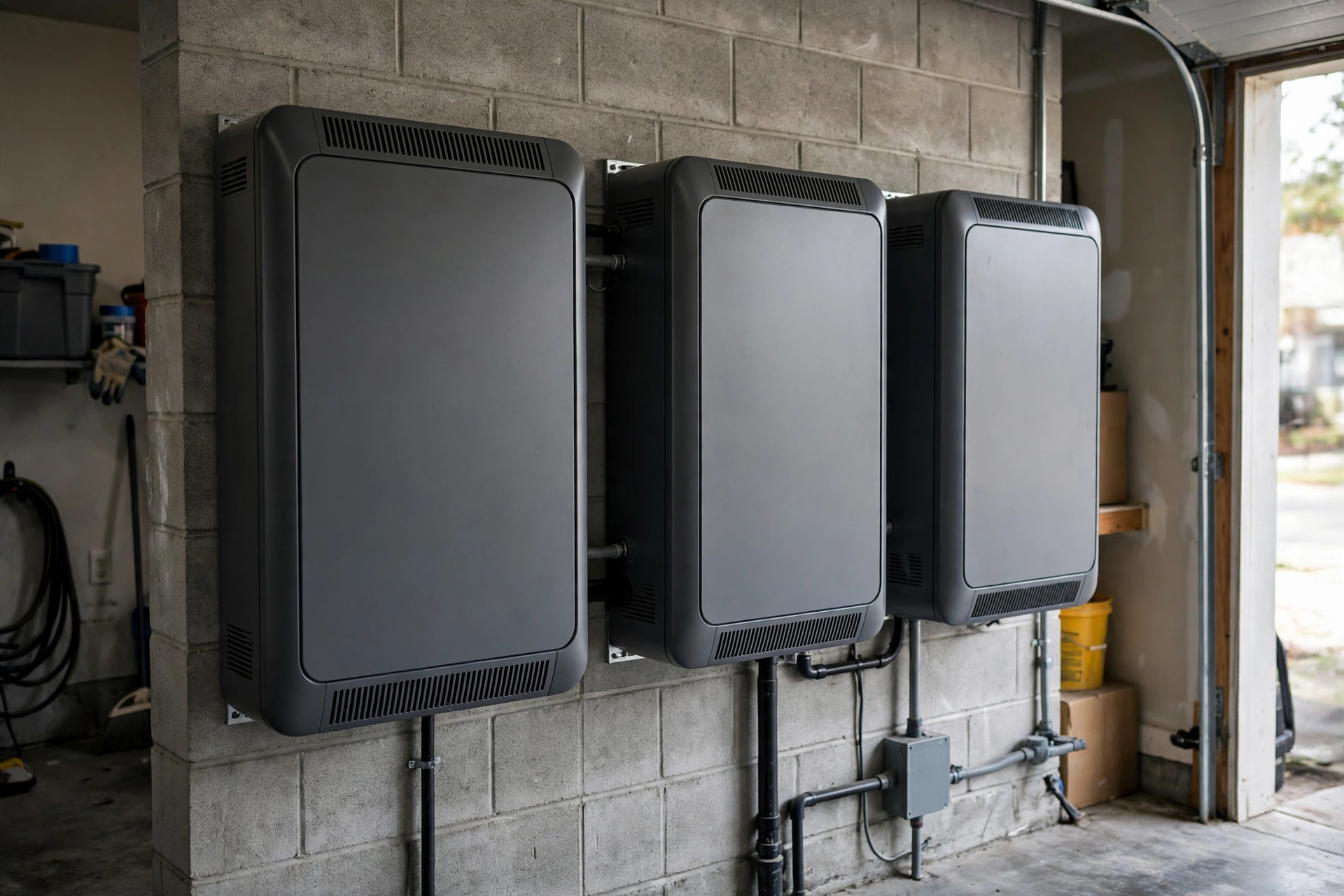
Can a Home Battery Run a Refrigerator Overnight? Runtime Math (2026)
Key takeaways
- Yes — a home battery can run a refrigerator overnight: a typical full-size fridge needs only about 0.5 to 0.75 kWh across a 12-hour night.
- A 2 kWh portable power station holds enough usable energy for roughly a full day of fridge-only runtime; a 10+ kWh home battery stretches that to a week or more.
- The spec that trips people up is not capacity but startup surge — a fridge compressor can briefly draw 800 to 1,200 watts when it kicks on.
- Keep the doors closed and skip the ice maker and through-door dispenser during an outage: every opening and every extra load shortens runtime.
- Size for your fridge's real daily consumption from its EnergyGuide label (annual kWh divided by 365), not the wattage printed on the back.
Can a home battery run a refrigerator overnight? Yes — comfortably. A typical modern full-size refrigerator draws only about 0.5 to 0.75 kWh across a 12-hour night, so even a modest 2 kWh portable power station carries enough usable energy for a full night of fridge backup, and a 10 kWh or larger home battery can keep the same fridge cold for many days.
The reason this question comes up so often is that refrigerators feel like big loads. They are tall, they hum, and losing one means losing hundreds of dollars of food. But a fridge is not a space heater or an air conditioner. Its compressor cycles on and off all day, so its average power draw is far lower than the wattage on its rating plate. Once you separate average draw from surge draw, the overnight math becomes simple — and reassuring.
How Much Energy a Refrigerator Actually Uses Overnight
A refrigerator's energy use is best read from its yellow EnergyGuide label, which states annual consumption in kWh. Divide that number by 365 and you have the fridge's real daily appetite. A modern Energy Star full-size fridge typically lands between 350 and 550 kWh per year, which works out to roughly 1.0 to 1.5 kWh per day. An older or very large side-by-side with an ice maker can reach 2 kWh per day, while a compact or highly efficient top-freezer model may use under 1 kWh per day.
Overnight, the picture is even kinder. Nighttime hours are cooler, the kitchen is dark, and nobody is opening the door every twenty minutes. A fridge that uses 1.2 kWh across a full day will typically use only about 0.5 to 0.6 kWh between 8 p.m. and 8 a.m. That is the number your battery actually has to cover to get you through the night.
Notice the last column: the average draw of a standard fridge is only about 50 to 60 watts — less than an old incandescent light bulb. That is why the overnight answer is yes for almost any home battery on the market.
EF ECOFLOW DELTA Pro Ultra 12kWh Power Station

High-capacity LiFePO4 home battery that runs a refrigerator overnight many times over; ideal pick for fridge-backup buyers
*Affiliate Disclosure: As an Amazon Associate, Elevate Home earns from qualifying purchases. Pricing and availability subject to change.
The Runtime Formula: Turning Battery Size Into Hours
To work out how long any battery will run your fridge, use three numbers: the battery's rated capacity in watt-hours, its usable fraction, and your fridge's average draw.
Usable energy = rated capacity × depth of discharge × inverter efficiency. Modern lithium iron phosphate (LiFePO4) batteries allow roughly 90 percent depth of discharge, and a good inverter runs at about 85 to 90 percent efficiency. So a battery's usable energy is typically around 80 percent of its headline number. Then divide usable watt-hours by the fridge's average watts to get runtime hours.
Worked example: a 2,000 Wh portable power station delivers about 1,600 usable watt-hours. Divide by a 50-watt average fridge draw and you get 32 hours — nearly three nights — from a battery many people assume would barely last one. Scale up to a 12 kWh home battery and the same fridge runs for more than a week on its own.
These are fridge-only figures. In a real outage you will also run lights, phones, and a router, which is why the practical rule is to size one tier above the bare minimum if the fridge is your must-not-fail load. If you are choosing between battery sizes for whole-home coverage, our 10 kWh vs 13.5 kWh vs 20 kWh comparison walks through how each tier behaves when the fridge is only one of several loads.
Startup Surge: The Spec Most People Miss
Capacity answers "how long," but the inverter answers "will it start at all." When a fridge compressor kicks on, it draws a brief surge — typically 3 to 6 times its running wattage — for a fraction of a second. A fridge that runs at 150 watts can surge to 800 to 1,200 watts at startup, and older models can spike higher.
This is the number one reason an undersized power station fails a fridge test: the battery has plenty of energy, but its inverter cannot clear the surge and shuts down on overload. The fix is simple — check the inverter's surge (peak) rating, not just its continuous rating. For a standard full-size fridge, look for an inverter rated at 2,000 watts continuous or better, which typically carries a 4,000-watt-plus surge rating and clears any normal fridge compressor with room to spare. Small 500-watt-class stations may run a compact fridge but will often trip on a full-size model, so match the inverter to the fridge, not just the battery size to the runtime.
One more electrical detail matters: use a pure sine wave inverter. Modern fridges use variable-speed compressors and electronic controls that can misbehave — or refuse to start — on the modified sine wave output of cheap inverters. Every reputable home battery and portable power station today outputs pure sine wave power, but it is worth confirming before you buy.
If you want your exact number instead of a table estimate, a plug-in kWh meter gives it to you in a day. Plug the meter into the wall outlet, plug the fridge into the meter, and read the cumulative kilowatt-hours after 24 hours of normal use. That single reading replaces every estimate in this article with your fridge's real consumption in your kitchen, at your room temperature, with your door-opening habits. Read the meter at bedtime and again in the morning for the exact overnight figure. It is the cheapest sizing tool you can own, and it removes all guesswork from choosing a battery size.
What Else You Can Run Alongside the Fridge
A fridge-only calculation is conservative, because a real outage night also includes lights, phones, a Wi-Fi router, and maybe a fan. The good news is that these are all small loads. LED lighting for a whole evening uses under 0.3 kWh, a router and modem together draw about 15 watts, and phone charging is negligible. Adding them to a 2 kWh station still leaves a full night of fridge runtime with margin.
What changes the math is heat and cooling: a space heater draws 1,500 watts continuously and will drain a 2 kWh station in about an hour, and a window air conditioner is nearly as hungry. The practical outage strategy is to treat the fridge as a protected circuit — it stays on the battery no matter what — and treat heating, cooling, and cooking as loads you ration or move to a generator. Our guide to home batteries for outage-prone areas covers how to split loads this way across a multi-day outage.
Stretching One Charge Through a Multi-Day Outage
If the outage runs past the first night, four habits stretch your battery dramatically. First, keep the fridge and freezer doors closed — every opening dumps cold air and forces a compressor cycle, and an unopened fridge holds safe temperatures for about four hours on its own even with no power at all. Second, turn off the ice maker and do not use the through-door water or ice dispenser; the ice maker alone can add 100 to 200 kWh per year to a fridge's consumption. Third, pre-chill: if a storm is forecast, turn the fridge a degree or two colder before the outage so it starts with a thermal buffer. Fourth, fill empty space with jugs of frozen water — thermal mass keeps temperatures stable and reduces how often the compressor cycles.
For outages longer than two or three days, solar recharge changes the equation entirely. A portable station that accepts solar input can top up during daylight hours, and even a single 400-watt panel in decent sun can replace most of what a fridge uses in a day. If your setup is a permanently installed home battery paired with rooftop solar, the system recharges itself daily and the fridge question effectively disappears. If you expect to grow your system over time, see our guide to expanding home battery storage for how modular batteries let you add capacity later without replacing the inverter.
Portable Power Station vs Whole-Home Battery for Fridge Backup
Both approaches keep a fridge running overnight; they differ in convenience and scope. A portable power station is the faster, cheaper route: you buy it, charge it, and plug the fridge directly into it when the power goes out. The trade-off is manual — you have to be home, you have to move the fridge plug, and the station powers only what you plug into it. A whole-home battery is wired into your electrical panel, switches over automatically in milliseconds (fast enough that the fridge never notices), and can back up several circuits at once, but it costs far more and requires professional installation.
For most households, the decision comes down to outage frequency. If your area loses power once or twice a year for hours at a time, a portable station in the 2 to 3.6 kWh range is the sensible fridge insurance. If you face multi-day outages every storm season, or you already have solar and want the whole house covered, a permanent battery is the better long-term answer — and the fridge is the load that justifies it first. Either way, size the system from your fridge's EnergyGuide number and the runtime formula above, and you will not be guessing.
Whichever route you choose, keep the battery itself ready. A lithium battery stored at full charge for months degrades faster than one stored near half charge, so check the manufacturer's storage guidance, and top the unit up the day a storm is forecast rather than leaving it plugged in year-round. A battery that is charged and waiting is the difference between a calm outage night and a scramble for ice at midnight.
The Verdict
Can a home battery run a refrigerator overnight? Yes — this is one of the easiest backup jobs a home battery can do. A standard fridge needs roughly half a kilowatt-hour across a 12-hour night, so even a 1 kWh station gets you through the night, a 2 kWh station covers two to three nights, and a 10 kWh home battery keeps the fridge cold for the better part of a week. Check two specs before you buy: enough usable capacity for your fridge's daily consumption, and an inverter with the surge rating to start the compressor. Get those right, keep the doors closed, and the food stays safe no matter what the grid does overnight.
Frequently asked questions
Can a home battery run a refrigerator overnight?
Yes. A typical full-size refrigerator uses only about 0.5 to 0.75 kWh across a 12-hour night, so almost any home battery or portable power station of 1 kWh or more can keep it running overnight. Larger batteries extend that to several days of fridge-only runtime.
What size battery do I need to run a fridge overnight?
For one night, a 1 kWh station is enough for most modern fridges. For two to three nights with margin for lights and phones, choose 2 to 3.6 kWh. For a week or more of fridge backup, or to run the fridge alongside other household circuits, a 10 kWh or larger home battery is the right tier.
Why does my power station shut off when the fridge compressor starts?
That is a surge problem, not a capacity problem. A fridge compressor briefly draws 800 to 1,200 watts at startup, and if the station's inverter surge rating cannot clear that spike it shuts down on overload. Choose a station with a 2,000-watt continuous inverter (typically 4,000 watts surge) for a full-size fridge.
How long will a 2,000Wh power station run a refrigerator?
About 32 hours of fridge-only runtime for a standard 1.2 kWh-per-day fridge, after accounting for roughly 80 percent usable energy. In practice that is two to three nights, or one night with lights, router, and phone charging added.
Can a home battery run a fridge and freezer at the same time?
Yes, if the combined load fits the inverter and the capacity. A separate chest freezer adds roughly 0.5 to 1 kWh per day, so a 2 kWh station covers about a day for both, while a 10 kWh home battery covers both for several days. Check the combined startup surge, since both compressors can occasionally start near the same time.
Keep reading
Battery Sizing
Sizing Home Batteries for All-Electric Homes: Heat Pumps, EVs & Induction
Sizing home batteries for all-electric homes takes different math: heat pumps, EVs, and induction change kW an…
Expansion
Adding a Second Home Battery: 2026 Guide
Adding a second home battery in 2026: modular vs add-a-box expansion, inverter headroom, rewiring, permits, an…
Pillar 01 · Energy Resilience
10kWh vs 13.5kWh vs 20kWh Home Battery: Which Size Is Right? (2026)
10kWh vs 13.5kWh vs 20kWh home battery compared: usable capacity, backup runtime, solar pairing, and which tie…
Pillar 01 · Energy Resilience
Best Home Battery for Outage Prone Areas 2026: Picks for Every Outage
Best home battery for outage prone areas 2026: installed vs portable picks, sizing math, and the verdict for s…
Pillar 01 · Energy Resilience
Bluetti vs EcoFlow Whole Home Battery Backup: Which Wins? (2026)
Bluetti vs EcoFlow whole home battery backup compared: output, capacity, solar input, automatic backup paths, …