Reading Your Home Water Test Before Setting Up a Tank
Key takeaways
- Test the tap before anything living goes in: ammonia and nitrite must read zero, chlorine or chloramine must be neutralised, and nitrate should sit under 20 ppm.
- pH stability matters more than pH perfection — match your stocking list to the water you actually have instead of dosing adjusters every change.
- Chloramine does not gas off by standing water overnight; only a dechlorinator rated for chloramine removes it.
- A tank that tests differently from the tap is telling you the substrate, rock or wood is shifting the water — find the cause before stocking.
- Test results assume filtration never stops, so outage backup belongs in setup planning, not in blackout improvisation.
Reading your home water test before setting up a tank means checking one thing first: whether the water coming out of your tap can support fish and plants without changes, and if not, exactly what to fix before anything living goes in. Test the tap, read six numbers — pH, ammonia, nitrite, nitrate, general hardness and carbonate hardness — plus chlorine or chloramine, and only then decide on stocking, plants and equipment.
Most setup failures blamed on "bad luck" are really untested water. A tank filled with untreated chlorinated tap water, or cycled in water whose pH swings every water change, will stress fish no matter how good the filter is. The test itself costs little and takes minutes; the mistakes it prevents — a crashed cycle, burned gills, melted plants — cost weeks. Do it in this order: test the tap, test the filled tank after 24 hours, then test again during cycling. Each round answers a different question.
Test the Tap First, Then the Tank
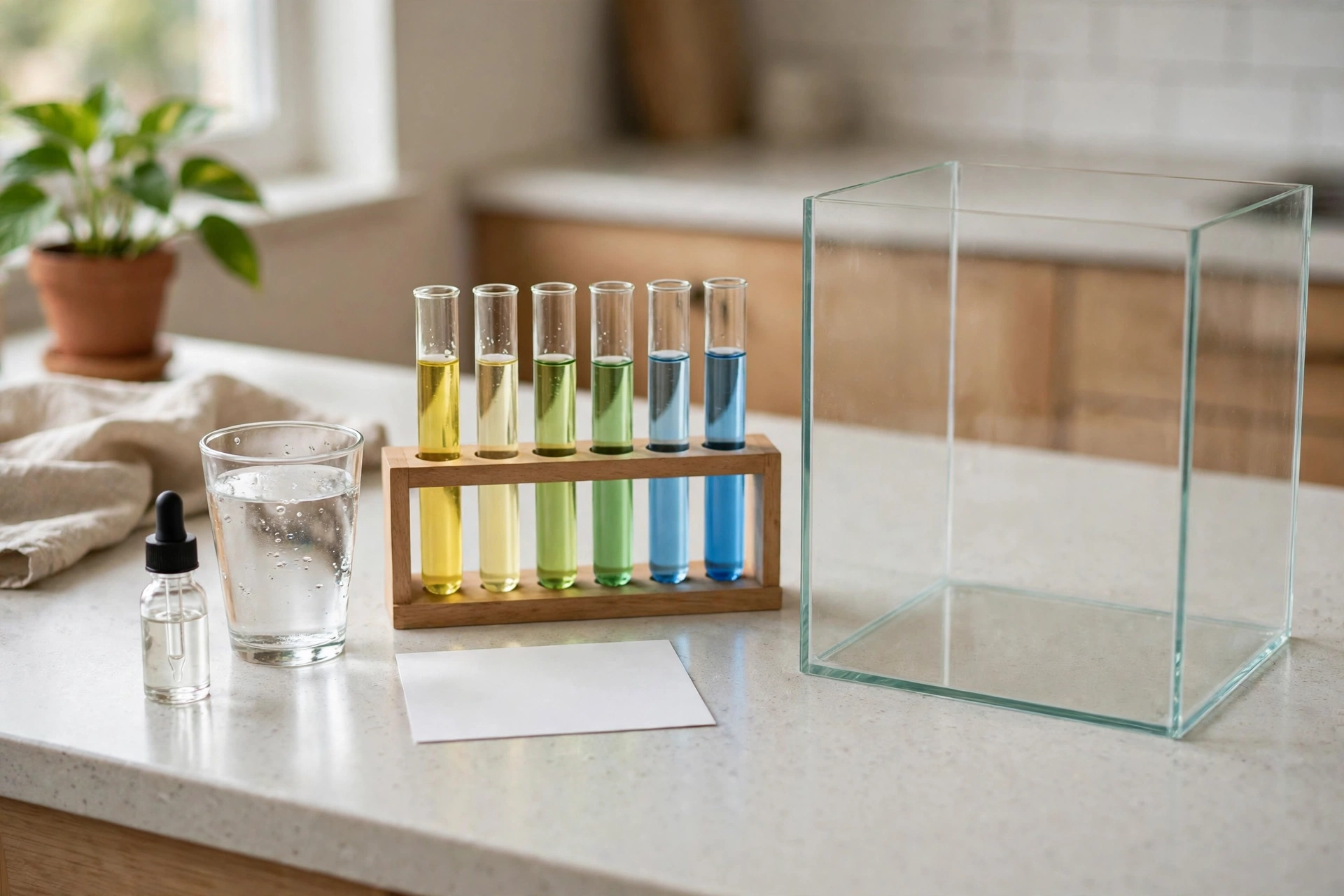
Your tap water is the baseline everything else is built on. Municipal supplies vary by city, by season and even by street, because treatment plants adjust disinfectant doses and source water changes through the year. A neighbour's perfect tap water tells you nothing about yours. Run the cold tap for 30 seconds, fill a clean glass, and test that sample — not water that has sat in a kettle, a filter jug or a hose.
The second test, after the tank is filled and the substrate and hardscape are in, tells you what the tank itself adds. New substrate can raise or lower pH, driftwood can soften and acidify water, and some rocks leach minerals that push hardness up. If the tap reads pH 7.4 and the tank reads 8.0 after a day, the tank — not the tap — is doing something, and you want to know that before fish are the test subjects. Our guide to how to read a water test walks through the mechanics of strips versus liquid kits if you are choosing between them.
Liquid reagent kits are the better choice for setup decisions. They cost more per test than strips, but they resolve the low ranges that matter — ammonia at 0.25 parts per million versus zero, for example — where strips often blur. Strips are fine for quick weekly checks later. For the pre-setup read, precision is the point: you are making stocking and treatment decisions off these numbers, so use the tool that can actually show them.
API Freshwater Master Test Kit (800-Test)
Live-verified 2026-10-27 via US Amazon listing (browser fetch): product title + Add to Cart present, ASIN B000255NCI confirmed on page, 1K+ bought in past week — the liquid reagent kit this guide recommends for the pre-setup read. No price or star rating claimed: the live US page fetch showed no price/rating, so none is stated.
*Affiliate Disclosure: As an Amazon Associate, Elevate Home earns from qualifying purchases. Pricing and availability subject to change.
The Numbers That Decide Your Setup
Six parameters plus disinfectant cover nearly every pre-setup decision. You do not need to memorise chemistry; you need to know each number's safe zone, what a reading outside it means, and which fix applies. The table below is the whole decision in one place.
Two of these deserve emphasis because beginners misread them most. First, ammonia and nitrite must both read zero before stocking — not "low", zero. Any detectable amount means the bacterial colony that converts waste is not established yet, and fish added now become the ammonia source while the colony catches up. Second, pH stability beats pH perfection. Fish adapt to a steady pH of 7.8 far better than to a pH that bounces between 6.8 and 7.8 with every water change because someone keeps dosing adjusters. If your tap is stable, build the stocking list around it.
How to Take a Sample You Can Trust
A bad sample produces a confident wrong answer, so technique matters more than kit brand. Test at the same time of day when comparing readings, because pH drifts slightly with temperature and dissolved carbon dioxide. Rinse the test tube in tank water, not tap water, before filling. Fill to the kit's line exactly — too much or too little water changes the reagent ratio and shifts the colour. Hold the tube against the white part of the colour card in daylight, not under yellow kitchen bulbs, which warm every colour by a shade.
Write results down with the date. Memory is a poor lab notebook, and the trend across a week of cycling tells you far more than any single reading: ammonia rising then falling, nitrite spiking then clearing, nitrate climbing slowly. That curve is the cycle happening in front of you. A single snapshot cannot show it, which is why the pre-setup read is a short series of tests, not one test on one evening.
Reading Your Results: What Each Outcome Changes
Work through the results in priority order, not the order printed on the kit box. Chlorine first — if it is present, nothing else matters until it is neutralised, because it kills the very bacteria you are trying to grow. Ammonia and nitrite second — both must be zero. Nitrate third — high tap nitrate is a setup constraint, not a failure: it means larger or more frequent water changes, or plants that consume nitrate aggressively, from day one. Hardness and pH last, because they mostly decide which fish suit your water, not whether the tank can run at all.
The single most useful sentence in this guide is this: match the fish to the water you actually have. The hobby's expensive failures almost all come from the opposite approach — buying fish that need soft, acidic water and then waging a permanent chemical war against hard, alkaline tap water. Water wins that war every time, and the fish pay for it. Your test result is not a problem to fix; it is a stocking list waiting to be read correctly.
Fix the Water Before Fish Go In
Three fixes cover most pre-setup readings, and none of them is a bottle labelled "pH adjuster". First, dechlorinate everything — every bucket, every top-off, without exception. Second, cycle the tank fishlessly: add a small ammonia source, test daily, and wait for ammonia and nitrite to read zero for several consecutive days while nitrate rises. That takes two to six weeks, and no product reliably shortcuts it to a weekend. Third, if hardness or pH genuinely blocks the species you want, change the water itself — blending with reverse-osmosis water or choosing a different species — rather than dosing adjusters that wear off between changes.
While the tank cycles, sort the room around it, not just the water in it. A tank's weight, its electrics and its leak risk all deserve the same pre-setup attention as the test result: our guides to how much a large aquarium weighs and what your floor needs to hold, aquarium electrical safety at home and leak-proofing a room for a big fish tank cover each one. The water test tells you the tank can run; those guides make sure the room can hold it safely.
Keep the System Running Once the Water Is Right
A clean test result is a snapshot of a running system, and it quietly assumes the filter never stops. Beneficial bacteria need oxygenated water flowing over them around the clock; a long power cut stalls that flow, and a stalled filter can dump ammonia back into the tank when it restarts. That is why setup planning should include outage planning, and why it is worth reading up on keeping filters and lights alive in an outage before the first fish go in rather than during the first blackout. Test results, filtration and backup power are one system, not three separate chores.
Retest Schedule and Setup Checklist
Once stocked, testing does not stop — it just slows down. Test weekly for the first two months, then every two weeks once readings are stable, and always after a water change with a new water source, a medication dose, a filter-media change or any fish death. Keep the log: a nitrate line creeping upward over months is your earliest warning that changes need to be larger or more frequent, long before fish show stress.
Before the first fish, run this checklist against your log: chlorine neutralised on every change, ammonia zero, nitrite zero, nitrate under 20 ppm, pH stable between tap and tank readings, stocking list matched to your hardness, and a retest plan written down. If every box is ticked, the water is ready. The fish are the last thing to add to a tank, not the first — and a test kit is what tells you the wait is over.
Frequently asked questions
Does letting tap water sit overnight remove chlorine and chloramine?
No. Chlorine gasses off if water stands for 24 hours, but chloramine — used by most US utilities today — does not. Check your utility's water quality report, and use a dechlorinator rated for chloramine on every water change unless you have confirmed your supply uses chlorine only.
How often should I test before adding fish?
Test the tap first, then the filled tank after 24 hours, then daily during fishless cycling until ammonia and nitrite read zero for several days running. After stocking, test weekly for two months, then every two weeks once readings are stable.
Are test strips accurate enough for a pre-setup read?
Not on its own. Test strips are fine for quick weekly checks, but their low ranges blur — exactly where setup decisions live, such as ammonia at 0.25 ppm versus zero. Use a liquid reagent kit for the pre-setup read, and keep strips for routine monitoring afterwards.
Why does my tank water test differently from my tap water?
Usually the tank, not the tap: substrate, rock or driftwood shifting pH or hardness. Remove or identify the suspect hardscape and retest after 24 hours before stocking, rather than dosing pH adjusters to force the numbers back.
My tap pH is 8.0 — do I need to lower it before stocking?
Match the fish to your water instead of fighting it. Stable pH matters more than a textbook value — fish adapt to a steady 7.8 far better than to a pH bouncing between 6.8 and 7.8 after every dosed water change.
Keep reading
Testing
How to Read a Water Test: 2026 Guide
How to read water test results: hardness, pH, TDS, iron, coliform, lead, arsenic explained — what each number …
Structural Safety
How Much Does a Large Aquarium Weigh? Floor Load Guide for Homeowners
A filled 55-gallon aquarium weighs 550-650 lbs. Tank weight table, IRC floor-load rules, and placement checkli…
Electrical Safety
Aquarium Electrical Safety: GFCI Outlets, Drip Loops & Power Near Water
GFCI protection, drip loops, and NEC rules for aquarium equipment: how to run heaters, filters, and lights saf…
Water Damage Prevention
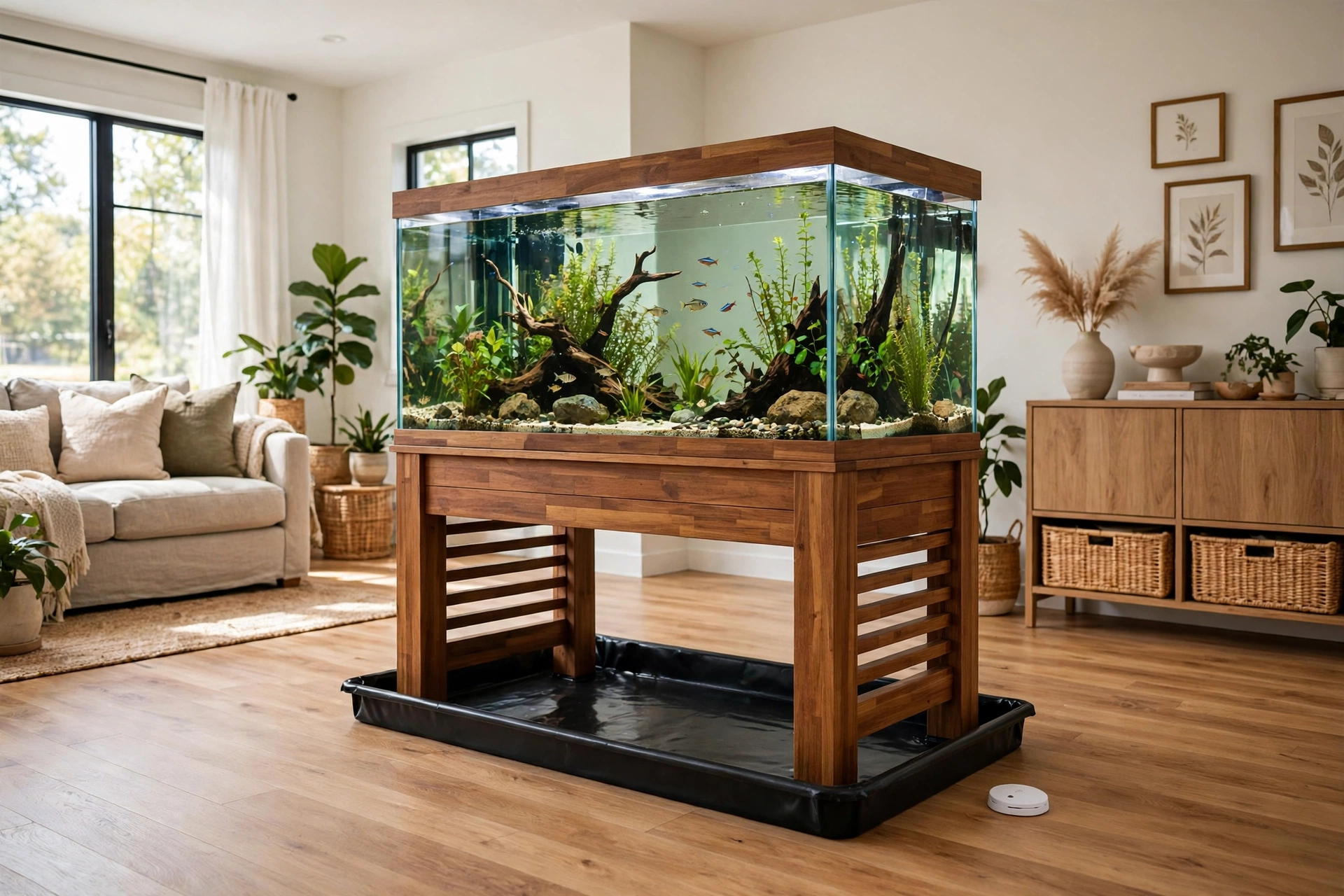
Leak-Proofing a Room for a Big Fish Tank: Water Damage Prevention
A big tank can release 75+ gallons in one failure. Layered leak-proofing — trays, sensors, shutoffs — that kee…
Transfer Equipment
100A vs 200A Automatic Transfer Switch
100 amp vs 200 amp transfer switch: service-entrance vs subpanel topology, when each is required, costs, and l…
Pillar 01 · Energy Resilience
10kWh vs 13.5kWh vs 20kWh Home Battery: Which Size Is Right? (2026)
10kWh vs 13.5kWh vs 20kWh home battery compared: usable capacity, backup runtime, solar pairing, and which tie…