Home Battery Backup Cost Per kWh Installed 2026: What Each kWh Really Costs
Key takeaways
- In 2026, home battery backup typically costs $800-$1,300 per usable kWh fully installed; the widely cited market average sits near $1,159 per kWh.
- Always divide by usable kWh, not nameplate kWh — depth of discharge and reserve settings can make two identically sized batteries 10-20% apart in real storage.
- Small systems carry the highest cost per kWh because fixed costs (inverter, backup panel, labor, permits) are spread over fewer kilowatt-hours.
- The federal battery tax credit that cut 30% off storage costs expired for purchases after December 31, 2025, so 2026 quotes depend far more on state and utility incentives.
- A quote below $700 per usable kWh deserves scrutiny: check what is excluded (panel upgrade, backup panel, permits, monitoring) before celebrating the bargain.
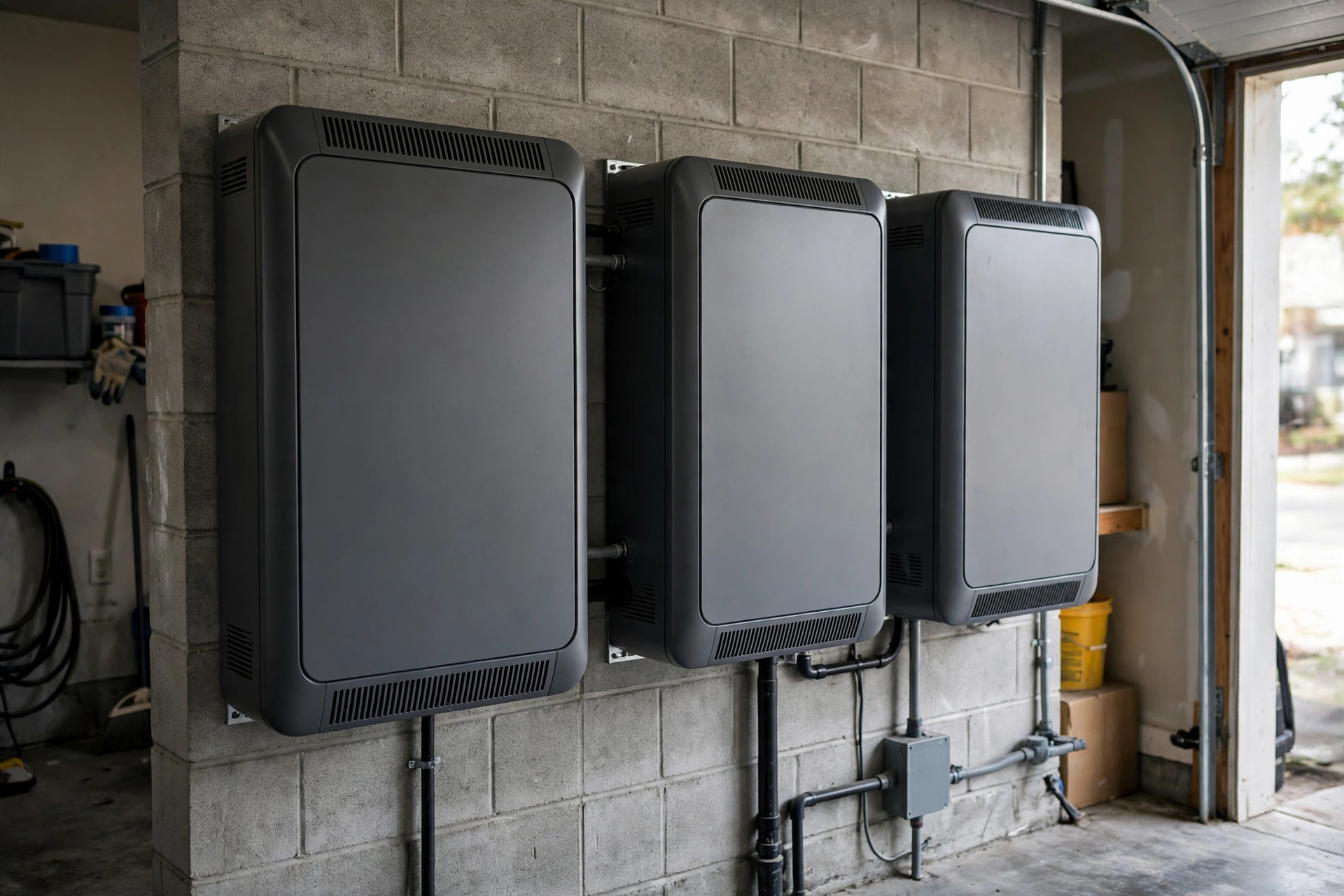
Home battery backup cost per kWh installed in 2026 typically runs $800-$1,300 per usable kWh fully installed, with the market average near $1,159 per kWh — which means a 13.5 kWh system lands roughly in the $11,000-$17,500 installed range before any state or utility incentive. That single metric, cost per usable kilowatt-hour, is the fairest way to compare battery quotes, because it strips away the marketing around system size and forces every bid onto the same denominator: what you pay for each kilowatt-hour you can actually use during an outage.
Most homeowners shop batteries backwards. They compare headline system prices — one installer quotes $14,000, another $19,000 — without asking how much usable storage each price buys, what equipment is included, or whether the cheaper bid quietly omits the backup panel, the panel upgrade, or the permit fees. Two systems with the same nameplate capacity can differ by thousands of dollars in installed cost and by real usable energy, and the cost-per-kWh figure exposes both gaps at once. This guide explains how the metric is calculated, what 2026 benchmarks look like by system size and brand, what pushes your number up or down, and how to use it to judge quotes without getting misled.
What Cost Per kWh Installed Actually Measures
Cost per kWh installed is simple arithmetic: total installed project cost divided by usable capacity in kilowatt-hours. Total installed cost means everything — battery modules, inverter, backup panel or gateway, disconnects, wiring, labor, permitting, inspection, and any required main-panel upgrade. Usable capacity means the energy you can actually draw, which is nameplate capacity multiplied by usable depth of discharge, minus any reserve your installer sets aside for daily cycling or backup-only operation.
The usable-versus-nameplate distinction matters more than most buyers expect. A lithium iron phosphate (LFP) battery with a 13.5 kWh nameplate and 100% usable depth of discharge delivers roughly 13.5 kWh. An older nickel manganese cobalt (NMC) design with the same nameplate but a 90% usable depth of discharge delivers about 12.2 kWh. Divide the same $15,000 installed price by those two denominators and you get $1,111 per kWh for the first and $1,230 per kWh for the second — a 10% difference hiding inside an identical headline capacity. Always ask installers to state usable capacity in writing, and recompute the metric yourself from their quote.
One more trap: some quotes divide by nameplate capacity and exclude the inverter or backup panel as a separate line item, producing an artificially low per-kWh figure. Others bundle a solar inverter replacement or a full panel upgrade into the battery price, inflating it. Neither is dishonest on its own, but neither is comparable until you normalize for what is included. The formula only works when the numerator is the complete, installed, permitted project and the denominator is usable energy.
EF ECOFLOW DELTA Pro Ultra with Smart Home Panel 2, 6144Wh Power Station

Modular 6.144kWh home battery buyers can scale; strong fit for a cost-per-kWh comparison audience
*Affiliate Disclosure: As an Amazon Associate, Elevate Home earns from qualifying purchases. Pricing and availability subject to change.
2026 Benchmarks: Cost Per kWh by System Size
Across 2026 market data, installed cost per usable kWh clusters between $800 and $1,300, with larger systems generally landing at the lower end of that range and small systems at the higher end. The reason is fixed cost: a 5 kWh system and a 20 kWh system both need an inverter, a backup panel, design work, permits, and a crew day, so the small system spreads those fixed costs over far fewer kilowatt-hours. The table below gives realistic 2026 ranges, before state or utility incentives.
Notice the pattern: per-kWh cost falls as capacity rises, but total cost rises steeply. Buying more storage than you need to chase a lower per-kWh figure is a false economy — a 27 kWh system at $900 per kWh still costs roughly twice a 13.5 kWh system at $1,150 per kWh. Size first from your loads (see our guide to sizing home battery backup), then use cost per kWh to compare quotes at that size. If you are still choosing between capacity tiers, our 10 kWh vs 13.5 kWh vs 20 kWh comparison walks through which tier fits which home.
What Pushes Your Cost Per kWh Up or Down
Seven factors explain most of the spread between a $850-per-kWh quote and a $1,300-per-kWh quote for the same capacity. First, the inverter: systems with an integrated hybrid inverter (Tesla Powerwall 3, FranklinWH aPower 2) bundle that cost into the battery, while AC-coupled retrofits to existing solar may need a separate inverter or a retrofit device — our AC-coupled retrofit cost guide covers that case in detail. Second, the backup panel: whole-home backup needs a larger gateway and more circuit work than essentials-only backup, and that labor shows up directly in the numerator.
Third, your main electrical panel. A home with a modern 200-amp panel usually needs no upgrade; a home with a 100-amp panel, a crowded panel, or an obsolete panel brand may need a $2,000-$5,000 upgrade before any battery can be installed safely, and that cost inflates the per-kWh figure through no fault of the battery. Fourth, chemistry and brand: LFP batteries now dominate residential storage and generally offer longer cycle life, while premium brands charge for warranty length, app quality, installer network, and features like storm-watch automation. Fifth, labor market: installation labor in California, the Northeast, and Hawaii runs well above the national average, and permitting timelines and interconnection fees vary by utility.
Sixth, whether the battery is installed with new solar or retrofitted to existing solar. A combined solar-plus-storage install shares design, permitting, and crew mobilization, usually lowering the battery's marginal cost per kWh. A standalone retrofit repeats those fixed costs for the battery alone. Seventh, scale within the home: adding a second battery module to an existing system is almost always cheaper per kWh than the first, because the inverter, gateway, and panel work are already done — which is why phased expansion can beat a single oversized purchase for budget-conscious buyers.
Brand Comparison: Cost Per kWh for the Systems Buyers Actually Cross-Shop
Brand-level cost per kWh is harder to pin down than system-size benchmarks because installers bundle different scopes, but the ordering is consistent. Tesla Powerwall 3 (13.5 kWh usable, integrated inverter) typically lands near the middle of the market on a per-kWh basis once installation is included, and its integrated design keeps the equipment count low. Enphase IQ Battery 5P (5 kWh per unit) looks expensive per kWh as a single unit but becomes competitive at 10 kWh with two units, because the second unit adds storage without a second inverter. FranklinWH aPower 2 (15 kWh per unit, with its aGate controller) competes on a per-kWh basis at larger sizes, where its single large unit covers whole-home loads that would otherwise need two smaller batteries.
Modular portable-based systems such as the EcoFlow DELTA Pro Ultra (6.144 kWh per base unit, expandable with extra batteries) play a different role: they can undercut permanent systems on upfront cost per kWh for partial-home backup, but they are not a like-for-like substitute for a hardwired whole-home system with automatic transfer, and comparing their per-kWh figure directly against a Powerwall or FranklinWH without adjusting for backup scope will mislead you. The right comparison is always at equal backup scope: same circuits backed up, same automatic transfer behavior, same usable capacity. Our time-of-use battery guide and Generac PWRcell cost-per-kWh analysis apply the same normalization to those specific systems, so you can see how the metric behaves brand by brand.
How to Use Cost Per kWh When Comparing Quotes
When three quotes land on your desk, run this five-step check before choosing. One: confirm each quote's usable capacity in writing, not nameplate capacity, and recompute cost per kWh yourself. Two: list what each quote includes — inverter, gateway or backup panel, disconnects, monitoring, permits, inspection, and interconnection — and add the cost of any missing item to the cheaper quote before comparing. Three: separate one-time site costs (panel upgrade, trenching, long wire runs) from battery costs, so a home with a difficult install is not blamed on the battery brand. Four: check warranty terms alongside price — a 10-year warranty versus a 15-year warranty changes lifetime cost per kWh even when upfront cost per kWh looks identical, because replacement or degradation risk lands differently. Five: ask whether the quote assumes any incentive, and recompute both gross and net cost per kWh; a quote that silently nets out a rebate you may not qualify for will look cheaper than it is.
Red flags deserve a second look, not an automatic rejection. A quote well below $700 per usable kWh in 2026 usually means something is excluded, the capacity is nameplate rather than usable, or the system is a portable unit being compared against hardwired systems. A quote above $1,400 per usable kWh for a mainstream 13.5 kWh system usually means a panel upgrade, a difficult install, a premium brand, or a high-labor market — any of which may be legitimate, but each should be itemized so you can see which one you are paying for. The metric's job is not to pick the cheapest battery; it is to force every bidder to explain their price in the same units.
Incentives and Net Cost Per kWh in 2026
Incentives change the net figure more than any other single factor, and 2026 is a transition year. The federal Residential Clean Energy Credit that previously cut 30% off qualifying battery storage expired for purchases after December 31, 2025, so buyers can no longer assume a federal credit in their net cost-per-kWh math. What remains is a patchwork: California's Self-Generation Incentive Program (SGIP) still offers storage rebates in certain territories, several utilities run bring-your-own-battery or virtual power plant programs that pay for grid services, and a handful of states offer their own storage incentives or tax treatments. None of these is universal, and several are capacity-limited or waitlisted.
That patchwork makes gross-versus-net discipline essential. Compare quotes on gross installed cost per kWh first, then apply only the incentives you have confirmed you qualify for, in writing, from the program administrator — not from a sales sheet. A $1,150-per-kWh gross figure that drops to $800 net after a confirmed state rebate is genuinely good value; the same $800 net figure built on an expired federal credit or an unconfirmed utility program is fiction. If an installer promises a net figure, ask them to show the program name, the eligibility rule you meet, and whether the incentive is paid upfront or as a later rebate, because cash-flow timing matters as much as the headline.
The Verdict: What Good Value Looks Like
For most US homeowners in 2026, good value is a mainstream 10-15 kWh LFP system, installed for $900-$1,250 per usable kWh gross, with the inverter, backup panel, permits, and inspection included, a 10- to 15-year warranty, and a backup scope matched to the loads you actually need during an outage — not every circuit in the house. Below that range, verify scope before celebrating. Above it, demand an itemized explanation: panel upgrade, premium brand, difficult site, or high-labor market. And size before you optimize: the cheapest battery per kWh is still a bad buy if it cannot run the loads that matter to you, and the most expensive per kWh can still be the right buy if it is the only system that covers your well pump, medical equipment, or central AC.
Use cost per kWh installed as your comparison lens, not your decision. Size from your loads, compare at equal backup scope, recompute every quote on usable capacity, and confirm incentives in writing. Do that, and the metric does what it is supposed to do: it turns three confusing quotes into one clear ranking, and it keeps a bargain that is not really a bargain from winning your signature. For the full picture on total project budgets rather than per-kWh math, see our whole-home battery backup cost guide.
Frequently asked questions
What is a good cost per kWh for a home battery in 2026?
A good value in 2026 is roughly $900-$1,250 per usable kWh fully installed for a mainstream 10-15 kWh LFP system, with inverter, backup panel, permits, and inspection included. The market average sits near $1,159 per kWh. Below $700 per usable kWh usually signals excluded scope, and above $1,400 usually reflects a panel upgrade, premium brand, or high-labor market.
Should cost per kWh use nameplate or usable capacity?
Always use usable capacity. Nameplate capacity is what the battery can theoretically hold; usable capacity is what you can actually draw after depth-of-discharge limits and reserves. Dividing by nameplate capacity flatters systems with restrictive usable limits by 10-20%, so ask installers to state usable kWh in writing and recompute the metric yourself.
Why is a small battery more expensive per kWh than a large one?
Because fixed costs — inverter, backup panel, design, permits, crew mobilization — are roughly the same whether the system is 5 kWh or 20 kWh. A small system spreads those fixed costs over fewer kilowatt-hours, so its per-kWh figure is higher even when its total price is lower. Adding a second module later is usually cheaper per kWh than the first unit.
Does the federal battery tax credit still apply in 2026?
No. The federal Residential Clean Energy Credit for battery storage expired for purchases after December 31, 2025. State programs such as California's SGIP, utility bring-your-own-battery programs, and virtual power plant payments still exist in some areas, but they vary by location and must be confirmed individually before counting them in a net cost-per-kWh figure.
Is the cheapest battery per kWh the best buy?
Not necessarily. Cost per kWh only compares fairly at equal backup scope, equal usable capacity, and equal warranty. A cheaper per-kWh system that cannot start your well pump or run your central AC, or that carries a shorter warranty, can cost more over its life than a pricier system that covers the loads that matter to you.
Keep reading
Pillar 01 · Energy Resilience
10kWh vs 13.5kWh vs 20kWh Home Battery: Which Size Is Right? (2026)
10kWh vs 13.5kWh vs 20kWh home battery compared: usable capacity, backup runtime, solar pairing, and which tie…
Pillar 01 · Energy Resilience
Generac PWRcell Cost Per kWh: What Each Stored Kilowatt-Hour Really Costs (2026)
Generac PWRcell cost per kWh in 2026: installed ranges by system size, what drives the price, and how it compa…
Cost Guide
Whole Home Battery Backup Cost: 2026 US Price Guide
Whole home battery backup cost in 2026: realistic US price ranges for equipment, installation, panel upgrades …
Pillar 01 · Energy Resilience
Best Whole Home Battery for Time of Use Rates 2026: Picks That Earn Their Keep
Best whole home battery for time of use rates 2026: TOU arbitrage math, the features that decide payback, and …
Pillar 01 · Energy Resilience
AC Coupled Battery Retrofit Cost 2026: What Adding Storage Really Costs
AC coupled battery retrofit cost in 2026: installed price ranges, what drives them up, and how AC coupling com…
System Sizing
How to Size a Home Battery Backup System: Partial vs Whole Home, Worked Math (2026)
Size a home battery step by step: critical loads, kWh math, surge checks, multi-day outages, and the partial v…