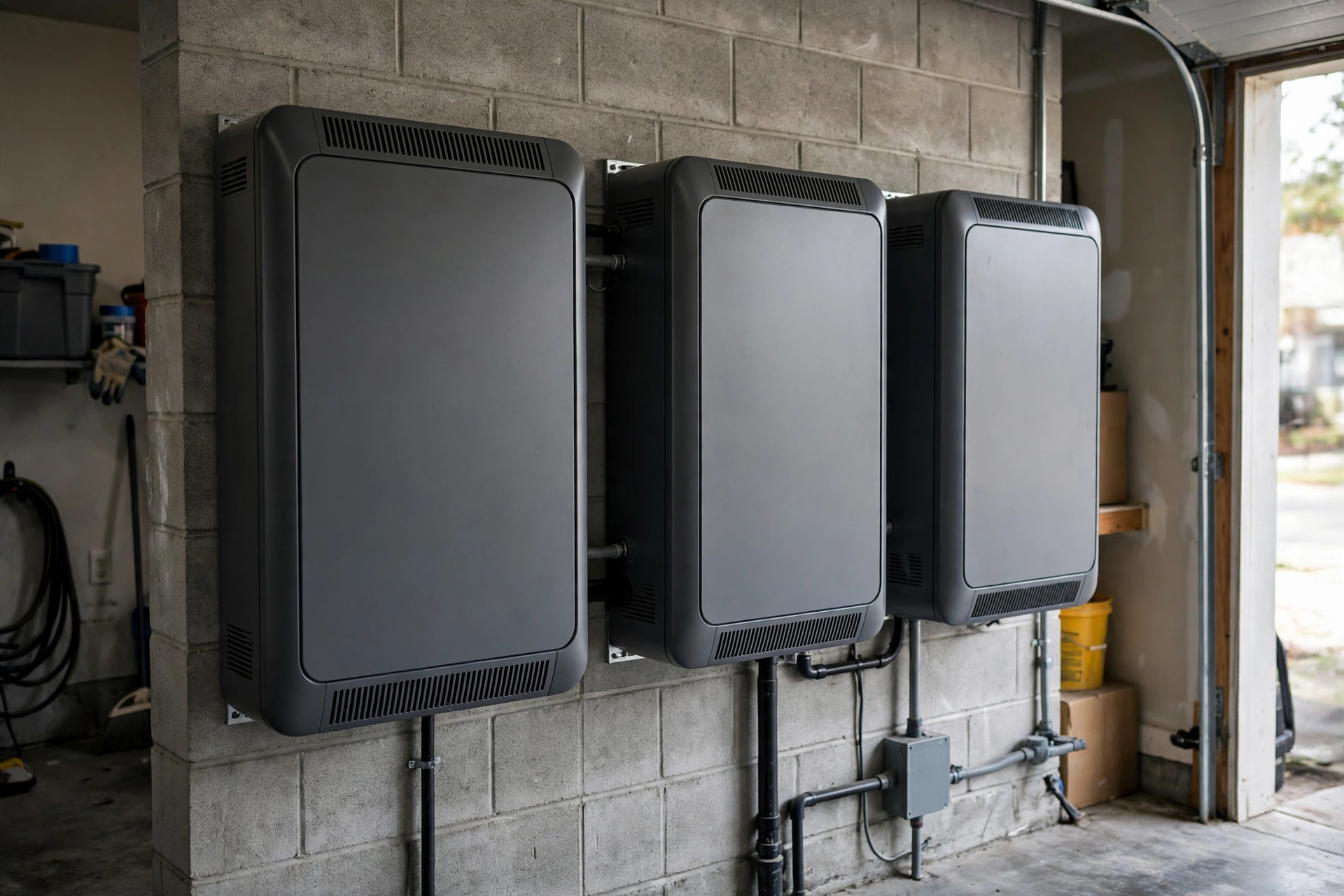
How Long Does a 10kWh Home Battery Last During an Outage? (2026)
Key takeaways
- A 10kWh home battery lasts roughly 22 hours on essential loads averaging 400W, about 12 hours at 750W, and only 2-3 hours if a central air conditioner is running.
- The runtime formula is simple: usable energy divided by average load. A 10kWh lithium battery typically delivers about 9kWh of usable energy after depth-of-discharge and inverter losses.
- The battery does not decide the runtime — your load list does. Backing up only essential circuits is the single biggest lever on how long the power lasts.
- A single 10kWh battery will not carry a whole home at normal usage through a multi-day outage; solar recharging during the day or a second battery is what makes multi-day coverage realistic.
- Surge loads matter as much as running watts: a central AC compressor or well pump can draw two to three times its running power at startup, and some systems will refuse the load entirely.
How long does a 10kWh home battery last during an outage? On essential loads alone — refrigerator, lights, Wi-Fi, and phone charging averaging about 400W — roughly 22 hours; at a more typical 750W household draw, about 12 hours; and with a central air conditioner running, just 2 to 3 hours, because runtime is not a property of the battery alone but of the loads you ask it to carry.
That range surprises people in both directions. Shoppers hear “10 kilowatt-hours” and assume a full day of normal living, or they hear “only a few hours” and dismiss the battery as useless. Both reactions miss the point: a 10kWh battery is a fixed tank of energy, and how fast it empties depends entirely on how wide you open the tap. This guide gives you the formula, realistic load numbers for the appliances that actually matter in an outage, and the decisions — before and during a blackout — that stretch the same battery from a few hours to more than a day.
The 30-Second Answer: The Runtime Formula
Every runtime estimate in this article comes from one equation:
Runtime (hours) = usable energy (kWh) ÷ average load (kW)
A 10kWh battery does not deliver a full 10kWh to your home. Modern lithium iron phosphate (LFP) systems typically allow about 90% depth of discharge, and the inverter that converts stored DC power to household AC power loses roughly 5-10% in conversion. So a realistic usable figure is about 9kWh, and closer to 8.5kWh once inverter losses are counted. That is the number to use in the formula — not the nameplate 10kWh.
Worked example: 9kWh ÷ 0.4kW (400W of essentials) = 22.5 hours. The same battery at 1.5kW (essentials plus a mini-split air conditioner) gives 9 ÷ 1.5 = 6 hours. At 3.5kW (a central AC running), it gives 9 ÷ 3.5 = about 2.6 hours. If you remember nothing else from this article, remember that division: it lets you sanity-check any runtime claim a salesperson makes, for any battery size.
One more wrinkle: “average load” is doing quiet work in that formula. A refrigerator does not draw its rated watts continuously — its compressor cycles on and off, so its average draw over 24 hours is far lower than its running watts. A microwave draws 1,000W but only for minutes. Outage runtime is governed by the average across hours, not by the biggest number on any appliance label.
EF ECOFLOW 12kWh Power Station: DELTA Pro Ultra with Extra Battery, 120/240V 7200W AC Output, LiFePO4 Home Battery Backup Expandable to 90kWh

Expandable 12kWh-class LFP whole-home unit buyers configure around the 10kWh runtime question; verified live 2026-10-29 (4.7 stars/720 ratings, In Stock, Prime, add-to-cart)
*Affiliate Disclosure: As an Amazon Associate, Elevate Home earns from qualifying purchases. Pricing and availability subject to change.
Runtime by Load: What 10kWh Actually Buys You
The table below applies the formula to the load profiles homeowners actually live through in an outage. Treat these as planning estimates, not guarantees: your refrigerator's age, your home's insulation, and your battery's reserve setting all move the numbers.
The practical reading of that table: a 10kWh battery comfortably covers an overnight outage on essentials, and a typical US outage — most last under 4 hours — with room to spare. It does not cover a normal-consumption day, and it certainly does not cover a multi-day outage on its own. Anyone selling you a single 10kWh unit as “whole-home backup for days” is describing a different system than the one in the quote.
What Each Appliance Really Costs You in Runtime
Runtime planning fails when people budget using nameplate watts instead of average draw. A refrigerator labelled 150W does not consume 150W all day; its compressor runs perhaps a third of the time, so its daily energy use is closer to 1-2kWh. Conversely, a device that looks small can be expensive if it runs continuously. The table below uses realistic average draws for outage planning.
Two appliances deserve special attention. First, the refrigerator: a home battery can run a refrigerator overnight with energy to spare, because cycling compressors are cheap in average-draw terms — the fridge is the best-value load on any backup panel. Second, anything with a motor: compressors and pumps draw a startup surge two to three times their running watts for a fraction of a second. A battery inverter has a surge rating, and if a starting compressor exceeds it, the system may shut down or refuse the load even though the running watts look manageable. This is why installers ask about your AC tonnage and well pump before quoting, and why a soft-start kit is a common add-on for homes that insist on backing up central AC.
Essential-Loads vs Whole-Home Backup: The Design Decision
Most 10kWh installations are wired as essential-loads (partial-home) backup: a critical-loads subpanel carries the fridge, lights, internet, a few outlets, and any medical equipment, while heavy loads stay on the grid side and simply go dark in an outage. That wiring choice is what makes the 22-hour figure real. The same battery wired for whole-home backup — where everything stays live until the battery dies — will drain in a few hours of normal evening use, because nobody in a dark house reliably remembers to leave the dryer off.
Whole-home backup with 10kWh is not impossible, but it requires active load management: either a smart panel that sheds heavy loads automatically, or disciplined manual behaviour during the outage. If your household includes teenagers, guests, or anyone who will run the dishwasher “because the lights are on,” partial-home backup is the honest choice. The panel layout is decided at install time and is expensive to change later, so treat this as a design decision, not a setting you will fix during a storm.
Reserve settings matter too. Many systems let you hold back a percentage of charge for backup rather than cycling it daily for bill savings. If your battery is set to keep a 20% reserve, your outage runtime starts from 80% of usable capacity, not 100%. Before a forecast storm, switch the system to backup-only or full-charge mode so the outage starts from a full battery — that single setting change can be worth several hours of runtime.
What Changes the Math: Solar, Second Batteries, and Seasons
Solar recharging is the biggest runtime multiplier available. A battery paired with solar panels that can island during an outage — meaning the inverter keeps harvesting solar while the grid is down — refills during daylight hours, so a 10kWh battery can cover essentials indefinitely across a multi-day outage in sunny weather, drawing down overnight and recharging by day. Without islanding capability, older grid-tied solar inverters shut down in an outage and contribute nothing; if your solar was installed before you added storage, confirm islanding works before counting on it. Our troubleshooting guide covers the case where a home battery is not charging from solar, which is often a mode or settings issue rather than a hardware fault.
A second battery roughly doubles runtime at the same load: two 10kWh units give about 18kWh usable, turning the 22-hour essentials figure into roughly 44 hours. That is the usual path for homes that need genuine multi-day coverage without solar. The comparison matters here too: 10kWh vs 13.5kWh vs 20kWh home battery sizing shows how the capacity tiers map to real outage scenarios, and many buyers find that one larger unit is cheaper per kWh than two smaller ones, while two units give redundancy if one faults.
Season affects runtime in two ways. In summer, air conditioning dominates the load list and is the reason a 10kWh battery feels small; in winter, heating loads and shorter solar days dominate instead, and a gas furnace's blower fan (a few hundred watts) is far cheaper to back up than electric resistance heat (several thousand watts). Cold also trims usable capacity slightly, since lithium batteries deliver less energy at low temperatures and their management systems may limit charging below freezing. None of this changes the formula — it changes the load number you plug into it.
How to Stretch 10kWh During an Actual Outage
When the grid goes down, runtime becomes a budgeting exercise. Start by confirming the battery's state of charge and switching off anything on the backup panel you do not need — a second refrigerator in the garage, decorative lighting, and a pool pump are the usual silent drains. Run the microwave and coffee maker one at a time rather than together; short high-wattage bursts cost little energy but can trip an inverter if they coincide with a compressor startup.
Cooling strategy deserves a plan of its own. Rather than running a mini-split continuously, pre-cool one room before the battery runs low, then cycle the unit: cool the room, switch it off, and let insulation carry you for an hour or two before cooling again. Close blinds on sun-facing windows during the day and open windows at night when outdoor air is cooler. These are small behaviours, but on a 10kWh budget they are worth several hours.
Finally, protect the loads that protect the house. A home battery keeping a security system online costs almost nothing in energy — routers, cameras, and panels draw tens of watts — and it preserves exactly the capability you most want during a blackout. The same logic applies to medical devices and sump pumps: budget for them first, treat comfort loads as optional, and the battery will last as long as the math says it should.
The Verdict: Is 10kWh Enough for Your Outage?
For the outage most Americans actually experience — a few hours, occasionally overnight — a 10kWh battery on an essential-loads panel is enough, with margin. For a full day without grid power and without solar, it is enough only if you are disciplined about loads. For multi-day outages, 10kWh alone is not enough; you need solar recharging, a second battery, or a generator to bridge the gap. That is not a failure of the battery — it is the honest capacity of 10 kilowatt-hours, and knowing it before you buy is what separates a system that feels like a lifesaver from one that feels like a disappointment.
Size the battery to your worst realistic outage, not your average one, and size it with the load list you will actually live with — not the one you imagine. If your plan includes central air conditioning through a summer blackout, budget 20kWh or more, or accept that the AC stays off. If your plan is food safety, light, communications, and medical devices through the night, 10kWh does the job well, and the money saved versus a larger system buys a lot of peace of mind elsewhere. And remember that home battery degradation over 10 years gradually trims usable capacity, so a system that covers your needs with margin today will still cover them in year eight.
Frequently asked questions
How long will a 10kWh battery last during a power outage?
About 22 hours on essential loads averaging 400W (fridge, lights, Wi-Fi, phone charging), about 12 hours at 750W, and 2-3 hours if a central air conditioner is running. Runtime equals usable energy (about 9kWh for a 10kWh lithium battery) divided by your average load in kW.
Can a 10kWh battery run a house for 24 hours?
Only on essential loads. A 10kWh battery delivers about 9kWh of usable energy, so it covers 24 hours only if your average draw stays under about 375W. Normal whole-home use at 2-3kW would drain it in 3-4 hours. Solar recharging during the day is what makes 24-hour-plus coverage realistic.
Can a 10kWh battery run central air conditioning?
Briefly, and often not at all without help. A 3-ton central AC draws 3,000-3,500W running, emptying a 10kWh battery in under 3 hours, and its startup surge can exceed a small inverter's rating. Most installers exclude central AC from a 10kWh backup panel; a single-room mini-split at 900-1,200W is the practical cooling option.
How long does a 10kWh battery last with solar panels during an outage?
Potentially indefinitely in sunny weather, if the system supports islanding. Solar panels recharge the battery during daylight, so the battery covers the night and refills by day. Without islanding capability, grid-tied solar shuts down in an outage and the battery runs on stored energy alone.
Is 10kWh enough for a multi-day power outage?
Not on its own. A 10kWh battery covers essentials for roughly a day; multi-day coverage needs solar recharging, a second battery (about 18kWh usable for two 10kWh units), or a generator. Size for your worst realistic outage, and keep a reserve for medical devices and refrigeration first.
Keep reading
Pillar 01 · Energy Resilience
Can a Home Battery Run a Refrigerator Overnight? Runtime Math (2026)
Yes — most home batteries run a fridge overnight easily. See the runtime math, the startup surge to watch, and…
Pillar 01 · Energy Resilience
10kWh vs 13.5kWh vs 20kWh Home Battery: Which Size Is Right? (2026)
10kWh vs 13.5kWh vs 20kWh home battery compared: usable capacity, backup runtime, solar pairing, and which tie…
Never Go Dark
Home Battery Backup for Home Security System: Keep Cameras and Alarms Online (2026)
Home battery backup for home security system: size the right UPS or power station so cameras, NVR and alarms s…
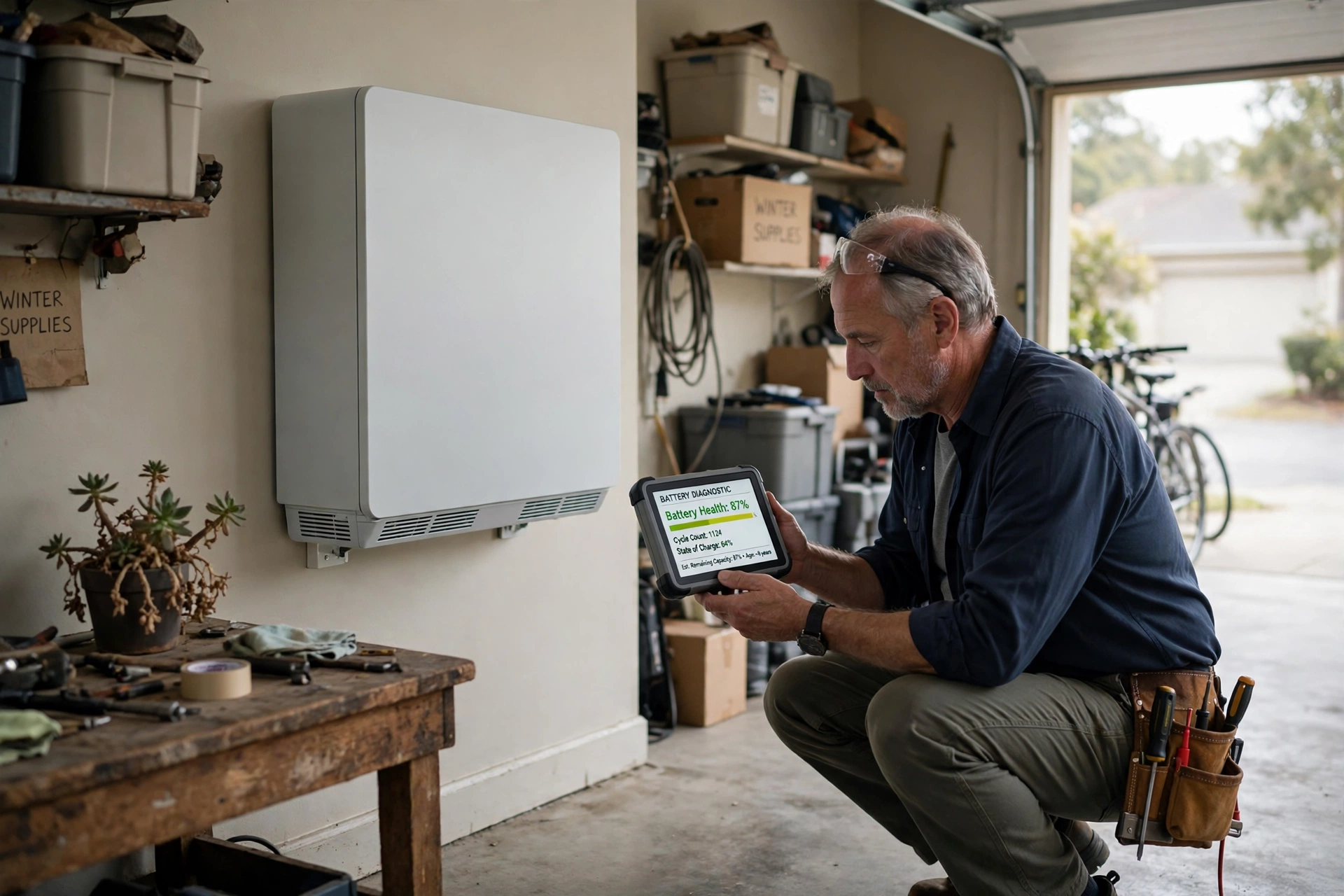
Capacity, Cycles, and Time
Home Battery Degradation: What to Expect Over 10 Years (2026)
Home battery degradation explained: how much capacity LFP and NMC batteries lose per year, what speeds it up, …
Interactive Tool
Home Battery Size Calculator: What Size Do You Need?
How many kWh of battery storage do you need? Our free home battery size calculator estimates your backup need,…
Interactive Tool
Power Outage Cost Calculator: What Blackouts Cost You
What do blackouts really cost you? Our power outage cost calculator totals food loss, hotels, lost work, and f…